New MARS Method Enables Durable Superhydrophobic Fabric Production
One-step fabrication technique improves water repellency and mechanical stability in textiles
A research team led by Prof. DONG Zhichao has developed a new fabrication method for producing superhydrophobic fabrics with improved durability. The findings were published in Nature Communications on March 20.
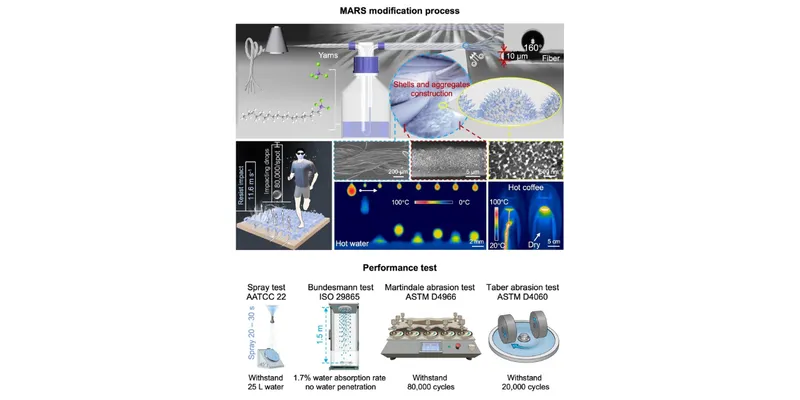
A research group from the Technical Institute of Physics and Chemistry of the Chinese Academy of Sciences has introduced a one-step fabrication strategy, termed MARS (Molecularly Assembled Robust Superhydrophobic Shell), for creating superhydrophobic fabrics with stable performance under mechanical stress.
Superhydrophobic textiles are widely used in outdoor, protective, and industrial applications, but maintaining long-term water repellency has remained a challenge. Conventional approaches often rely on costly nano-fillers and toxic chemicals, while commercially available waterproof fabrics depend on fluorochemicals, which are expected to face restrictions in multiple countries from 2026. In addition, the protective surface layer in such fabrics is prone to degradation due to friction, washing, and exposure to extreme environments.
The MARS approach enables the formation of a durable superhydrophobic shell directly on individual fibers. This treatment achieves water repellency at the single-fiber level and can be applied to both natural and synthetic materials. The performance is retained when the treated fibers are further processed into knitted or woven fabrics.
The researchers evaluated the durability of the treated fabrics under various conditions. The materials maintained superhydrophobic properties during prolonged raindrop exposure and high-speed droplet impact. In abrasion testing, including Martindale and Taber methods, the fabrics retained functionality after tens of thousands of cycles. Additional testing under simulated wear conditions—such as friction from backpack straps, repeated stretching, brushing, tape peeling, and physical activities like running and walking—confirmed consistent performance.
The fabrics also demonstrated stability across a wide temperature range. Superhydrophobic properties were maintained at high temperatures of 160 °C under steam and at low temperatures of -196 °C under liquid N2.
Tests further indicated that the treatment process does not affect key fabric characteristics, including breathability, moisture permeability, softness, and tensile strength. This allows the material to retain comfort while incorporating water-repellent functionality.
The study indicates that the MARS method can be applied in the development of waterproof textiles for outdoor, protective, medical, and industrial uses. The research was supported by the National Natural Science Foundation of China and the Young Elite Scientists Sponsorship Program of the China Association for Science and Technology.