New Issue Brief Highlights Rising Risks for Wood-Dependent Supply Chains
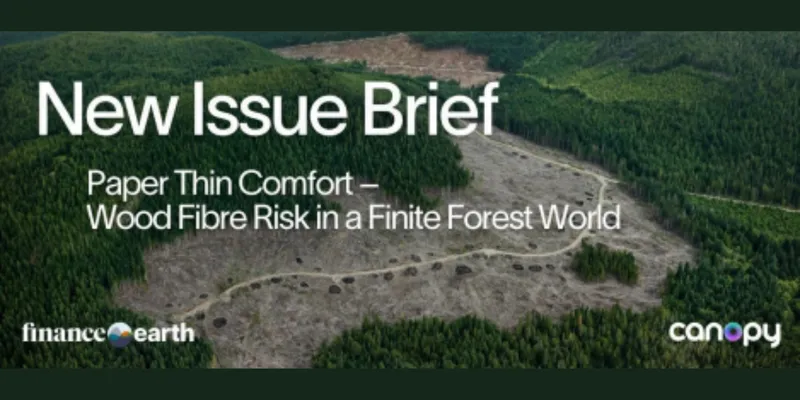
A new issue brief released on 15 January 2026 by environmental non-profit Canopy warns that global supply chains reliant on wood fibre—particularly in paper, packaging, and textiles—are facing increasing structural risks. Titled Paper Thin Comfort – Wood Fibre Risk in a Finite Forest World, the brief examines how tightening regulations, climate pressures, and rising cross-sector demand are reshaping access to wood resources and increasing exposure for businesses dependent on conventional inputs.
The issue brief, developed jointly by Canopy and Finance Earth, outlines near- and medium-term challenges linked to growing competition for a finite supply of wood fibre. According to the analysis, escalating demand, climate-related disruptions, and regulatory constraints are converging to create a more volatile operating environment for companies reliant on virgin wood in paper, packaging, and textile applications.
The report highlights that wood consumption is increasing across multiple sectors, including energy and construction, intensifying competition for limited forest resources. These pressures are compounded by new deforestation and due-diligence regulations, which are expected to drive sustained cost increases, supply instability, and higher compliance requirements for wood-dependent industries.
The brief also notes that supplies of credibly certified wood are already constrained and highly contested. As a result, existing volumes of certified material are unlikely to meet projected demand growth, limiting the availability of lower-risk sourcing options for companies pursuing sustainability commitments.
Commenting on the findings, Nicole Rycroft, Founder and Executive Director of Canopy, said:
“Forests are one of our greatest climate allies and central to meeting global climate and nature targets, yet current sourcing models and supply chains are pushing them to breaking point. This brief makes it clear: if companies and investors stay locked into business-as-usual wood sourcing, they are signing up for higher costs, greater supply vulnerability, and growing regulatory and reputational risk. This exposes businesses unnecessarily, given there is a clear exit ramp with Next Gen and alternative sources.”
The brief identifies three primary risk areas affecting wood fibre-dependent brands and investors: rising demand that exceeds sustainable forest supply; supply constraints driven by land competition, climate impacts, and ecosystem degradation; and increasing compliance costs linked to regulations such as the EU Deforestation Regulation (EUDR) and human-rights due-diligence requirements.
To address these risks, the report proposes a three-part strategic framework. Recommendations include reducing dependence on virgin wood by scaling circular and Next Gen alternatives made from agricultural residues, recycled textiles, and waste streams; strengthening due diligence and traceability for any remaining virgin wood use; and integrating wood-related risks into long-term scenario planning and investment decisions.
Elizabeth Beall, Managing Director at Finance Earth, added:
“The good news is that many corporates engaged in wood fibre sourcing are already starting to consider the financial implication of these risks to their bottom line. By quantifying the risks associated with business-as-usual wood fibre sourcing, businesses are able to see the clear rationale for investing in resilience and doubling down on sourcing of lower risk supply.”
Building on the brief’s findings, Canopy stated it will continue working with brands, investors, producers, and innovators to scale circular and Next Gen solutions and strengthen resilient sourcing models that reduce pressure on climate-critical forests.