New Global Report Maps Advanced Plastic Recycling Capacities
Europe Leads Global Expansion in Advanced Recycling Technologies
The nova-Institute’s latest report, Mapping of Global Advanced Plastic Recycling Capacities, offers an in-depth global overview of 390 active, planned, and operational recycling plants, spotlighting Europe’s leadership in advancing circular recycling technologies.
Advanced recycling technologies—both chemical and physical—are playing a vital role in keeping carbon within the production loop. The nova-Institute’s newly released report, “Mapping of Global Advanced Plastic Recycling Capacities,” presents the most extensive and up-to-date assessment of the global market. It maps 390 facilities worldwide—covering those planned, under construction, or already operational—and details their input and output capacities, technological processes, and regional distribution.
Advanced Recycling as a Complement to Mechanical Recycling
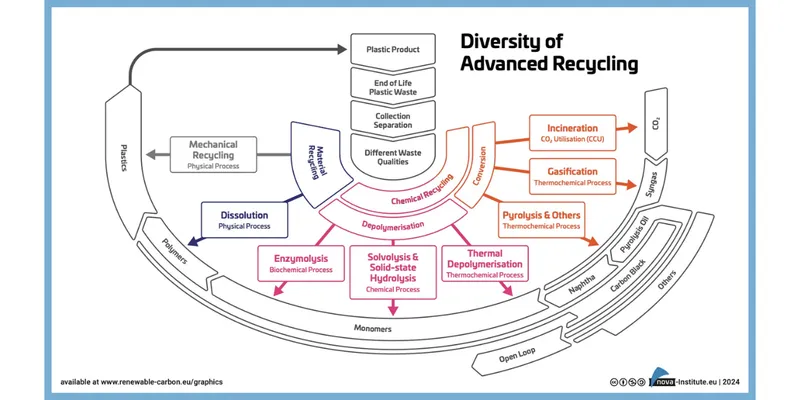
While mechanical recycling remains essential for processing certain plastic waste streams, it struggles with mixed or contaminated materials. Advanced recycling bridges this gap by deploying a variety of technologies such as dissolution, enzymolysis, solvolysis, pyrolysis, and gasification to convert diverse plastic wastes into high-value raw materials. These outputs include monomers, naphtha, secondary chemicals, and syngas, which can be reintroduced into the plastics manufacturing cycle, reinforcing circularity.
Europe: Driving Innovation and Capacity Growth
Europe currently leads the world in advanced recycling capacity, accounting for around 20% of global input and 26% of output in recycled polymers, monomers, naphtha, and specialty value chemicals (SVC). Countries such as Germany and the Netherlands are spearheading innovation, supported by a strong industrial base and firm policy commitment to circular economy goals.
According to the report, Europe’s capacity to produce polymers, monomers, and naphtha through chemical and physical recycling is projected to quadruple by 2031, while global capacity is expected to triple within the same timeframe.
Key Technologies and Industry Leaders
Within the EU27+3 region, more than 70 operating and upcoming facilities are identified, including major players such as LYB Solvent Recycling (Germany), Carbios (France), and Blue Alp (Belgium). Among all available technologies, pyrolysis and solvolysis currently dominate installed capacities. However, rapid advancements are also emerging in biochemical and physical recycling processes.
Policy Progress and Investment Landscape
Although the sector faces challenges due to slow regulatory developments and financing hurdles, the outlook remains promising. The European Commission’s ongoing updates to recycling directives and funding frameworks are expected to provide greater incentives for innovation and infrastructure investment. The report stresses that achieving a truly circular carbon economy in Europe will be impossible without large-scale deployment of advanced recycling technologies.
Comprehensive Data and Upcoming Presentation
The 35-page report features global and regional data on capacity, technology distribution maps, and a Sankey diagram detailing material flow across processes. It serves as a crucial resource for policy leaders, investors, and industry professionals steering the transition toward renewable carbon and a sustainable plastics economy.
The full findings will be unveiled at the Advanced Recycling Conference on 19–20 November 2025 in Cologne and online.
For further details: www.advanced-recycling.eu
Access the full report here: nova-Institute Publication