Nepal’s Inflation Eases to 3.4%, Forex Reserves Hit $17.6 B
Nepal’s economy displayed moderate stability in mid-April 2025, with key indicators reflecting easing inflation and strong foreign exchange reserves, though trade imbalances and weaker remittance inflows raised concerns.
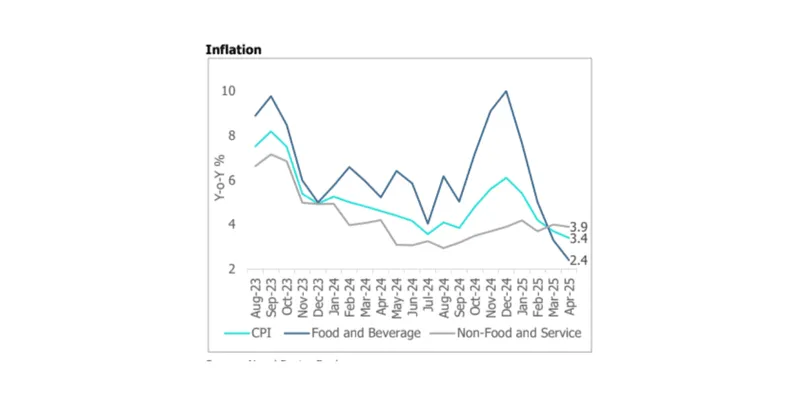
According to the latest economic update, year-on-year consumer price inflation dropped to 3.4% in April from 3.7% in March 2025. The decline was driven mainly by the Food & Beverages segment, which saw inflation fall to 2.4%, while the non-food and services category recorded a moderate price rise of 3.9%.
One of the most notable highlights was the surge in foreign exchange reserves, which rose to an all-time high of USD 17.6 billion. This provides import coverage for 14.2 months, offering a strong buffer for the country’s external stability. However, Nepal’s trade deficit widened significantly to ₹133.9 billion as imports surged by 19.6% (₹164 billion), while exports remained modest at ₹30 billion, down 3.1% month-on-month.
In contrast, remittance inflows, a critical source of foreign income, declined to ₹139.5 billion in April, compared to ₹151.2 billion in March. Despite the monthly dip, remittance flows over the fiscal year remained robust, helping support household consumption.
In the first nine months of FY2025, Nepal registered a current account surplus of ₹210.2 billion, up from ₹179.8 billion in the same period last year. Additionally, net capital transfers reached ₹7.7 billion, while foreign direct investment (FDI) amounted to ₹9 billion. The balance of payments (BoP) continued to show strength, although the surplus narrowed slightly to ₹346.2 billion.
Tourism, a vital sector for Nepal’s economy, showed mixed signals. While tourist arrivals in mid-April fell by 4.3% from March, year-on-year growth stood at 4.6%. Cumulatively, 920,000 tourists visited Nepal during the nine-month period of FY25, compared to 900,000 a year ago—reflecting a modest recovery in the sector.
Overall, Nepal’s macroeconomic environment appears relatively stable with solid forex buffers and a current account surplus. However, the trade imbalance and weakening monthly remittances will require policy attention moving forward.