NAPS GLOBAL INDIA LIMITED

- Introduction:
- Brief introduction of the company:
A business called NAPS Global India Limited started back in 2014. Based in Mumbai, it moves fabric between suppliers and makers without stepping into retail. Cotton weaves flow through its network just like synthetic ones do. This firm helps clothing producers stay stocked, operating quietly behind stitching machines across factories.
- Industry overview:
Right now, India's fabric sector ranks among the biggest globally. A big number is expected by 2030, around 350 billion dollars. Inside that space, NGIL works handling trade and delivery stuff. Pressure from shortages in synthetic fabrics. Instead of waiting, it steps into gaps where need outpaces what’s available.
- Purpose of the analysis:
Looking at how things stand after NGIL became a publicly traded firm, this review checks money matters, day-to-day performance, also where it sits among peers.
- Company Overview:
- Background and history:
One fresh start began when NAPS Trading Private Limited shifted gears. A new chapter opened after it changed names during 2024. This move came alongside a shift into a Public Limited structure. Big decisions shaped what came next. The rebrand was more than just words on paper.
- Business model:
A single office in Mumbai sets the base for NGIL, while storage runs out of Bhiwandi. Instead of owning factories, it leans on suppliers from China and Hong Kong for fabric bought in large amounts. These materials move straight into the hands of clothing makers across India. Operations stay lean by skipping heavy infrastructure.
- Key products/services:
- Most income comes from fabrics - cotton, velvet, stretchy knits, along with linen.
- Clothing brings in 18.77% of earnings - styles for men, others for women, a line made for children too.
- Market position:
Footprint growing across India, though rooted as a go-to source in Maharashtra. Known by the government for handling exports, it operates with quiet reach. Expansion happens piece by piece, not all at once. Regionally strong, yet moving beyond borders step by step.
- Promoter or Founder introduction:
- Name of promoter(s)/founder(s):
- Mr. Pankaj Jain (Chairman & MD)
- Mr. Ronak Mistry (Whole-Time Director & CFO).
- Professional background:
Promoters typically have backgrounds in commerce and industry-specific trading, with expertise in supply chain management and vendor relationships.
- Role in company growth and strategic decisions:
- Mr. Pankaj Jain runs both strategy and money matters at the firm - his touch shows in every move they make. Though quiet about it, his role shaped their growth path sharply.
- Business growth grabs Ronak Mistry’s attention, along with smoothing out daily operations. Shaping financial strategy falls into his hands, especially across China and Hong Kong.
- Financial Statement Analysis:
- Income Statement Analysis: (Figures in ₹ Crores)
Particulars | Mar-23 | Mar-24 | Mar-25 |
Sales + | 26 | 47 | 71 |
Expenses + | 25 | 46 | 69 |
Operating Profit | 0 | 1 | 2 |
Other Income + | 0 | 1 | 0 |
Profit before tax | 0 | 2 | 3 |
Tax % | 39% | 19% | 25% |
Net Profit + | 0 | 1 | 2 |
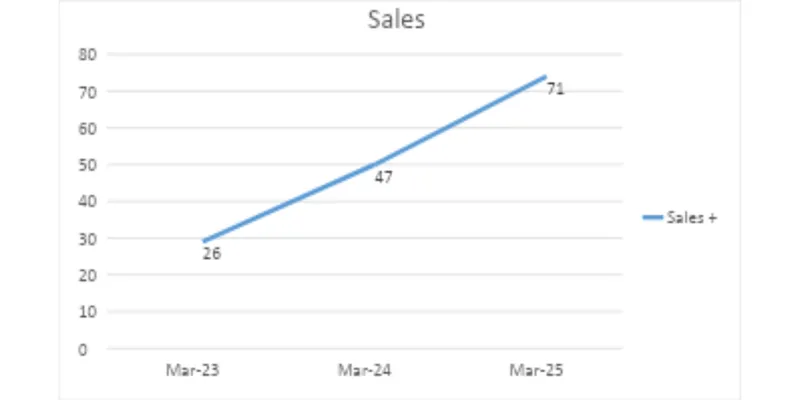
A sharp rise in activity marks NGIL’s path across recent financial cycles, yet slim returns persist because trading rarely yields heavy profit.
- Balance Sheet analysis:
Particulars | Mar-23 | Mar-24 | Mar-25 |
Equity Capital | 0.01 | 3 | 4 |
Reserves | 1 | 1 | 13 |
Borrowings + | 0 | 0 | 0 |
Other Liabilities + | 5 | 8 | 9 |
Total Liabilities | 7 | 12 | 26 |
Fixed Assets + | 0 | 0 | 0 |
Investments | 1 | 1 | 3 |
Other Assets + | 5 | 10 | 23 |
Total Assets | 7 | 12 | 26 |
Fueled by fresh funds from the public offering, total holdings climbed sharply and landed around ₹26 crore three years later.
- Cash Flow statement analysis:
NGIL struggled with cash flow in FY25. This happened because money got stuck in stock and unpaid customer bills. Fast-rising sales played a big role here. Instead of boosting liquidity, expansion soaked up available funds.
- Key Financial Ratios:
- Profitability Ratios- Net Profit Margin: 2%–4%
- Return on Equity (ROE): 8%–12%
- Liquidity Ratios- Current Ratio: 1.2-1.5 (adequate but not strong)
- Leverage Ratios- Debt-to-Equity Ratio: 0.5-1.0 (moderate leverage)
- Efficiency Ratios- Inventory Turnover: Moderate.
Sluggish turnover of receivables hints at lagging payments. Collections drag on longer than ideal. Cash waits too long to come in. Delays pile up behind invoices sent. Money moves late, stuck in pending loops.
- Key Insights and Interpretation:
- Strengths:
Light on assets means room to grow without dragging down profits. Built-up buying power comes from long-standing channels across China and Hong Kong. These links often mean lower costs when picking up goods.
- Weaknesses:
Tiny profits mean every expense shift hits hard. Small changes in spending ripple through quickly when earnings barely cover costs. Fast expansion means spending across daily work. Growth pulls hard on available funds, leaving less room to cover costs.
- Risk factors
Being heavily reliant on shipments from China leaves the business exposed when political strains rise, while shifts in exchange rates add further pressure. When borders tighten or trade rules shift, delays often follow. Stability fades if outside forces control key parts of your flow.
- Future outlook:
Growth now leans less on internal scaling, more on joining forces with others. These steps point to tighter clustering within the industry landscape. Instead of slow build up, the path forward favors bold integration.
- Conclusion:
- Final evaluation of financial health:
Right now, NGIL’s finances show rapid growth. Though earnings climb fast, steady cash flow remains shaky. Profit margins need tightening - without that, lasting success isn’t certain. A stronger financial base would help weather future bumps.
- Investment or performance perspective:
Looking at returns, shares have bounced around since going public - hovering close to ₹38 by early 2026. Keeping an eye on how smoothly new units blend in matters just as much as watching whether cash flow operations tighten up over time.
- REFERENCES:
- Company’s Website: https://napsglobalindia.com/
- Annual reports of the last 3 years.