Nanosatellite and Microsatellite Market Projected to Reach USD 30.55 Billion by 2034
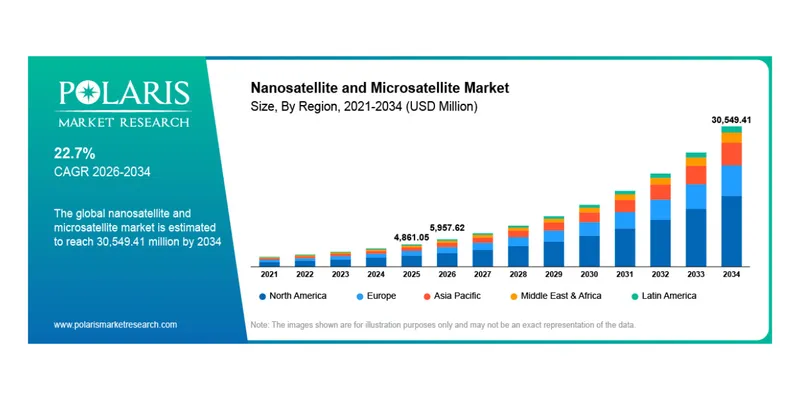
Rising demand for Earth observation, satellite constellations, and AI-enabled space systems drives growth in the small satellite industry
The global nanosatellite and microsatellite market is projected to expand significantly over the next decade, supported by increasing demand for Earth observation services, advances in satellite miniaturization, and growing investment in the NewSpace economy.
According to findings published by Polaris Market Research, the market was valued at USD 4,861.05 million in 2025 and is expected to reach USD 30,549.41 million by 2034, registering a compound annual growth rate (CAGR) of 22.7% during the forecast period from 2026 to 2034.
Nanosatellites, typically weighing between 1 kg and 10 kg, and microsatellites, ranging from 10 kg to 100 kg, are increasingly being adopted for missions including Earth observation, broadband connectivity, IoT data relay, maritime surveillance, environmental monitoring, and military reconnaissance. The lower production and launch costs associated with these platforms have accelerated their adoption across commercial, academic, and defense applications.
The report highlights semiconductor and electronics technologies as key enablers of small satellite development. Miniaturized processors, MEMS sensors, compact power systems, and onboard AI chips are contributing to improved satellite capabilities while reducing overall system size and operational costs.
Demand for Earth observation services continues to increase across sectors such as agriculture, forestry, disaster response, infrastructure monitoring, and defense. In July 2025, National Aeronautics and Space Administration and Indian Space Research Organisation launched the NISAR mission, which uses dual-frequency radar technology to deliver global monitoring imagery every 12 days.
The report also identifies satellite constellations as a major industry trend. SpaceX’s Starlink network surpassed 10,000 operational satellites in low Earth orbit (LEO) as of March 2026, reflecting the growing deployment of constellation-based communication and observation systems.
Private sector investment continues to expand within the small satellite industry. In February 2026, Rocket Lab USA signed a multi-launch agreement with BlackSky Technology for small-satellite deployment missions.
By segment, nanosatellites accounted for a 76.41% revenue share in 2025, supported by their lower cost and use in remote sensing, academic research, and technology demonstration missions. The commercial end-use segment held the largest share at 47.1%, driven by demand for geospatial analytics, supply chain monitoring, and asset tracking services.
Low Earth Orbit represented 78% of total market revenue in 2025, reflecting demand for low-latency communication and Earth observation applications. The scientific research and academic training application segment is projected to grow at a CAGR of 20.4% through 2034 as universities and research institutions expand their use of small satellites for space research programs.
Regionally, North America accounted for a 42.4% revenue share in 2025, supported by government defense spending, venture capital investment, and the presence of aerospace companies including Lockheed Martin Corporation, The Boeing Company, Planet Labs Inc., and Raytheon Company. Europe is expected to register a CAGR of 24%, supported by European Space Agency-backed missions and academic partnerships focused on environmental monitoring and Earth observation.
Artificial intelligence integration is also expanding across the small satellite value chain. AI technologies are being used for onboard data processing, imaging analysis, satellite autonomy, and reducing reliance on continuous ground-station monitoring.
Other companies profiled in the report include Surrey Satellite Technology Limited, GomSpace Group AB, Thales Group, Clyde Space Inc., and Sierra Nevada Corporation.