NAMIBIA
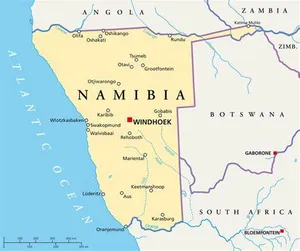
Namibia, officially the Republic of Namibia, is a country in Southern Africa. Its western border is the Atlantic Ocean, it shares land borders with Zambia and Angola to the north, Botswana to the east and South Africa to the south and east. Namibia gained independence from South Africa on 21 March 1990, following the Namibian War of Independence. Its capital and largest city is Windhoek. Namibia is a member state of the United Nations, the Southern African Development Community, the African Union and the Commonwealth of Nations. The Himba are indigenous peoples with an estimated population of about 50,000 people living in northern Namibia, in the Kunene Region and on the other side of the Kunene River in southern Angola. There are also a few groups left of the OvaTwa, who are also OvaHimba, but are hunter-gatherers. HIMBA PEOPLE SOCIAL ORGANISATION AND RELIGIOUS BELIEFS The Himba live in Northern Namibia, they refuse modern progress and Western culture and still live according to ancient traditions. The villages have a circular shape and are generally enclosed by a fencing made up of mopane branches, for protection against any type of danger and to delimit the village borders. The huts are circular in shape, too, and are built using mud, excrements and mopane branches. Access is via a small opening on one side and the interior is plain. Huts are arranged around the central fencing, called kraal, where the cattle is kept. A sacred fire, the okuruwo, is lit at the centre of the village, close to the headman’s hut. The Himba society is matriarchal. Women play a fundamental role in the Himba society and do most of the duties, such as the collection of water, the construction of homesteads and the care of the children. It is up to the eldest woman of the village to tender the sacred fire. The fire must be kept lit at all time to protect the inhabitants from demons. This sacred fire is considered the spirit protecting the good. Men mainly look after the cattle and take it on long transhumance, in search for better pastures. Anthropologists, who have studied the Himba social structure, have stated that they are characterized by a double, or bilateral, lineage, that can be found in other ethnic groups who live in extreme environments. Double lineage means that each Himba belongs to two clans at the same time, the matriarchal and the patriarchal, this enables them to rely on two family groups when in need. The patriarchal clan, oruzo, passes the residence down to new generations, the matriarchal one, eanda, which is much more important, hands down the property of land and cattle. The importance of being able to count on an extended family is confirmed by a tribal teaching that says: “Do not built your village starting with cattle, start with people”. Polygamy is permitted in the Himba society, each man can marry more than one woman, the first marriage is usually arranged by the village elders whereas the following ones are free, the only thing required is the consent of all the spouses. The different clans living in a village are led by a headman who establishes rules and prohibitions, such as the ban for menstruated women to eat the meat of a certain animal or to milk cows. The Himba are animists, their religious beliefs revolve around the god Mukuru and the cult of ancestors. Each family must keep the ancestral fire lit to communicate with Mukuru through the intercession of the ancestors. The Himba also believe in witchcraft, omiti, and “black magic”, and think that those who practice omiti can even cause illness or death. Another belief is related to the so-called fairy circles, the Himba believe they are the prints left by gods when they go to certain spots to pray, when a Himba gets sick, he or she is brought to the centre of the circle of fairies for healing. HIMBA CLOTHING AND ACCESSORIES What makes the Himba people unique and immediately recognisable is their appearance and especially the result of a paste that women rub on their bodies and make them look like terracotta statues. This red paste, thanks to which the Himba are known as “the Red People of Namibia”, is called otjize and it is usually smeared on the body, hair and even on clothes and jewellery. The otjize is a mixture of butterfat, ochre pigment and scented resins extracted from the Commophora wildii, the Himba women use it to protect themselves from the extremely hot and dry climate of the Kaokoland and sunrays; it is also a good repellent against insect bites. It is considered an aesthetic beauty cosmetic. It gives the skin and hair a terracotta-like reddish colour. For the Himba, red is rich in symbolism, it represents the earth’s rich red colour and blood, i.e. the essence of life, these people live on the land farming and livestock. For the Himba women, skincare is a rather laborious task, they can’t use water to wash themselves or cool off, the only thing they can use is the Otjize and they apply it 2 or 3 times a day. In such a dry area, the water is considered sacred by the Himba tribe and only married men are allowed to use it for washing, but only for special religious ceremonies. Apart from covering their bodies with the cream obtained by mixing butterfat and ochre pigment, the Himba women perfume themselves by taking real baths of scented smoke. Inside the huts they light a small fire on which they burn aromatic herbs and the resin obtained from the Commiphora multijuga tree. Smoke is used to purify their bodies and clothes and also for its anti-bacterial effect. The traditional clothing for the Himba women is decidedly skimpy, they just wear a simple skirt of ombuku goat hide, leaving their breasts exposed and wearing leather sandals. Also the men wear a skirt, though the goat hide is often replaced by more modern textiles and it is matched with non-traditional clothing, such as shirts or jackets, that somewhat clash with the surrounding environment. The Himba women love wearing big adornments, mainly made of leather, iron or copper, and embellished with bone fragments, the most important and precious jewelley is given as a gift to the mother following the birth of her first child. It is a necklace called ohumba, consisting of a white large shell, the symbol of fertility, the shell comes from Angola and is hung between her breasts. Hair and hairdressing play a significant role among the Himba as they indicate the social status of each individual within the community, young girls use to dress their hair with two braided hair plait extending forwards, whereas after the puberty, hair are worn down and numerous rasta braids are made and covered with the same butter and ochre paste used for the body. The hairstyles of the Himba women are true masterpieces, when a woman is married she wears a sort of diadem made from antelope hide, called omarember or erembe; widows wear this singular hat in reverse. Young boys shave their hair on both sides of the skull, except for a tuft of hair left on top, with a braided hair plait extended to the rear of the head, while married men wear a cap that is only removed when they go to sleep or in mourning. Due to the lack of water in the area where they live, the Himba use wood ash and aromatic herbs for hair cleansing, while men cover their body in ash mixed with butter, this cream, unlike the one used by women, does not turn red but it moisturizes the skin while maintaining a natural colour. Dreadlocks from the Himba tribe of Northwestern Namibia For the Himba tribe, hair indicates one’s age, life stage, and marital status. The tribe lives in the northwestern region of Namibia. Tribe members use a mixture of ground ochre, goat hair, and butter to create their dreadlocks. They also include hair extensions when weaving their dreadlocks. Teenage girls wear braid strands or dreadlocked hair that hangs over their faces. Doing this symbolizes that they’ve entered into puberty. Married women and new mothers wear Erembe headdresses made from animal skin. Young women who are ready for marriage tie their dreadlocks to reveal their faces. Unmarried men wear a single braid to show their status. Once they get married, they cover their heads never to unveil them in public again. They remove their head covering at funerals only.
{"source_sid":"00D9FE1D-2570-4CFA-A0FC-C94C534DFD0D_1593381537374","subsource":"done_button","uid":"00D9FE1D-2570-4CFA-A0FC-C94C534DFD0D_1593380976961","source":"share_action_sheet","origin":"unknown"}
article by Harshika Sapra biblogaphy https://www.exploring-africa.com https://thereadersbureau.com https://en.wikipedia.org https://www.britannica.com