Monforts ATC Helps Textile Manufacturers Move New Finishing Processes Towards Production
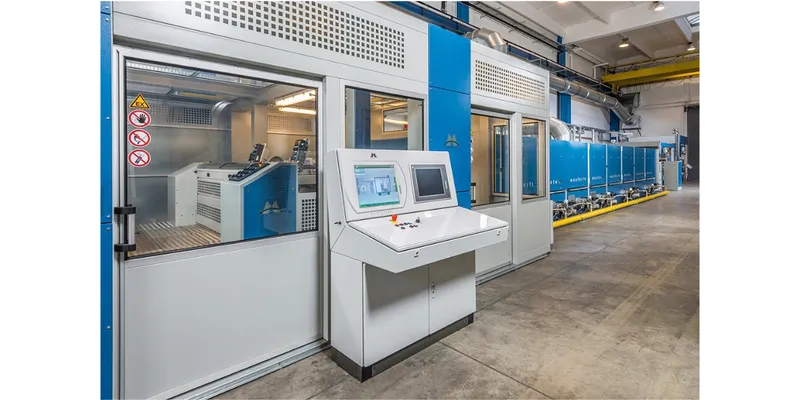
Mönchengladbach technology centre provides full-scale equipment for trials across technical textiles, knitwear, denim and woven fabrics
The Monforts Advanced Technology Centre (ATC) at the company’s headquarters in Mönchengladbach provides textile manufacturers with access to full-scale dyeing and finishing equipment for testing new materials, processes and finishing technologies. Covering 1,200 square metres, the centre enables customers to conduct confidential trials under real production conditions before transferring processes to their own mills.
Originally opened in 2013 and subsequently expanded, the ATC houses two full MONTEX finishing lines, a THERMEX range for continuous dyeing of denim and other woven fabrics, a full colour kitchen and several laboratory-scale systems for smaller batch trials.
Full-Scale Trials Under Production Conditions
“The ATC allows our customers to test their own textiles and technical fabrics on Monforts dyeing and finishing machines under fully confidential, real production conditions,” says the company’s Marketing Manager Nicole Croonenbroek. “Using the results from these trials, we are also able to make recommendations for improving many fabric finishes.”
The centre allows manufacturers to evaluate machine settings, temperatures, dwell times and application parameters while also assessing the effects of new processes on energy, water and chemical consumption.
Technical Textile Processing
A controlled environment was a key consideration in the development of the dedicated MONTEX technical textiles line at the ATC.
“Technical textiles are extremely diverse in their end-use applications and manufacturers can be called upon to quickly produce a succession of materials with widely differing properties and performance applications – often within a single shift,” explains Monforts Textile Technologist Saskia Bollhöfer. “These range from substrates for digitally-printed soft signage to carbon fabrics for today’s high-performance composites, and from filter media which must perform in extreme temperatures to flame retardant barrier fabrics. These very different materials all require expert coating and finishing for maximum efficiency and the technology to allow for ultimate flexibility and the ability to switch quickly from one fabric formula to the next, without compromising on the economical use of energy or raw materials.”
The line incorporates a Montex four-chamber, horizontal chain stenter and an explosion-proof coating application chamber for treatments involving organic solvents and other volatile materials.
It can process materials at temperatures of up to 320°C and can treat the top and bottom faces of certain materials at different temperatures during a single machine pass. Such separate temperature treatments can be used for applications including floorcoverings, where the textile face and rubber backing require different temperatures, as well as PVC flooring with chemical foams and blackout roller blinds with heavy backings.
The equipment also supports applications in the pharmaceutical sector involving organic solvents, including anti-septic treatments that require controlled application and specific temperatures.
Digital Spray Technology Added
The technical textiles line has recently been equipped with a Baldwin TexCoat™ G4 digital spray unit, which is available for full customer trials, including applications using sustainable finishing chemistries supplied by Archroma.
BW Converting’s Baldwin TexCoat G4 is designed to precisely apply water-based chemicals such as softeners, antimicrobials, durable water repellents and flame retardants to textile surfaces. In combination with MONTEX stenters, the system can reduce water, chemistry and energy consumption by up to 50% compared with traditional pad application processes, according to the company.
“The new TexCoat installation is making an important contribution to what we can achieve and we are excited to be working together with Archroma and BW Converting to bring further transformative change to the dyeing and finishing space,” says Saskia Bollhöfer.
Equipment for Knitwear Processing
The second production line at the ATC is designed for conventional knitwear production and is based around a MONTEX stenter with vertical chain return.
“Knitted fabrics need delicate handling as they often have a higher degree of elasticity compared to more rigid woven materials,” says Nicole Croonenbroek. “Our MONTEX stenters provide smooth treatment at very low and precisely controlled tension during all stages of knitted fabric handling, as well as very gentle and even thermal treatment. The MONTEX is extremely flexible in terms of the different fabric qualities it can accommodate and also provides significant benefits in terms of energy consumption.”
The line features the company’s Eco Applicator system, which replaces a conventional wet-on-wet padder with trough and roller techniques to apply the required quantity of liquid or coating.
With a conventional padder, the fabric entering the stenter has an initial moisture content of around 60%. The Eco Applicator reduces this to 40% and provides a short fabric path between the coating unit and the stenter.
The system can apply finishes to one or both sides of a fabric, separate finishes to each side, or finishes to specific areas. Its applications include woven fabrics, denim and delicate knitted materials.
THERMEX and Energy Recovery
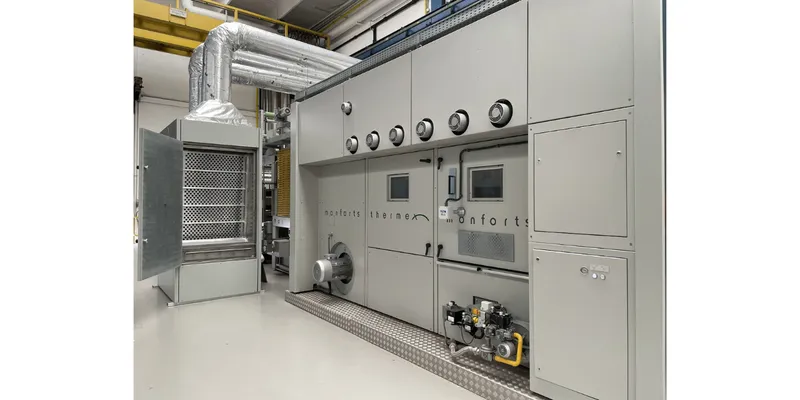
Almost 1,000 Monforts THERMEX hotflue dyeing systems are currently operational in key manufacturing countries, with more than 150 using the Econtrol® process.
With Econtrol®, reactive dyestuffs are fixed in the fabric through a one-step dyeing and drying process using a controlled combination of steam and air. The complete pad-dry process takes approximately two to three minutes at temperatures of 120–130°C and relative humidity of 25–30%.
The THERMEX line at the ATC has also been equipped with the Monforts Universal Energy Tower, a standalone module that recovers heat from the exhaust air flow of thermal processes. The system can deliver energy savings of up to 25%, depending on exhaust air volume and operating temperature.
“The current focus of the industry is very much on cleaner processes in order to meet the commitments on sustainability made by the major fashion brands and with further regulations already in the pipeline,” says Nicole Croonenbroek. “This is calling for new investments that enable a significant reduction in resource consumption to be achieved, but that are easy to integrate into existing production systems. THERMEX lines running Econtrol fit the bill perfectly.”
From Laboratory Trials to Industrial Production
The ATC combines Monforts’ process expertise with full-scale production equipment, allowing manufacturers to assess new fabrics, finishes and processes under industrial conditions rather than relying solely on laboratory testing.
Trials can help establish optimum machine settings, temperatures, dwell times and application parameters, while providing production data on resource consumption. Manufacturers can use these results when introducing processes at their own facilities or evaluating further investment.
The centre is also being used as textile manufacturers explore lower resource consumption, new finishing chemistries and specialised fabric performance. Customers can work with Monforts technologists across conventional apparel fabrics, technical textiles, coating and dyeing, and thermal finishing.
“The ATC draws on all of the know-how of our company in respect of fabric processing,” concludes Saskia Bollhöfer. “It gives customers the opportunity to work with our specialists and our latest technologies to establish solutions that are not only technically achievable, but practical and economically viable in production.
“Whether the objective is to improve an existing process, develop an entirely new product or evaluate the potential of a new technology, we can work with customers from the initial trials through to the optimum production parameters. This is what makes the ATC such an important resource for turning new ideas into industrial reality.”