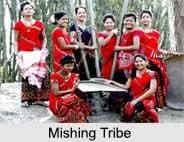
Mishing Tribe of Aasam

Weaving Culture of Mishing Tribe of Assam Dr. Anshu Sharma Head and Associate Professor Department of Textile Science and Apparel Design SNDT Women’s University, Mumbai Introduction Assam is a land of various tribes and communities located over the entire span of the state. These tribes bear huge cultural and linguistic differences and at the same time similarities too. One of the prominent tribes in the upper Assam is the Mising tribe. Mising (or formerly Miris) tribe comprises of ethnic people inhabiting mainly the Dhemaji, North Lakhimpur, Tinsukhia, Dibrugarh, Sibsagar, Jorhat and Golaghat districts of Assam. Also many of the tribe are settled in various districts of Arunachal Pradesh. One of the biggest river islands in the world 'Majuli' is mainly inhabited by the Mishing people.


Mishing tribe of Assam The Mishings is one of the major sections of the plain tribes of Assam. Originally the Mishings were hill tribe like Akkas, Daphalus, Abors. The ‘Mishing’ officially recorded as ‘Miri’ was given to them evidently by the plain people. The mishing, extract form and pronunciation have different meaning and the former is the right applicable word to the community. Mishing itself explain Mi = Yasvng or Mi + Ansvng = Misvng. Mi represents human being. Yasvng represent good, white and Ansvng represent good, calm and peace loving. Therefore, peace loving people on the other hand the ‘Miri’ which is an Assamese word signifying a ‘go between’ from circumstances. The colourful ethnic group is now plain tribe of Assam. Handloom and Weaving culture Weaving is the exclusive preserve of the Mising women who start their training in this craft before they reach their teens. They also have a good knowledge of natural dyes. They weave cotton jackets, towels, endi (shawls), thick loincloths and sometimes shirts for their men folk. They also weave ege (skirt-like garments), ri:bi(rectangular cloth with narrow stripes wrapped over the lower garment from bodice to knees), seleng gasor (fabric occasionally worn instead of a ri:bi), riya (a long scarf) and níseg (a cloth tied over the shoulder for carrying babies). They also weave the gamocha, the traditional cotton scarf and Assamese cultural symbol that are bestowed on honoured guests visiting the village. Cotton thread was readily available the Mising used to grow their own cotton and spun the yarn themselves. They also use some silk yarns, but sparingly. They used to use endi yarn obtained from silk worms fed on the leaves of castor-oil plants however they later learned the use of the golden muga (silk obtained from worms fed on the som tree) and the white paat (from worms fed on mulberry leaves) from neighbouring communities.
The Mising women of Majuli are specifically renowned for their exquisite handlooms, especially their mirizen shawls and blankets, and they reinvent their traditional diamond pattern in countless weaves using their favourite colours orange, yellow, green, black and red. The Mishing also make a very special textile called gadu, a blanket that is fluffy on one side and woven on a traditional loin loom. It is extremely intricate and time-consuming work. The warp is cotton spun into thick and strong yarn and the weft is spun into soft yarn, cut and inserted piece by piece to form the fluff. Sadly this particular form of weaving is fast disappearing due to the ready availability of inexpensive blankets in the market. Handloom is the most popular traditional industry of Mishing tribe. Handloom, an ancient art is a constant source of mental peace, equilibrium and revelation to both one who perceives it. The handlooms in our country were in a manner reverenced as an important part of our rich cultural heritage. In India almost all handloom have a history which relates them to certain religious rituals and social customs, making them an inherent part of its culture. There are clear indications of cultural awareness about handloom products. The North East of India is like a Variegated patch work quilt. A multiplicity of tribes and tribal groups each with its own distinct culture in habitat this region. Every tribe has three or more distinctive clothes of its own. An important aspect of the weaving is that the designers are a result of a process of evolution. They are not just something created individualistically by the weavers but have a cultural significance. Textile weaving seems to have played a pivotal role in social and economic life of the Indian people through out the age. The art of weaving made the village society a self contained one, which is characteristic of Assam society too. The social functioning of Mishing is based on the code of personnel relation and duties handed down from generation to generation. The people of this land do not take execution of this craft as a compulsion but a sacred duty. The Mishing loves weaving of textiles appears as a replica of the cosmic process. The art of weaving has much more developed in Assam as compared to other parts of India. In Assam weaving is a entirely the work of women. Weaving is a part of their domestic duties. In fact it is one of the primary of qualification of a Mishing woman. The handloom weaving is practically monopolized by women not from the idea of economic necessity but also from the sense of social customs. Weaving is an indispensable part of Mishing women. Most of the Mishing of the rural area are expert in spinning and weaving is practiced by both unmarried and married women. Costumes whatever might be its origin serve as a symbol of role and status of the individuals in society and it obtain for the wearer a reward of recognition and identification. Costumes obvious to any interest in humanity are a marked characteristic of any culture. Culture is an important adjunct of ones personality. Costumes of a community or a nation are inherent aspect of its cultural heritage, a mirror of the time and the people of that community. The tribal costumes bring up a picture of life of the community. The Mishing tribe of Assam plains has a very colourful textile tradition. The textiles are produced mainly to meet the requirement of the household. The mishing girls produced almost all the clothes required by them after marriage before they get married and continue to do so. Traditional Costumes The Mishing costumes are very beautiful and embellished with intricate motifs and designs as well as very colourful too. The dress of the Mishing can be divided into two distinct types: (i) general dress and (ii) special dress for festivals and ceremonial functions. The costumes used by Mishing for daily use are simple. The dresses of the men are similar to non tribal Assamese. A simple white dhoti (ugon) or sometimes a long colored dumer (towel) and a shirt (galuk) are the costumes of the men for daily use. The costumes of the women are also simple but divided into two pieces of garment. They generally wear a skirt (mesanam age) covering the part from waist to the knee. The upper piece (gasong or gero) fastened above the breast falling along with the skirt. Occasionally, a blouse is seen to cover the upper part of the body.


Traditional Mishing costumes


Front view of Mibu Galuk Back view of Mibu Galuk The costumes for particular occasion are the special product of their loom. In this dresses, they are the mixture of various colours, e.g. Red, black, green, yellow are common. On the special occasion, a man wear a shirt (Mibu galuk) over his usual dress and a dumer (towel) is a must along with a turban (paguri). The dresses on special occasion are used in such a way, so that, it looks like a Gam or leader. The dress of women is same as they used daily but the dresses for festival and function are more coloured and decorated. The plain dress without colour and decoration are generally not used in festivals and rituals. Women are fond of various types of ornaments. Ear and neck ornaments (kentumaduli), chains (tadok), different type of bracelets (konge), golpata (necklace), onsalmora (necklace ), kardoni (bangles ), sondrong (locket ), lv:tog (necklace ) turiang (ear ring) etc. Fibres and yarns used The fibre and yarn which is traditionally used by Mishing tribes of Assam are cotton and silk. Cotton is also grown in rural areas of Mishing’s villages. However, the amount of cotton production is not sufficient for producing large amount of fabrics. Therefore they used to purchase cotton yarns from markets. The silk produced in Assam, generally Muga silk (Antheracea assama ww), mulberry (Bombyx linnacus) and eri (Philosamia recini B) are commonly produced. Sericulture has been practiced for a long time. Assam enjoys the world monopoly over production of muga silk and eri silk. The eri culture is mostly practiced among Mishing tribe of Assam. Silk weaving is a special feature of Assam. It plays an important part in the socio-economic life of the people in specialized weaver’s villages of Assam. Processing of fibres and yarns The Mishing women mostly used natural fibres viz. cotton and silk. To ptoduced good quality yarns for weaving they follow the following processes.
- Cotton
To produced cotton yarn from cotton pods, they first do—
- Ginning- it is the process of removing the seeds from cotton pods. This is carried out by using a craft which is made up of wood.
- Carding – The carding means cleaning of cotton by flicking method where a bow is used which is made up of bamboo tied with a strong rope.
- Spinning- Spinning means giving twist to the yarn by using a spinning craft which is also made up of wood and bamboo.
- Silk
To produced silk yarn the following process are involved –
- Cooking: - It is process of removing sericin from eri cocoon by boiling in water along with alkali for a period of 5- 10 minutes.
- Spinning- Spinning means giving twist to the yarns by using primitive spinning craft. Spinning and weaving are also undertaken by the rearers generally for their own use. Spinning of eri is done in spindles-Whorl (letai), which is made up of wooden or bamboo stick below which a circular disc is inserted by making a hole in middle of the wooden circular disc. Spinning is only done by women folk, including young girls, even while they are in walk around and signifies their interest for weaving is marked as an interesting and unique feature in Assam. Eri silk is used mainly to weave shawls, used in winter. It is also used to weave a few other items for day to day dressing.
Dyeing The use of wealth of colours in handloom products is a unique feature of the textile tradition of Assam. The dyeing is mostly done with indigenous dye stuffs, mostly from barks, leaves, roots etc. The common types of natural mordants like common salt, silica (Terminalina citrine) were used The natural dyes like Lac (Cocus lacca), Achugach (Morinda augustifolia), Halodhi (Cucurma longa), tepor (Garcinia Xanthocymus) etc are also used. But now, the Mishing women also use vat or synthetic dyes for dyeing. Prior to dyeing, first they desized the yarns and remove excess dyes by boiling them in water or by immersing them in for water whole night and then dry sunlight. The dyed yarns then undergoes for the other process like winding and bobbining i.e, preparation for warping in loom. This is done with the help of a winding machine called Cheriki and ugha by using jotor (Charkha). Types of Loom used The Mishing community uses two types of looms. The Loin loom and Throw shuttle loom. Now they use Fly Shuttle loom, Jaccquard loom, Dobby loom and in some industries among Mishing community the power loom is also found to be in used. Gadoos a type of blanket are woven in loin loom. Loin loom is also mused to weave bags pillow covers etc. This looms is very simple, portable and convenient to erect and dismantle. The compact texture of the cloth woven and its intricate design are the most important factors for which the loin loom has still not lost its popularity. It is a part and parcel of the tribal textile tradition. The loom has no frame or upper structure, but it consists of two vertical bamboo poles kept horizontally. A few pieces of stout bamboo and wooden rods of varying thickness with a wooden beating sword is used as accessories of the loom. The throw shuttle loom is the most common and traditional loom used by all communities in Assam. A crude type throw shuttle loom has been found among Mishing tribe, four wooden posts required for the loom are fixed firmly on the ground. The beam and wrap are set to the frame just above the ground level. The weaver sits on the bench attached towards the wrap-beam to operate the treadles, but no weaving belt is used as in case of loin loom. This loom is found comfortable compared to contemporary loin loom. However, being a traditional loom, it is highly valued by the Mishing’s and they still use it. Deep cultural significance is attached to this loom and its inheritance passes to her daughter. The accessories required for the existing throw shuttle loom are very simple and can easily be made out of indigenous materials, mostly bamboo and wood. As such, it is easily accessible to the rural folk of Assam. The other parts of the loom are the wrap and cloth beams, reed, treadles, temple, shuttle, etc. Adoption of new technology and use of improved looms in household weaving is still rare in Assam especially among Mishing tribe. The archaic type of loom cannot be the basis for commercial production. Motifs and designs Nature played a vital role in inspiring the folk and tribal artisans to reproduce its many beauties in their crafts. The handloom fabrics of Assam are noted for their various indigenous artistic designs. The ornamentation is done on the loom itself. The designs are brought out by means of employing an additional layer of dyed yarns based on the ground materials. These extra yarns for design normally float over the main interlocking of warp and weft. This traditional technique is called the extra weft technique. Not only the motifs and designs, colours too play a vital role in the textile tradition of Mishing tribe of Assam. The indigenous design of the Mishings is called Ghai- yamik designs. These depict the excellent capability of Mishing weavers to arrange different geometric forms in a rich borders design. The Tapum Ege (Eri Shawl) and Pe-Charpi-pekok are good example of traditional items which is very intricate designs are used. These are highly cherished item in the respective tribal communities. Ege is another costume worn by women to cover the lower part of the body from waist to the ankle. The most common colour used is black. On the black base ornamentation are done yellow, red, and white. The traditional designs is named as Ghai yamik small buties named punjer symbolizing star, deer, horse butterfly etc. are arranged in geometrical order above the main border design. This depicts the excellent capability of Mishings weavers to arrange different geometric forms in a rich border design.


Mishing Ege and Gasor Ege Gasor with ghai yamik design Yapapacha traditional motif designed on a particular costume known as Ribi Gacheng. It is an indispensable part of unmarried girl. It is always woven out of cotton yarns and designed with stripes of red, black, and white. The stripes are widely distributed though out the body at regular interval. A cross border design with zig-zag lines and diamond is woven in the pallau and is spread all over of the cloth.


Gasor of Mishing tribe Ribi Gacheng Another important costume of Mishings is ‘gero’, which is used ony by married women only. Based on design used it is named as kem- nam gero or ki- nam gero. It is woven in white with bold design of about 40 to 50 cm width is red, black and redin centre of the cloth. Another gero named Charuchamang gero is also a continuing example of traditional textile of Mishing. It is woven specially to carry baby, tied at back by women while working or traveling.


kem- nam gero Charuchamang gero These gero were woven with care and kept ready by a girl before her marriage. But this rich and traditional textile item is being gradually getting replaced by plain cloths. The plain version is called nichek. Another highly priced textile items woven out of eri silk is Tapum gachor ( eri shawl), used in winter. The border of the shawl is design with the motifs like flowers, diamond, ridges of hills and lines are woven in side borders and cross borders in brown and maroon colours in the shawl. The designs used are worked by weavers from the old scraps of designs or from a separate design catalogue. In olden days designs were worked on banana leaves. Since banana leaf is not durable the design was subsequently worked on the thick sheath of areca plam tree. The designs are woven on a warp of coarse yarn with fine bamboo sticks or thatching grass as the pick of the designs.


Geometrical design Floral motif arranged on geometrical order


Butterfly designs Ghai- yamik designs


Combination of floral and lines Lines are designed with for creating designs different colour combination


Geometrical design used Geometrical design used only in Shawl only in Gero Changes in the motifs and designs from traditional geometric to recently adopted innovative and vivid patterns is noted in some cases since the innovative category of motifs does not contain symbolic meaning as in the case with traditional motifs, the motifs combination also become non symbolic in nature. It is of interest to note that, among the study communities only the Mishing have retained the traditional motifs and designs. A harmonious blending of traditional designs and colours are still being maintained and used in the different Mishing textiles items. While other have by and large switch over to the contemporary designs of more vivid and symbolic nature, the Mishing have been more conservative and they still use their traditional geometric designs having symbolic meaning. With the influence of modern society the various items have been prepared or made by using different traditional and contemporary textile items which include the Mekhela-chaddar, shirt, wrapper, shawl, sari, pillow cover, napkin, table cloth, salwar-kameez, jacket ,rug, bed cover, drapery materials etc. The instinct in human being since earliest time is to study his surroundings and as such has consciously and unconsciously absorbed a great deal in the process. These have created many original ideas and satisfied his inner yearning to express it in visual form. A gradual disappearance of handloom weaving as a household craft has been marked in recent years. But the craft of weaving in Assam still continues, albeit with the changes incorporated in it, as a living craft and as an integral part of tribal and non tribal cultures. Moreover, it provides an important prop to the rural economy. The practice of producing one’s future post marital requirements in cloths is still in existence as an element of Mishing culture. This helped keeping textile tradition alive. The growing cultural awareness about culture specific indigenous textile items plays an important role for symbolic elements in the projection of respective cultural identities. Use of certain textile item called Ribi Gacheng as ceremonial flag for projecting ethnics- cultural identity is noteworthy. Thus the handloom textiles have played an important role in the upliftment of socio-economic scenario of rural Assam in great extent.