Ministry of Textiles Holds Second TEXPORT Programme in Noida to Strengthen Apparel Export Readiness
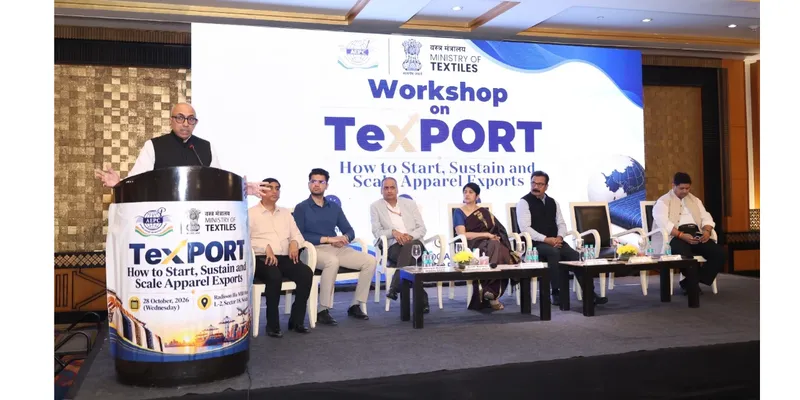
The AEPC-led initiative under the National Export Continuity Programme focuses on exporter training, market access, compliance and strengthening India's textile and apparel export ecosystem.
The Ministry of Textiles, Government of India, organised the second TEXPORT capacity-building programme in Noida on 28 October 2026 through the Apparel Export Promotion Council (AEPC). Titled “TEXPORT: How to Start, Sustain and Scale Apparel Exports,” the programme aims to strengthen export preparedness among established, new and potential exporters through targeted training and industry engagement.
TEXPORT Programme Expands Across Textile and Apparel Clusters
The Noida programme is the second in a series of training and capacity-building initiatives being conducted under the Ministry’s National Export Continuity Programme. The first programme was organised in Surat, Gujarat, in collaboration with MATEXIL.
The Ministry is planning further programmes across key textile and apparel clusters in India. These initiatives are intended to address location-specific and exporter-specific challenges while strengthening the country's overall export ecosystem.
The Noida programme was chaired by Ms. Alaknanda Dayal, IAS, Joint Secretary, Ministry of Textiles. Other attendees included Mr. A. Bipin Menon, ITS, Trade Adviser, Ministry of Textiles; Mr. Mithileshwar Thakur, Secretary General, AEPC; Shri Sheshmani Panday, IAS, Government of Uttar Pradesh; Mr. Amit Kumar, ITS, Director (Trade); and Mr. Hemant Kumar, Deputy DGFT.
Representatives from the apparel industry, Sardar Vallabhbhai Patel institutions in Coimbatore, the National Institute of Fashion Technology (NIFT), and other participating organisations also attended the programme.
Focus on India's US$100 Billion Textile and Apparel Export Vision
Addressing the programme, Ms. Alaknanda Dayal highlighted the Ministry’s efforts to expand India's textile and apparel exports and strengthen exporter capabilities. She outlined the vision of increasing India's textile and apparel exports to US$100 billion by 2030.
She explained that TEXPORT is designed as a nationwide capacity-building initiative for established exporters, new entrants and potential exporters.
Highlighting Noida’s potential as a Champion District for apparel exports, she emphasised the need to identify local opportunities and exporter-specific challenges. She also stressed the importance of targeted training, export-readiness support and institutional handholding.
Following the first programme in Surat, the Noida initiative reflects the Ministry’s broader efforts to improve export preparedness across major textile and apparel centres in the country.
Technical Sessions on Export Potential and Global Competitiveness
Mr. A. Bipin Menon, ITS, Trade Adviser, Ministry of Textiles, delivered a technical presentation on India's textile and apparel export potential and opportunities to strengthen the sector's global competitiveness.
The presentation covered the role of Free Trade Agreements (FTAs) in improving market access and competitiveness. It also addressed country-product strategies, market intelligence, compliance, export promotion and effective engagement with international buyers.
The programme began with a welcome address by Mr. Mithileshwar Thakur, Secretary General, AEPC. He highlighted the need to broaden India's export base, noting that nearly 88% of the country's exports originate from just 100 districts.
He emphasised inclusive export growth and outlined the strategy of developing 100 Champion Districts as global export hubs and 100 Aspirational Districts as self-reliant manufacturing centres.
Mr. Thakur also highlighted opportunities emerging from India's expanding network of FTAs, including new-generation agreements covering digital trade, e-commerce, investment and sustainability.
Dedicated Sessions Address Exporter-Specific Challenges
A key feature of the programme was three dedicated interactive sessions for regular exporters, irregular exporters, and new or potential exporters.
Through technical discussions and diagnostic questionnaires, the sessions sought to identify business-specific challenges and capacity-building requirements in several areas:
- Export procedures and regulatory compliance
- Finance and logistics
- Product development
- Buyer connectivity
- International market access
A dedicated question-and-answer session also gave participants the opportunity to raise export-related issues, seek clarifications and interact with officials and experts.
Building Export Capabilities Across India
The TEXPORT initiative under the National Export Continuity Programme aims to establish a structured platform for exporter capacity building and handholding across the country.
Through a series of training programmes in key textile and apparel centres, the Ministry of Textiles intends to broaden India's exporter base, strengthen local manufacturing clusters and improve export preparedness.
The initiative also seeks to help more enterprises enter international markets, sustain their export operations and expand their global presence, contributing to India's ambition of becoming a leading global textile and apparel sourcing destination.