MILK FIBER
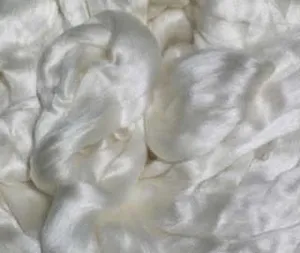
Introduction Milk Fiber was firstly introduced in 1930 in Italy & America to compete the wool. It is new generation of innovative Fiber & a kind of synthetic Fiber made of milk casein Fiber through bio-engineering method with biological health which has passed international ecological certification of oeko-tex standard 100. There are also some different brands for the same fiber manufactured from milk casein known as Aralac, Lanatil and Merinova. Milk Yarn Cyarn milk protein fiber dewaters and skims milk, and manufactures the protein spinning fluid suitable for wet spinning process by means of new bio-engineering technique, and new high-grade textile fiber is made by combining them. Cyarn milk protein fiber is healthy for skin, comfortable, with bright colors due to good dyeability, etc. The milk protein fiber can be spun purely or spun with cashmere, silk, spun silk, cotton, wool, ramie and other fibers to weave fabrics with the features of milk protein fiber. It can also be used to create top-grade underwear, shirts, T shirts, loungewear, etc. to satisfy people's pursuit of comfortable, healthy, superior and fashionable garments. Characteristics of Milk Fiber:
- In milk fiber, the natural protein humectant factor is present, which makes the skin delicate and smooth...
- It absorbs moisture very well as it is hygroscopic in nature.
- It is antibacterial and antifungal as amino acids present in the fibre.
- It is glossy and luxurious in appearance, feel and comfort ability, just like silk..
- It is very easy to dye and can be dyed under normal temperature.
- It can be blended well with other different fibers ,such as tencel, cotton ,bamboo, modal fiber.
Advantage
- Today's Milk Fiber is environmentally friendly, high strength & much more superior as compare to man-made fibers. Some of the benefits of having Milk Fiber are as given below:
- As it is having continues graft polymerization technique hence it is totally eco-friendly in nature.
- It can be considered as "Green Product" as no formaldehyde is present in the product.
- Milk fiber is made from milk casein instead of fresh milk. We may use acid, reactive or cationic dyes for this kind of specialty fiber.
- Ph of milk fiber is 6.8 which are same as that of human skin. Hence the products made up from them are more compatible to human skin.
- Milk Fiber contains seventeen amino acids & natural anti-bacterial rate is above eighty percent. Hence milk fiber has sanitarian function.
- It is a new synthetic Fiber having milk protein as main material based on high technical process. Milk Fiber has the advantages natural Fiber combined with synthetic Fiber.
- These are more comfortable, excellent water transportation & air permeability
Application Because of the healthy & bacteriostatic nature of milk Fiber, it is being considered as a perfect material for manufacturing of underwear. As discussed above, milk casein proteins are considered as a main ingredient of milk protein Fiber, which can lubricate the skin. The milk protein contains the natural humectant factor which can help to maintain the skin moisture, to reduce the wrinkles & to smoothen the skin - which may help to realize the people of taking milk bath. The major usages of milk Fiber are as given below:
- T-Shirts
- Underwear
- Sportswear
- Ladies outerwear
- Sweaters
Production Process of Milk Fiber: Milk protein fiber production line application processing system cannot do without the cooperation of the link. Shanghai is home on R & D Technology Co., Ltd. milk silk protein fibers, also engaged in spinning, dyeing and finishing of technical research, raw material quality, technology is complete, customers can better support the promotion of milk fiber. Milk protein fiber can be used, in theory, cationic dyes, direct dyes, acid dyes, reactive dyes, neutral dyes, generally more than the actual cationic dye and reactive dye used is suitable for pure milk protein fiber and its products, such as staple fiber, yarn line, knitted fabrics, woven fabrics and garments. Period in order to milk protein fiber textiles as an example of pure cationic dyes and reactive dyes on the usage described as follows. After Treatment of Milk Fiber:
- Cationic dyes and finishing the first treatment process, due to temperature and moisture absorption of the products are strong, so do not need special treatment.
- With 60 ?water, liquid running back 10s, and then the second can of cold wash. In the special white process, the use of prescription and bleaching conditions were as follows:
- 5% sodium hydrosulfite (95 ?with warm water even after accession); 5% of the standard soap powder (use warm water even after the accession), not alkaline , does not contain brighteners; bath ratio 1:20 ~ 30; temperature of 95 ~ 98 ? time is about 15s ~ 30s, but also according to liquor ratio, equipment and raw materials of different thickness to adjust.
- Note that, if so special white, raw materials without cooling; If the training is finished, then white, must be 2% to 3% of the HAC, 60 ?water running 5s ~ 10s, cold washed twice, and then softening. Prescription and use of the whitening process conditions:
- 6% cationic brighteners (Dilute with warm water even after accession); 3% HAC (Dilute with warm water even after accession); temperature of 95 ~ 98 ? time of 15s ~ 20s ; bath ratio 1:25 ~ 30.
- In the dyeing process, the basic cationic dye with the general approach, but not 1227, and NaAc.
- To liquor ratio 1:25 to 30, for example, dyeing conditions to control the following table. Cleaning, light to be 1 or 2 times the cold wash, cold wash in the dark to be 1 or 2 times and then wash with hot water, 70 ?10s, and finally cold wash 1 or 2 times. In the post-treatment processes, the use of softener 5% to 8%; temperature 45 ~ 50? Time of 20s or so; bath ratio 1:20 ~ 25.
- According to different requirements of customers can choose different softeners, such as the fabric soft, smooth, elastic anti-wrinkle, anti-contamination, etc. when requested, by the production units to decide.
- In the dehydration process, in order to reduce the discount video, dehydration, slower, time is shorter, usually 1 minute each time, while patients have to row together, try not to let cloth folded.
- In the drying process, the use of the cage drying temperature of 80 ? 5 ? time is 20s ~ 30s, speed too quickly, after drying grounds lit 12 to 24 hours after the stereotypes. Using rotary drying temperature of 90 ? 5 ? fast speed, the disadvantage is the easy bit like a very light, must be strictly controlled temperature.
- In the setting process, the general shape of water rolling open sites, the effect is better than the cylindrical shape. Process parameters are 150 ? 5% overfeed of 10%, the line speed 15m / s, the pressure head of about 4kg.
- Reactive dyeing of basic aspects of pre-treatment with the former, but if the dye houses using recycled water, pH value may be unstable or reactive groups dealing with different materials, can be the first treatment bath by adding 1% of the HAC, it will give the pH value of the cloth evenly from the inside out, but also conducive to color dyes.
Proven, low temperature dyeing cotton used reactive dyes more suitable, light-colored soda instead of baking soda can be used as dyeing auxiliaries, the amount can be as long as required to achieve the color, the dark can be used for dyeing auxiliary sodium sulfate and soda ash , the amount of cotton fiber dyed with similar. Following are the varieties available in the market. Staple fiber/tops Milk fiber has passed oeko-tex standard 100 green certifications for the international ecological textiles. The milk fiber contains eighteen amino-acids, which is beneficial to human’s health and has the functions of nourishing and taking care of skin. The wet spinning technology, a unique spinning solvent is used, micro-zinc ions are embedded in the fiber, after drying and after treatment, zinc oxide is produced, and therefore it is bacteriostatic and durable. Casein fiber is produced almost entirely as staple, tow or top. The blending of milk fiber: When blended with other fibers casein added a soft draping quality and resiliency to fabrics. The fiber was blended with wool for creating felt and with spun rayon, wool, mohair and cotton for attractive woven and knitted fabrics in a variety of weaves, textures, and prints. The popular blends were wool- 94% and casein fiber -6%., viscose-50% and casein fiber- 50%. Casein/cotton blends are popular for hosiery and carpets. A small amount of fiber is used for 100% casein goods, but most casein fiber is blended with wool, cotton, rayon, nylon and other staple fibers. Blends containing casein may be spun on all the usual systems.
- Cotton system – viscose/casein blends.
- Woolen system – Casein/ wool or viscose blends.
- Worsted system – Casein /wool or viscose blends.
- Flax system – Casein/viscose blends
Chemical processing of Milk Protein Fiber (Casein): Milk protein fiber has different physical and chemical construction from natural protein fiber, care is taken in the following steps;
- Desizing- Enzyme products may be used, preferably at pH 4.0 to 6.0. If water-soluble sizes have been used, sizing is not necessary.
- Scouring- Synthetic detergents should be used, preferably under acid conditions, e.g. pH 6.0.
- Bleaching- Casein fiber is generally white, and bleaching is not usually necessary. If required, it should be carried out under weak conditions, e.g. pH 4.0-6.0 as Casein fibers retain maximum strength and minimum swelling under these conditions. Hypochlorite bleaches should not be used. Bleaching may be carried out with Hydrogen Peroxide – 2 GPL at a pH of 8.0 using Sodium Pyrophosphate. It must be followed by careful washing and acidification with acetic acid. Normal optical bleaching agents may be applied.
- Dyeing- Casein absorbs moisture readily and does not have a highly orientated structure. Dyes can penetrate into the fiber without difficulty. Casein can be dyed with dyestuffs used for wool. Acid, Basic, Direct and Disperse dyes are used where good washing –fastness is noted as a prime essential. Metal complex dyes give high wash fastness. PH of the dye liquor should be between pH 4 & 6. Dyeing is usually carried out at 90-95 deg c.
- Printing- Fabrics containing casein may be printed by block, screen, & roller. Acid, basic, direct, chrome, mordant, azoic, vat or pigment dyes may be used.
- Crease –resist finishes may be applied to blends containing casein fiber, using temperatures not higher than 160 deg c. for approximately 2.5 mins.
Uses of Milk Protein fiber: One of the earliest uses for casein fiber was in the making of feeling for hats. Casein/wool blends are used for knitted berets. Casein/cotton or nylon blended fabrics are used for interlock outerwear, T-shirts, cardigans, jumpers etc. Casein blended with wool, cotton, viscose, nylon is used in Raschel cloths, coatings, and blanket fabrics. Blends of casein and wool are made into pressed felts for use as floor coverings and used in conventional and tufted carpets. Pile carpets are made using casein -50% and wool or viscose -50%. Summary:
- Light, soft, comfortable, colorful and Elegant Colorful -Keeping tender hand-touch and right color after several washings Easy Care-Being resistant to fungus, good moisture absorption & conduction, insects and aging.
- It can be considered as "Green Product" as no formaldehyde is present in the product.
- Milk fiber contains as many as 18 amino acids, and has a pH of 6.8, which is the same as the pH of human skin.
- Some claim that the “natural protein humectant factor” of casein is preserved in milk fiber fabric, and so wearing it is actually good for the health of skin
- . It is known to be comfortable and anti-bacterial; it is moisture-absorbent, permeable, and heat-resistant. It feels lightweight and silky and is biodegradable
Article curated by - Bhavika Gulrajani. Image Courtesy-Google