Mid India Industries Limited

1. Executive Introduction & Industrial Context
For the astute student of corporate strategy, Mid India Industries Limited (MIIL) presents a compelling case study in distressed asset management and radical operational pivoting. Analyzing MIIL during the 2024-25 fiscal year requires a lens that transcends basic bookkeeping; one must evaluate the strategic maneuvers of a legacy manufacturing firm attempting to maintain its listing and viability through a lean, asset-light model. This report serves as a rigorous review of MIIL’s survival tactics in an era where agility is the only antidote to accumulated insolvency.
The industrial backdrop for the fiscal year was characterized by a widening delta between global stagnation and Indian domestic dynamism. While the global economy faced a modest growth projection of 3.3% amid ongoing inflationary pressures, the Indian economy stood out as a sign of resilience, with GDP growth projected at 7.0%.
MIIL’s management has positioned the firm to attempt to capture this domestic "demographic dividend," shifting its focus away from capital-intensive manufacturing toward the trading of heavy plant machinery and high-growth real estate development.
The objective of this analysis is to scrutinize MIIL’s transition from its historical manufacturing roots to its current architecture as a trading and real estate entity. This transition is not merely a change in sector but a fundamental reimagining of the corporate identity, moving from a production-centric model to one of opportunistic asset monetization.
2. Corporate Profile and Business Architecture
A deep dive into MIIL’s financial ledger is meaningless without first understanding its "Corporate DNA." Established in 1991, the company’s recent history is defined by a necessary retreat from manufacturing. The current business architecture is bifurcated into a "Trading Division," specializing in heavy plant machinery and spare parts, and a burgeoning Real Estate vector focused on affordable housing.
Strategic synthesis of the Board’s Report reveals that this pivot is a multi-year "liquidation-to-reinvestment" strategy. The catalyst for this shift was the disposal of old plant and machinery, approved during the 32nd Annual General Meeting. By divesting legacy industrial assets, the company has attempted to transition into the affordable housing segment, aligning with the Pradhan Mantri Awas Yojana (PMAY) and RERA frameworks to leverage its existing land bank into margin-accretive products.
This architectural shift has converted MIIL into a lean entity, relying on a skeletal staff to manage significant land assets and machinery trading, a strategy overseen by a seasoned leadership team.
3. Leadership and Governance: Promoter & Founder Profile
In small-cap entities burdened by historical losses, the role of Key Managerial Personnel (KMP) shifts from growth facilitation to "turnaround navigation." The leadership must maintain statutory compliance while executing a "shell-to-substance" recovery.
The current strategic direction is spearheaded by:
- Mr. Sanjay Singh: Chairman and Managing Director, providing the executive continuity required for long-term stabilization.
- Mr. Bhawani Shankar Soni: Whole Time Director. With 45 years of experience in Factory Management, Legal, and Administration, Mr. Soni’s expertise is critical in managing the complex regulatory and legal requirements of the company’s land bank.
A pivotal governance event this year was the BSE-sanctioned reclassification of promoters (including Mr. Nirmal Kumar Agrawal and family) to the "Public" category in June 2025.
However, a careful and objective analysis highlights two clear governance and compliance concerns:
- Listing Compliance: Only 41.35% of the non-promoter shareholding is held in dematerialized form, which falls below the SEBI-mandated requirement of 50%.
- Reporting Delays: The company recorded a 9-day delay in filing the reclassification intimation with the BSE, indicating that its administrative capacity may still be under strain.
While leadership provides the vision, the blueprints for MIIL’s survival are etched into its financial statements.
4. Comprehensive Financial Statement Analysis (2024-2025)
Evaluating MIIL’s year-over-year (YoY) performance presents a picture of a company that remains financially distressed, yet is beginning to show limited signs of stabilization at the margins.
Income Statement Synthesis
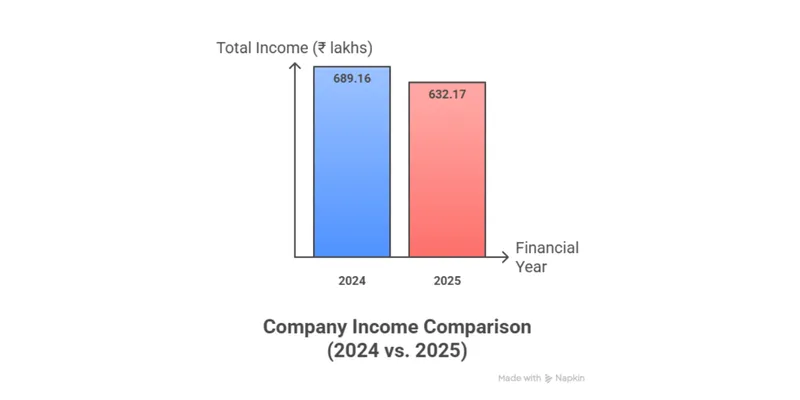
Metric | FY 2024-25 (INR in Lakhs) | FY 2023-24 (INR in Lakhs) |
Total Income | 632.17 | 689.16 |
Total Expenditure | 644.78 | 713.85 |
Net Loss | 11.79 | 42.44 |
Balance Sheet & Cash Flow Highlights
The asset base of the company is minimal, with Property, Plant, and Equipment (PPE) valued at only INR 32.79 Lakhs (approximately 3.28 Million). The most critical financial concern is the company’s Negative Net Worth. The "Other Equity" section of the balance sheet stands at a staggering negative INR 2,080.25 Lakhs, a figure that completely eclipses the Equity Share Capital of INR 1,630 Lakhs. This accumulated loss remains the primary hurdle to solvency.
Key Financial Ratios (2024-2025)
Ratio | Value | Interpretation |
Inventory Turnover | 59.79 | A 361% variance from the prior year; management cites significantly increased inventory levels, which may signal slow-moving machinery stock. |
Current Ratio | 0.21 | A decline from 0.42, signaling an acute liquidity crunch driven by a significant decrease in trade receivables (collections). |
Operating Profit Margin | 0.42% | Improved from 0.20%, a direct result of the 3-employee lean-management model. |
The numbers confirm that while operational efficiency (OPM) has improved through radical downsizing, the company faces a persistent liquidity crisis and a massive equity deficit.
5. Strategic Insights and Future:
To move beyond static data, we must apply a strategic critique to MIIL’s "active" state.
Strengths and Weaknesses:
- Strengths: MIIL has achieved a notable reduction in net losses through a hyper-lean structure. By operating with only three permanent employees, the company has optimized overhead to a level that allows for marginal OPM improvement despite declining revenues.
- Weaknesses:
The company is facing a clear liquidity crunch. A Current Ratio of 0.21 is critically low, and the relatively high inventory levels compared to turnover indicate that a portion of the stock in the trading division may be slow-moving or “dead” inventory.
Risk:
The trading business continues to operate in a highly competitive environment. At the same time, the sharp decline in trade receivables points to potential difficulties in collecting payments from customers, placing additional pressure on the working capital cycle. Moreover, the company’s shift toward real estate brings long gestation periods and regulatory complexities, which could prove challenging to manage with such a limited workforce.
Future Outlook: The company’s survival depends on the successful monetization of its existing land bank. Management’s optimism regarding the "Trading & Real Estate Division" is centered on India’s urbanization trends. However, this is essentially a "shell entity" strategy—leveraging legacy physical assets to fund a transition into more liquid markets.
6. Conclusion and Student’s Perspective
From a Senior MBA perspective, Mid India Industries Limited is a firm that is distressed but stabilizing. The 2024-25 fiscal year demonstrates that management has effectively "stopped the bleeding," as evidenced by the 72% reduction in net loss.
However, from an investment standpoint, MIIL remains a high-risk entity. The negative net worth of over INR 20.8 Crore is a systemic barrier to growth. The company is currently operating as a shell for its legacy land assets; its future viability depends entirely on whether it can convert these land holdings into cash fast enough to resolve its liquidity crunch and dematerialize its shares to meet BSE/SEBI compliance. For now, MIIL is a study in extreme lean management and the difficult realities of corporate reincarnation.
Data Source & Methodology
- Source: Data compiled exclusively from the 34th Integrated Annual Report of Mid India Industries Limited (FY 2024-25).
- Methodology: All figures, including the corrected PPE valuation of INR 32.79 Lakhs and the "Other Equity" deficit of INR 2,080.25 Lakhs, are derived directly from the statutory financial statements and notes. No external data or speculative figures have been used. Final figures were converted from thousands (as presented in the source) to Lakhs/Millions for analytical consistency.
- Source for logo: Company website https://www.midindiaindustries.com/