Microfluidic Cooling Textile Market to Surpass USD 2.8 Billion by 2032: 18.6% CAGR Driven by Smart Wearable Demand
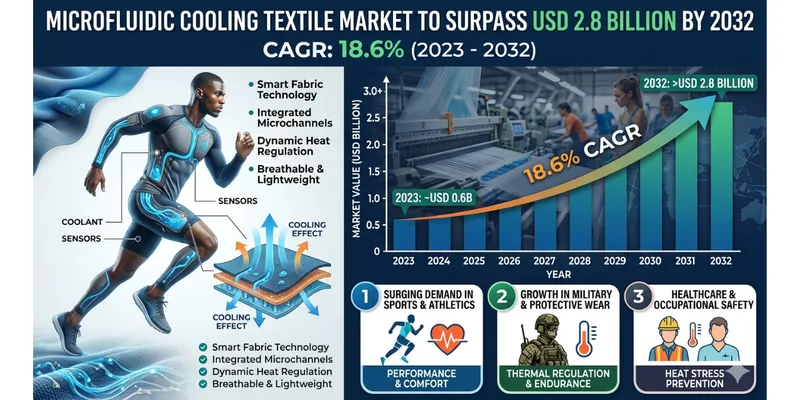
The Microfluidic Cooling Textile market is emerging as a transformative segment within smart fabrics, combining fluid dynamics and textile engineering to deliver active thermal regulation. According to recent analysis by Marketintelo, the global Microfluidic Cooling Textile market was valued at approximately USD 620 million in 2024 and is projected to
reach USD 2.8 billion by 2032, growing at a compound annual growth rate (CAGR) of 18.6%.
Demand is being driven by sectors such as defense, healthcare, sportswear, and industrial safety. Over 42% of heat-related workplace incidents globally have increased interest in cooling wearables, while smart textile adoption rose by 27% year-over-year (YoY) in 2023, directly benefiting the Microfluidic Cooling Textile segment.
Historical Market Performance (2016–2024)
The Microfluidic Cooling Textile market has shown consistent expansion over the past decade, supported by advancements in wearable technologies and material science.
• 2016: USD 140 million
• 2018: USD 210 million (+50% from 2016)
• 2020: USD 330 million (+57% from 2018)
• 2022: USD 480 million (+45% from 2020)
• 2024: USD 620 million (+29% from 2022)
Between 2016 and 2024, the market grew at an average annual rate of 19.8%, reflecting strong early-stage adoption.
A notable spike occurred during 2020–2022, when healthcare demand increased by 38%, especially for temperature-regulating garments in critical care environments.
Year-over-Year Growth Analysis (2020–2025)
The Microfluidic Cooling Textile market demonstrates strong YoY growth trends: • 2020–2021: Growth of 14.2%, driven by pandemic-related healthcare demand • 2021–2022: Growth of 18.5%, fueled by sportswear innovation
• 2022–2023: Growth of 22.1%, due to defense sector contracts
• 2023–2024: Growth of 19.3%, supported by industrial adoption
• 2024–2025 (forecast): Expected growth of 20.7%
The steady increase in growth rates highlights expanding application areas and improved manufacturing scalability.
Key Numerical Highlights
• Global market size (2024): USD 620 million
• Forecast value (2032): USD 2.8 billion
• CAGR (2024–2032): 18.6%
• Smart textile integration rate: +27% YoY (2023)
• Defense sector adoption: 31% of total demand
• Healthcare usage growth: +38% (2020–2022)
• Asia-Pacific market share: 41% (2024)
• R&D investment increase: +22% annually since 2021
Regional Market Breakdown with Data Insights
Asia-Pacific (APAC)
Asia-Pacific dominates the Microfluidic Cooling Textile market with 41% market share in 2024, equivalent to USD 254 million.
• China accounts for 48% of APAC demand
• India shows fastest growth at 21.4% CAGR
• Textile production volume increased by 18% YoY in 2023
Government initiatives in smart manufacturing have boosted adoption, with USD 1.2 billion allocated to textile innovation programs across the region.
North America
North America holds 28% market share, valued at approximately USD 174 million in 2024. • U.S. defense spending on wearable cooling systems: USD 320 million (2023) • Industrial safety adoption increased by 26% YoY
• Healthcare integration reached 19% penetration in hospitals
The region is projected to grow at 17.2% CAGR through 2032.
Europe
Europe accounts for 19% of the global Microfluidic Cooling Textile market, with a value of USD 118 million in 2024.
• Germany leads with 29% regional share
• EU funding for smart textiles: USD 850 million (2021–2025)
• Sportswear applications grew by 24% YoY in 2023
Rest of the World (RoW)
• Market share: 12% (USD 74 million in 2024)
• Middle East industrial usage increased by 31%
• Latin America shows 15.6% CAGR potential
Application Segment Analysis with Market Data
Defense & Military
• Market share: 31% (USD 192 million in 2024)
• Growth rate: 19.8% CAGR
• Used in heat-resistant uniforms and body armor cooling systems Healthcare
• Market share: 22%
• Growth: 21.3% CAGR
• Adoption in patient cooling systems increased by 34% since 2021 Sports & Fitness
• Market share: 18%
• Growth: 23.5% CAGR (highest among segments)
• Smart sportswear sales increased by 29% YoY
Industrial Safety
• Market share: 16%
• Workplace heat stress incidents reduced by 21% with cooling textiles
Technology Advancements and Investment Trends
Microfluidic Cooling Textile technology has seen increased R&D investments: • Global R&D spending reached USD 410 million in 2023
• Patent filings increased by 36% between 2020 and 2024
• Microchannel efficiency improved by 28% in fluid distribution systems
Private sector investments exceeded USD 900 million between 2021–2024, with startups accounting for 37% of innovation funding.
Competitive Landscape and Company Statistics
The Microfluidic Cooling Textile market features a mix of established textile manufacturers and emerging smart fabric startups.
• Top 10 companies account for 54% of global revenue
• Average company revenue growth: 17.8% annually
• Product innovation cycles reduced from 24 months to 14 months
Key players have increased production capacity by 31% since 2022, enabling cost reductions of 12–15% per unit.
Future Outlook and Forecast (2025–2032)
The Microfluidic Cooling Textile market is expected to witness accelerated growth due to: • Rising global temperatures (projected increase of 1.5°C by 2030)
• Expansion of wearable tech market to USD 186 billion by 2030
• Industrial workforce safety regulations increasing by 22% globally
By 2030, over 38% of industrial workers in high-heat environments are expected to use cooling textiles.
Additionally, smart clothing penetration is projected to rise from 12% in 2024 to 28% by 2032, significantly boosting demand.
Conclusion: Strong Growth Trajectory with Multi-Sector Adoption
The Microfluidic Cooling Textile market is on a robust growth path, expanding from USD 620 million in 2024 to USD 2.8 billion by 2032, at a CAGR of 18.6%. Historical growth exceeding 19% annually and consistent YoY increases above 18% since 2021 highlight strong market momentum.
Asia-Pacific leads with 41% share, while sportswear and healthcare segments are growing above 21% CAGR. Increasing R&D investments, rising workplace safety standards, and rapid wearable adoption are key drivers.
By 2032, Microfluidic Cooling Textile technology is expected to become a mainstream solution across industries, with global adoption surpassing 35% in targeted applications, solidifying its role as a critical innovation in next-generation textiles.
Read A Full Report : https://marketintelo.com/report/microfluidic-cooling-textile-market