Microfiber Pollution and the Laundering Problem: Why India’s Textile Industry Needs to Pay Attention Now
-1-300x365.webp?2026-04-28T06:25:26.511Z)
Rohini Swamy
Innovation & R&D Operations Lead,
Livinguard Technologies AG
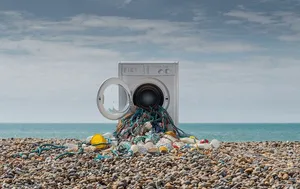
Microfiber pollution is rapidly emerging as one of the most significant — yet largely invisible — environmental challenges facing the global textile industry. Each time a synthetic or blended garment is washed, thousands of microscopic fibres are released into wastewater systems. Due to their small size, many of these fibres bypass filtration processes and ultimately enter rivers, oceans, and even the food chain.
While the issue has gained traction in Europe — where research, regulatory scrutiny, and early policy discussions are already underway — its relevance for India is arguably even greater. As one of the world’s largest producers of textiles and garments, and with a fast-growing domestic consumption base, India sits at the centre of this challenge.
Understanding the Science of Microfiber Shedding
Microfiber shedding occurs primarily during laundering, driven by mechanical stress, water flow, and chemical interactions. However, not all textiles shed equally. The rate at which fibres are released depends on several critical factors:
- Fibre type: Synthetic fibres, such as polyester, tend to shed more persistently than natural fibres due to their durability and resistance to degradation.
- Fabric construction: Looser yarns and certain knit structures are more prone to fibre release than tightly woven fabrics.
- Finishing chemistry: Chemical treatments applied during textile processing can either exacerbate or mitigate shedding, depending on how they interact with the fibre surface.
Historically, shedding has been viewed as an unavoidable side effect of textile use. However, recent advances in material science are challenging this assumption. By addressing fibre stability at the material level — rather than relying solely on downstream filtration solutions — it is possible to significantly reduce microfiber release at the source.
Why This Matters for India Now
India’s textile ecosystem is uniquely positioned at the intersection of production scale, cost competitiveness, and increasing global integration. This creates both a risk and an opportunity.
On one hand, domestic wastewater infrastructure in many regions is not equipped to capture microfibers effectively. This increases the likelihood that fibres released during washing enter natural water systems. On the other hand, Indian manufacturers are deeply embedded in global supply chains — supplying brands that are under growing pressure to address environmental impacts across the product lifecycle.
This dynamic is already translating into new expectations from international buyers. What was once considered a niche sustainability topic is now evolving into a measurable performance parameter. Brands are beginning to ask:
- How much does this fabric shed during washing?
- Can shedding performance be quantified and compared?
- What design or process interventions have been implemented to reduce fibre loss?
In parallel, regulatory and voluntary frameworks — particularly in Europe — are moving toward incorporating microfiber performance into ecolabels, product requirements, and procurement standards.
The Emerging Gap: Awareness vs. Expectation
Despite these developments, awareness of microfiber shedding within large parts of the Indian textile industry remains limited. In many cases, the focus is still primarily on traditional compliance metrics such as chemical restrictions or energy use.
This creates a growing gap between current industry practices and future buyer expectations.
For manufacturers, this gap is not just a sustainability issue — it is a commercial risk. Suppliers who are unable to provide data or demonstrate proactive engagement on microfiber reduction may find themselves at a disadvantage in sourcing decisions.
Conversely, those who act early have an opportunity to differentiate themselves. We, in India, are poised to anticipate these unmet needs and be prepared with solutions accordingly.
-800x450.webp?2026-04-28T06:26:15.856Z)
From Compliance to Competitive Advantage
The shift toward microfiber accountability represents a broader transformation in how textile performance is defined. Increasingly, performance is no longer limited to aesthetics, durability, or cost — it also includes environmental behaviour over the product lifecycle.
This is where innovation at the material level becomes critical.
Emerging technologies are enabling manufacturers to enhance fibre cohesion, reduce fragmentation, and maintain fabric integrity over repeated use and washing — without compromising on look, feel, or process efficiency. Importantly, such solutions can often be integrated into existing finishing processes, minimising disruption for mills.
For Indian manufacturers, the key question is not whether microfiber shedding will become relevant but how quickly they choose to engage with it.
A Strategic Inflection Point
Microfiber pollution is transitioning from an abstract environmental concern to a concrete sourcing criterion. As global brands, regulators, and consumers converge on this issue, transparency and measurable performance will become increasingly important.
India, with its scale and technical capabilities, has the potential to play a leading role in shaping solutions — not just responding to external pressure, but actively defining best practices.
Manufacturers that begin to measure, understand, and address microfiber shedding today will be better positioned to meet future requirements, strengthen relationships with global buyers, and contribute to more sustainable textile systems.
The laundering problem is no longer just a downstream issue. It is a material design challenge — and an opportunity for forward-looking players to lead.