Methyl Cellulose Market Projected to Reach $5.88 Billion by 2030
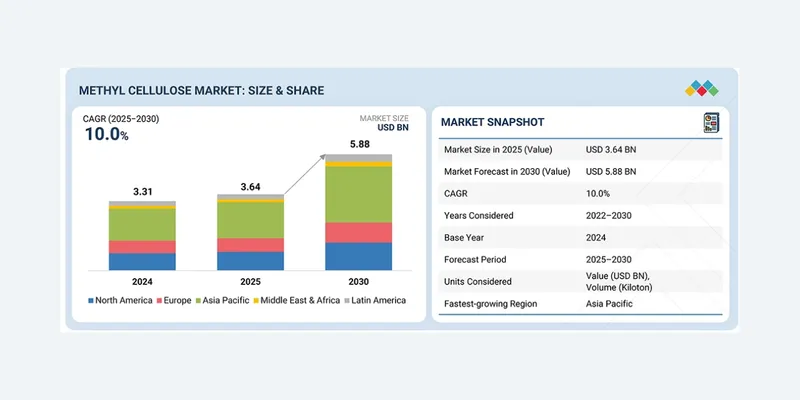
The global methyl cellulose market is projected to grow from USD 3.64 billion in 2025 to USD 5.88 billion by 2030, according to a new market report. The market is expected to expand at a Compound Annual Growth Rate (CAGR) of 10.0% during the forecast period. Increasing demand for multifunctional additives across industries such as construction, pharmaceuticals, food, and personal care is contributing to this growth.
Demand for methyl cellulose is increasing globally as industries look for additives that can enhance product performance across multiple applications. Manufacturers in sectors such as construction, pharmaceuticals, food, and personal care are seeking materials that improve product consistency and stability while meeting safety and sustainability requirements.
Methyl cellulose provides properties including water solubility, thermal gelation, film-forming capability, and non-toxic characteristics. These attributes allow it to be used in applications such as tile adhesives and mortars in construction, controlled-release pharmaceutical formulations, and texture management in food products.
Key market players
Major companies operating in the methyl cellulose market include Dow Chemical Company (US), Shin-Etsu Chemical Co., Ltd. (Japan), Ashland Global Holdings, Inc. (US), Nouryon Chemicals Holding B.V. (Netherlands), Shandong Head Co., Ltd. (China), and Hubei Jiahua Cellulose Co., Ltd. (China), among others.
Regional outlook
The Middle East & Africa region is expected to be the second-fastest-growing market for methyl cellulose during the forecast period. Market growth in the region is supported by increasing construction and infrastructure development as well as ongoing industrialization in countries including Saudi Arabia, the UAE, Qatar, Egypt, and South Africa.
Large-scale projects such as residential developments, commercial buildings, transportation infrastructure, and smart city initiatives are contributing to rising demand for construction materials. The region’s hot and dry climate also increases the need for water-retention agents in cement-based products, where methyl cellulose helps maintain workability and reduce premature drying in mortars, plasters, and tile adhesives.
Investment growth in sectors such as pharmaceuticals, food processing, and personal care—particularly in Gulf countries working to diversify their economies—is also contributing to rising consumption. As infrastructure development and manufacturing capacity expand in the Middle East & Africa, demand for functional additives such as methyl cellulose continues to increase.
Source: MarketsandMarkets