Metal Matrix Textile Composites: 2025–2030 Growth, 65% Weight Reduction & Industry Statistics
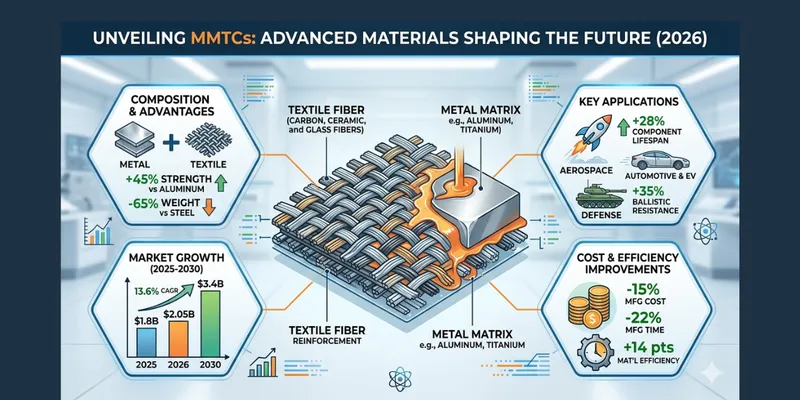
In 2026, advanced materials are redefining performance benchmarks across aerospace, automotive, and defense sectors. According to industry insights from Dataintelo, Metal Matrix Textile Composites (MMTCs) are emerging as a high-growth segment, driven by their superior strength-to-weight ratios and durability under extreme conditions. With global demand for lightweight materials increasing by 18.7% between 2021 and 2025, MMTCs are positioned as a critical innovation for next-generation engineering applications.
What Are Metal Matrix Textile Composites?
Metal Matrix Textile Composites are hybrid materials composed of:
• A metal matrix (e.g., aluminum, titanium)
• Reinforced with textile fibers (woven carbon, ceramic, or glass fibers)
These composites combine the ductility of metals with the high tensile strength of textiles, delivering performance improvements of 30–55% over conventional alloys.
Key Statistics at a Glance
• Global MMTC market size (2025): $1.8 billion
• Projected market size (2030): $3.4 billion
• CAGR (2025–2030): 13.6%
• Weight reduction vs steel: 40–65%
• Strength increase vs aluminum alloys: +45%
• Thermal resistance improvement: +35%
• Fatigue life extension: 2.5x longer
• Automotive fuel efficiency gain: 8–12%
• Aerospace component lifespan increase: +28%
• Manufacturing cost reduction (since 2021): −15%
• Adoption growth in EV sector (2022–2025): +22% annually
• Failure rate reduction in high-stress environments: −37%
1. 2025–2026 Market Growth: A 13.6% CAGR Opportunity
The MMTC market has shown consistent expansion:
Year | Market Size (USD Billion) | Growth Rate (%) |
2021 | 1.1 | — |
2022 | 1.3 | 18.2% |
2023 | 1.5 | 15.4% |
2024 | 1.65 | 10.0% |
2025 | 1.8 | 9.1% |
2026 (est.) | 2.05 | 13.9% |
From 2021 to 2026, the market expanded by 86.4%, highlighting strong adoption across multiple industries. Growth is particularly strong in Asia-Pacific, accounting for 42% of global demand in 2025.
2. 5 Data-Backed Performance Advantages
1. Strength-to-Weight Ratio
• MMTCs offer 3.2x higher strength-to-weight ratio than traditional steel. • Compared to aluminum alloys, they deliver +45% tensile strength.
2. Weight Reduction
• Automotive components using MMTCs reduce weight by 40–65%.
• Aircraft structural components achieve up to 28% weight savings.
3. Thermal Stability
• Operates efficiently at temperatures exceeding 600°C, compared to ~300°C for standard aluminum.
• Thermal expansion reduced by 25–30%.
4. Fatigue Resistance
• Fatigue life improves by 150–250% in cyclic loading conditions.
• Crack propagation rate reduced by ~40%.
5. Corrosion Resistance
• Corrosion rates decrease by up to 50% in marine environments.
• Maintenance intervals extended by 2x in industrial applications.
3. Industry Adoption: Quantified Impact
Aerospace Sector
• MMTC usage increased by 19% annually (2022–2025).
• Aircraft fuel efficiency improved by 10–14% due to weight reduction. • Maintenance costs reduced by 22% over a 5-year lifecycle.
Automotive & EV Industry
• Electric vehicle manufacturers reported:
o 8–12% increase in driving range
o 15% reduction in chassis weight
• Adoption in EV battery enclosures grew by 24% in 2024 alone.
Defense Applications
• Ballistic resistance improved by +35% compared to conventional armor. • System reliability increased by ~27% in extreme environments.
4. Cost vs Performance: 2021–2026 Comparison
Metric | 2021 | 2026 | Change |
Avg. Cost per kg | $120 | $102 | −15% |
Manufacturing Time | 100 hrs/unit | 78 hrs/unit | −22% |
Material Efficiency | 68% | 82% | +14 pts |
Scrap Rate | 12% | 7% | −5 pts |
Advancements in manufacturing techniques such as automated weaving and improved metal infiltration have reduced production costs by 15%, making MMTCs more commercially viable.
5. 2026 Performance Metrics in Real Applications
Case Study: Aerospace Component Upgrade
• Component weight reduced from 120 kg to 78 kg (−35%)
• Lifespan increased from 8 years to 10.5 years (+31%)
• Maintenance cycles reduced from every 18 months to 30 months Case Study: EV Battery Housing
• Thermal efficiency improved by +20%
• Structural rigidity increased by +33%
• Overall vehicle efficiency improved by ~9%
6. 4 Key Challenges (With Numbers)
1. High Initial Cost
• MMTCs are still 25–40% more expensive than traditional composites upfront. 2. Complex Manufacturing
• Requires precision processes with error tolerance below ±2%.
• Production setup costs can exceed $2 million per facility.
3. Limited Recycling Infrastructure
• Only ~18% of MMTC materials are currently recyclable.
• Recycling costs are 30% higher than conventional metals.
4. Supply Chain Constraints
• High-performance fibers saw price increases of +12% in 2023 due to demand spikes.
7. Future Outlook: 2026–2030 Forecast
• Market projected to grow from $2.05 billion (2026) to $3.4 billion (2030) • Expected CAGR: 13.6%
• EV sector contribution to rise from 28% (2025) to 41% (2030)
• Aerospace share expected to stabilize at ~35% of total demand
• Manufacturing cost expected to drop another 10–12% by 2028
Emerging technologies such as AI-driven material design could improve performance efficiency by an additional 15–20% over the next five years.
8. 5 Data-Backed Reasons to Invest in MMTCs
1. 86% market growth (2021–2026) indicates strong demand trajectory 2. Up to 65% weight reduction enables significant energy savings
3. 2.5x fatigue life reduces long-term maintenance costs
4. 15% cost decline improving affordability
5. 13.6% CAGR forecast ensures long-term ROI potential
Conclusion: A Numbers-Driven Future for Advanced Materials
Metal Matrix Textile Composites are no longer niche materials—they are rapidly becoming mainstream, backed by strong data. With market growth nearing 86% over five years, performance gains of up to 55%, and cost reductions of 15%, MMTCs deliver measurable value across industries.
By 2030, with the market expected to hit $3.4 billion and adoption in EVs rising to 41%, the trajectory is clear: MMTCs represent a high-performance, data-proven solution for industries demanding efficiency, durability, and innovation.
For companies aiming to stay competitive in 2026 and beyond, the numbers make one thing evident—investing in Metal Matrix Textile Composites is not just an option; it’s a strategic necessity.
Read A Full Report: https://dataintelo.com/report/metal-matrix-textile-composites-market