Mauritius Growth Forecast Lowered to 2.8% as Inflationary Pressures Build in 2026
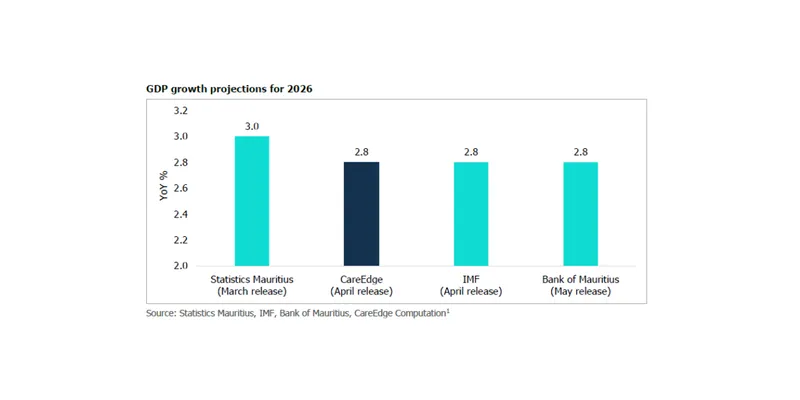
Bank of Mauritius aligns outlook with IMF projections while tourism remains resilient amid global uncertainties
The Bank of Mauritius (BoM) has revised its 2026 baseline growth forecast to 2.8%, aligning its outlook with recent IMF projections. The downgrade reflects the expected impact of rising fuel and electricity costs on economic activity and household purchasing power, alongside broader global uncertainties.
While financial services and the information and communications technology (ICT) sector continue to support domestic growth, overall economic momentum is expected to moderate. Ongoing geopolitical tensions are increasing input costs and disrupting supply chains, affecting manufacturing, agriculture and construction.
Despite these challenges, the economy has shown resilience, supported by gains in the tourism sector during the early months of the year.
Tourism maintains positive momentum
Tourist arrivals increased by 0.07% year-on-year (YoY) to 115,165 in May 2026. Between January and May 2026, cumulative arrivals rose 3.2% YoY to 579,373, driven by stronger inflows earlier in the year.
Europe remained the largest source market, accounting for 64% of arrivals. Within the region, France represented 37% of visitors and Germany 14%, recording YoY growth of 1.6% and 18.4%, respectively. Arrivals from India increased 18.9% YoY over the same period, while arrivals from the United Kingdom declined 14.2% YoY.
Gross tourism receipts rose 8% YoY in April, with cumulative earnings for January-April reaching MUR 39.5 billion, up 22.6% YoY. The increase reflects higher per-tourist spending and a 7.62% YoY depreciation of the Mauritian Rupee against the Euro in April 2026.
Recent connectivity measures, including the temporary approval granted to Ethiopian Airlines to operate in Mauritius, are expected to improve access to additional markets through its global and African network.
However, higher airfares and softer global consumer confidence linked to the Middle East conflict continue to pose downside risks. Between January and April 2026, tourist arrivals in the Maldives contracted 4.9% YoY, while Mauritius recorded 4.0% YoY growth.
Inflation accelerates
Headline inflation rose to 4.3% YoY in May 2026 from 3.6% in April, driven by higher prices in housing, water, electricity, gas and other fuels (4.2% YoY), transport (2.1% YoY), and furnishings, household equipment and routine household maintenance (1.6% YoY).
Core inflation remained unchanged at 6.1%, reflecting persistent domestic service and wage-driven price pressures.
The BoM projects headline inflation to average 5.5% in 2026, exceeding its target range of 2-5%, as higher global energy prices linked to the Middle East crisis continue to influence transport services and other energy-intensive sectors. Food inflation is also expected to remain under pressure due to ongoing supply chain constraints.
Policy rate raised to contain inflation
At its May 2026 meeting, the BoM's Monetary Policy Committee increased the key policy rate by 25 basis points to 4.75%.
The committee cited higher fuel prices, freight and logistics costs, and the risk of further pass-through to domestic prices as reasons for the decision, concluding that inflation risks outweigh potential downside risks to growth.
Trade performance remains subdued
Mauritius' merchandise trade deficit stood at MUR 16.2 billion in March 2026 compared with MUR 16.1 billion in March 2025. The slight widening resulted from a 1.3% contraction in exports while imports remained stable.
Exports declined due to a 30.3% drop in manufactured goods, partially offset by a 14.1% increase in exports of food and live animals.
For the first quarter of 2026, the merchandise trade deficit narrowed to MUR 45.5 billion from MUR 47.0 billion in the corresponding period of 2025, supported by a 3.3% YoY decline in imports compared with a 4.1% contraction in exports.
Statistics Mauritius projects the merchandise trade deficit to reach MUR 215 billion in 2026, compared with MUR 208 billion in 2025. Exports are expected to decline by 2.8% to approximately MUR 105 billion, while imports are projected to rise by 1.6% to around MUR 320 billion.
Foreign exchange reserves strengthen
Mauritius' gross official international reserves increased to MUR 471.0 billion (USD 9.8 billion) in May 2026 from MUR 463.1 billion in April. Import cover rose to 13.9 months from 13.6 months based on imports of goods and services excluding global business company (GBC) services.
Using the BoM's enhanced metric including GBC-related imports, import cover improved to 10.2 months in May from 10.0 months in April.
The Mauritian Rupee averaged MUR 47.8 per USD in May 2026, reflecting a slight depreciation over April and a 1.4% depreciation over the March-May period.
According to the report, persistent trade imbalances, higher import costs, global financial market volatility and a stronger USD continue to influence exchange rate movements, while central bank intervention and the recent policy rate increase are expected to provide support.