MATEXIL Chairman's Address: Navigating Global Challenges with Vision and Resilience
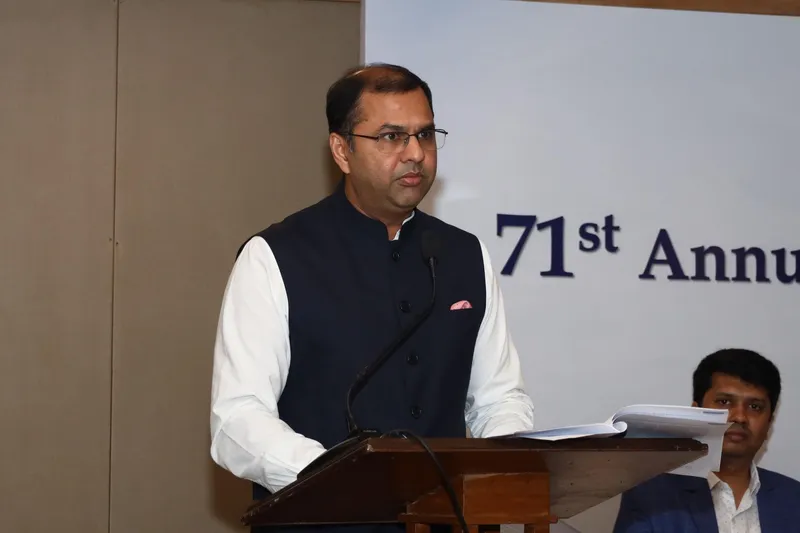
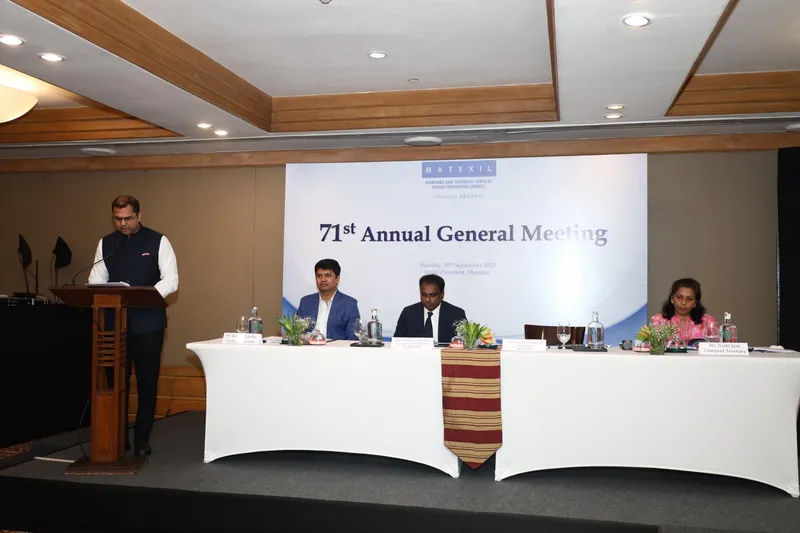
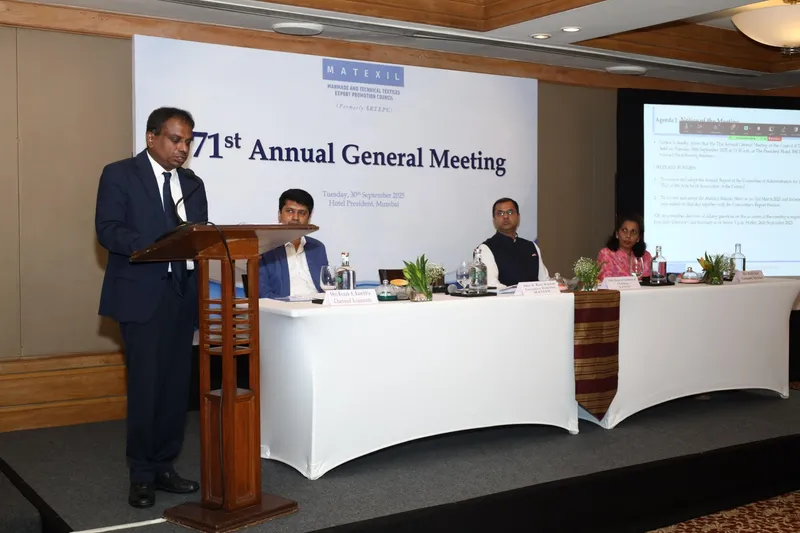
Shaleen Toshniwal Charts Path Forward at 71st Annual General Meeting
At the 71st Annual General Meeting of MATEXIL, Chairman Shaleen Toshniwal delivered a comprehensive address that reflected both the turbulence of the past year and the promising opportunities ahead for India's man-made fibre (MMF) and technical textiles sectors.
India's Economic Momentum Amid Global Uncertainty
Toshniwal opened his address by acknowledging the resilience demonstrated by Indian exporters in navigating a complex global economic landscape. Despite worldwide uncertainties and supply chain disruptions, India has emerged as a beacon of stability and growth, maintaining robust GDP expansion of over 8% annually for the past three years, with 6.5% growth recorded in the year under review. "Today, our nation shines as an epitome of resilience and opportunity," Toshniwal stated, highlighting transformative government initiatives including Atmanirbhar Bharat, the Production Linked Incentive (PLI) Scheme, PM MITRA, and the National Technical Textiles Mission (NTTM). These programs are paving the way toward the vision of Viksit Bharat—a $35 trillion economy by 2047. India currently stands as the world's fourth-largest economy and is projected to become the third-largest by 2030 with an estimated GDP of $7.3 trillion. Real GDP growth is expected to accelerate to 7.8% in Q1 FY 2025-26, driven by strong domestic demand, easing inflation, and rising employment.
A Historic Breakthrough: India-UK Free Trade Agreement
One of the most significant developments highlighted by Toshniwal was the recently signed India-UK Free Trade Agreement, which he described as "a major positive step." The agreement grants zero-duty access to the UK market for both MMF and technical textiles. The potential impact is substantial: India's MMF textile exports to the UK could surge from $218 million to $700 million, while technical textile exports may jump from $242 million to $900 million once the agreement is fully implemented. To capitalise on this opportunity, the Ministry of Textiles organised a high-level trade delegation to the UK from September 22-25, 2025. Toshniwal, along with the Vice Chairman and Executive Director, participated in fruitful meetings in London and Manchester focused on enhancing bilateral trade and investment.
The 50% US Tariff Challenge
However, not all developments were positive. Toshniwal addressed the "serious concern" of the steep 50% tariff imposed by the United States on textile imports from India, effective August 27, 2025, under Executive Order 14329 signed by President Donald Trump. This measure was introduced in response to India's continued import of Russian oil. "This 50% tariff on the entire range of textile products has made it almost impossible for Indian exports to the US," Toshniwal acknowledged. In response, he outlined a three-pronged strategy: diversifying export markets toward Africa, West Asia, Latin America, Australia, and Europe; negotiating cost-sharing solutions with US buyers; and coordinating with the government for support, particularly for MSMEs facing working capital constraints. Despite this setback, Toshniwal expressed optimism that either the ongoing India-US Bilateral Trade Agreement would be signed soon, or diplomatic efforts would successfully reduce tariffs to around 10%.
Geopolitical Headwinds and Supply Chain Disruptions
The Chairman provided a candid assessment of multiple challenges confronting exporters. The Russia-Ukraine conflict has created significant uncertainty, disrupting shipping routes through the Black Sea and Red Sea corridors, leading to shipment delays, higher logistics costs, and payment complications. Energy prices surged as Russian gas supplies to Europe dropped nearly 30%, pushing production costs up by approximately 12% in energy-intensive sectors. The Red Sea Crisis emerged as another major obstacle. Since November 2023, Houthi attacks have forced shipping companies to reroute around Africa's Cape of Good Hope, adding 10-14 days to journey times. Container shipments through the Red Sea plummeted by 75%, affecting approximately 20% of world trade and causing freight rates to surge nearly fivefold on Asia-Europe routes. Toshniwal urged the government to provide support to exporters facing these challenges and expedite the PLI Scheme for manufacturing containers in India to reduce dependence on imports.
Rising Bar: ESG Compliance Requirements
The Chairman emphasised the growing importance of Environmental, Social, and Governance (ESG) regulations in key markets, including the EU, the US, and Australia. These regulations mandate strict sustainability, circularity, and labour standards throughout the entire supply chain. "It has become necessary for exporters to understand these regulations and adapt their products and manufacturing processes accordingly," Toshniwal noted. The Council is organising awareness and training programs in collaboration with international agencies and ESG experts to help members navigate these requirements.
Export Performance: Growth Amid Headwinds
Despite challenges, the sector showed resilience. MMF textile exports reached $6,042 million in 2024-25 compared to $5,743 million in 2023-24, registering 5.2% growth driven by falling inflation and improving real incomes in the US and Europe. Technical textiles performed even better, growing 12.4% from $2,987 million to $3,357 million, fueled by rising demand in healthcare, agriculture, infrastructure, and automotive sectors. For April-June 2025, MMF textile exports remained stagnant at approximately $1,455 million due to declining yarn exports to Bangladesh, Turkey, and Brazil. However, technical textile exports showed robust 9% growth, reaching $840.1 million, with segments like Clothtech and Hometech recording impressive gains of 41% and 31% respectively.
Ambitious Export Targets for 2030
Looking ahead, the government has set ambitious export targets of $11 billion for MMF textiles and $10 billion for technical textiles by 2030. Toshniwal expressed confidence that these goals are attainable through strategic investments in technology, sustainability, and capacity-building.
Bharat Tex 2026 and Council Activities
Following the tremendous success of Bharat Tex 2025 held in February, the next edition will take place in 2026 in New Delhi. The flagship exhibition has become the world's largest textile event, covering the entire value chain, including dyes, chemicals, and machinery. The Council actively participated in numerous international exhibitions, including Techtextil Frankfurt, MAGIC Fair Las Vegas, and Istanbul Yarn Fair, while organising webinars, seminars, and training programs on digital marketing, high-performance fibres, and finding foreign buyers.
Policy Advocacy and Representations
Toshniwal outlined several key representations made to the government, including successful advocacy for QCO exemptions on imports against Advance Authorizations, proposals to reduce GST on waste bottles from 18% to 5%, and requests to extend RoDTEP and RoSCTL schemes for five years beyond September 30, 2025, and 2026, respectively. The Council also achieved success in getting the Minimum Import Price fixed on certain MMF knitted fabrics and is now pushing for similar measures on woven fabrics. Additionally, representations have been made to extend the Interest Equalization Scheme for five years and include non-MSMEs and job-work exporters.
Looking Forward: Initiatives for 2025-26
For the coming year, MATEXIL has planned an ambitious agenda including a targeted membership drive, capacity-building programs in Bhiwandi, Bhilwara, Surat, and Ichalkaranji, participation in international exhibitions like Heimtextil and Techtextil North America, promotional roadshows for Bharat Tex 2026, and educational webinars on ESG compliance, market diversification, and export finance.
Vision for Global Leadership
In his concluding remarks, Toshniwal articulated a vision of India's MMF and technical textiles sector achieving stronger global integration. With international buyers increasingly prioritising sustainability, innovation, and reliability, India is well-positioned to capture growing market share. "MATEXIL is committed to helping members embrace green technologies, circular business models, befitted to the global compliance requirements and digital tools that can enhance competitiveness," he affirmed. "By fostering innovation, building resilience, and aligning with global sustainability goals, we aim to ensure that Indian exporters not only participate in the global textile transformation but play a leadership role in shaping it." The Chairman expressed gratitude to the Committee of Administration, Vice-Chairman Anil Rajvanshi, Immediate Past Chairman Bhadresh Dodhia, Executive Director A. Ravi Kumar, and all council members and staff for their unwavering support and dedication. As MATEXIL navigates the complex interplay of geopolitical tensions, trade policy shifts, and evolving market demands, Toshniwal's address projected confidence that with strategic planning, government support, and industry collaboration, India's synthetic and technical textile sectors are poised for sustained growth and global prominence.