MATEXIL 71st AGM: Chairman’s Speech on Trade, Policy & Exports
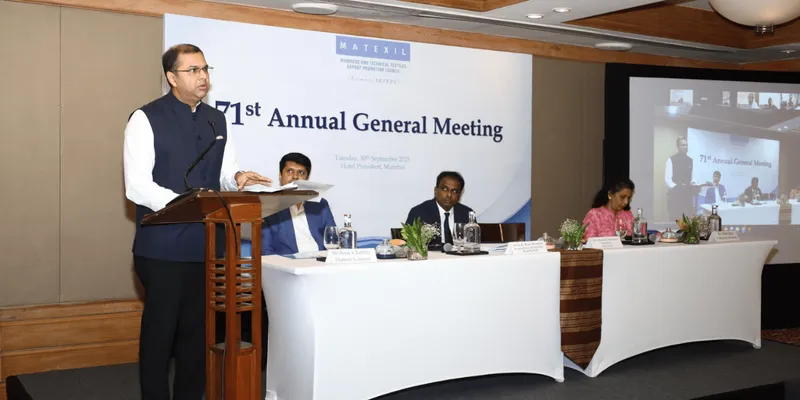
Resilience, policy reforms, and export opportunities in India’s textile sector
At MATEXIL’s 71st AGM on September 30, 2025, the Chairman addressed global trade challenges, India’s policy support, and strategies for textile export growth.
Dear Friends,
It is my privilege to welcome you to the 71st Annual General Meeting of MATEXIL. As we gather today, we reflect on a year marked by both significant challenges and promising opportunities that continue to shape our industry’s trajectory. The resilience and adaptability demonstrated by our exporters and members have been truly commendable amid a complex global economic environment.
Today, our nation shines as an epitome of resilience and opportunity at a time when the world continues to grapple with economic uncertainties and supply chain disruptions. The Government’s steadfast focus on Ease of Doing Business, coupled with massive investments in infrastructure and capital spending, has enabled the economy to consistently deliver a strong annual GDP growth of over 8% in the past three years, 6.5% in the year under review. Landmark initiatives of the Government such as Atmanirbhar Bharat, supported by transformative schemes like the Production Linked Incentive (PLI) Scheme, PM MITRA, and the National Technical Textiles Mission (NTTM), are creating new avenues for manufacturing excellence and nurturing entrepreneurship in the textile sector. Together, these efforts are laying down the pillars of a robust growth trajectory and moving the nation closer to the vision of Viksit Bharat—a US$35 trillion economy by 2047.
Global Ecosystem
The Global Trade Ecosystem in 2024-25 was marked by a gradual recovery in world trade, driven by falling inflation and improving real incomes, with projections of 2.6% growth of merchandise trade volume for 2024 and 3.3% for 2025 by the WTO. However, this recovery faced significant downside risks from rising geopolitical tensions, regional conflicts, and increasing economic policy uncertainty, which led the IMF to project a potential slowdown in 2025. The period also saw a growing trend of countries implementing "other trade and trade-related import measures" beyond traditional tariffs, often for reasons of national security and resilience, increasing trade coverage by such measures significantly by mid-2025.
It is our pride that currently India is the world’s fourth-largest economy and is on the track to become the third largest by 2030 with a projected US$ 7.3 trillion GDP. This momentum is powered by decisive governance, visionary reforms, and active global engagement. Notably, growth is accelerating, with real GDP expected to rise by 7.8% in Q1 FY 2025-26, up from 6.5% a year earlier.
The ascent is powered by strong domestic demand and transformative policy reforms, making India a prime destination for global capital. With easing inflation, higher employment, and buoyant consumer sentiment, private consumption is expected to further drive GDP growth in the coming months.
India–UK FTA
The recently signed India–UK Free Trade Agreement is a major positive step. Both MMF and Technical Textiles now enjoy Zero Duty Access to the UK.
Once fully implemented, India’s exports of MMF textiles to the UK can potentially rise from USD 218 million to USD 700 million, and technical textiles from USD 242 million to USD 900 million.
In this regard, to the understand the requirements of the UK and have a first-hand information from UK, the Ministry of Textiles has mounting a High-Level trade Delegation to the UK from 22nd to 25th September, 2025 and I along with Vice Chairman and Executive Director was a part of the delegation. The delegation has had fruitful meetings both in London and Manchester and discussed issues on enhancement of bilateral trade and investment.
50% US Tariff
The United States has imposed a steep 50% tariff on textiles imports from India with effective August 27, 2025, under Executive Order 14329 signed by President Donald Trump. This 50% tariff on entire range of textile products has made it almost impossible for Indian exports to the US which is a serious concern for us. The new tariff regime was introduced as a response to India’s continued import of Russian oil.
In view of this steep 50% US tariff on textiles, we need to diversify export markets beyond the United States, such as increasing outreach to regions like Africa, West Asia, Latin America, Australia, and Europe. We also need to negotiate cost-sharing solutions with US buyers, and coordinate with the Government for support, especially for MSMEs facing working capital issues.
However, we are hopeful that either the ongoing India–US BTA would be signed very soon, or Government’s dialogue and diplomacy would be successful to bring down the Tariffs to around 10%.
Challenges faced by the exporters
While on the global ecosystems, I would like to briefly touch upon some major challenges faced by the exporters.
Russia-Ukraine War
The prolonged geopolitical conflict has created significant uncertainty in global trade, disrupting shipping routes and timelines in critical corridors such as the Black Sea and Red Sea. For Indian exporters, this translated into shipment delays, higher logistics costs, and payment complications.
Sanctions imposed during the Russia–Ukraine war further reshaped global trade dynamics, with restrictions on Russian oil, gas, and major metals extending volatility in energy and commodities markets. Russian gas supplies to Europe dropped by nearly 30% between 2024 and mid-2025, driving a sharp rise in energy prices that pushed up production costs by around 12% in energy-intensive manufacturing sectors.
For Indian textile exporters, these disruptions added another layer of complexity. Weak consumer sentiment in the US and Europe—linked to inflation, high energy costs, and elevated freight charges—resulted in fluctuating demand. The combined effect of geopolitical instability, inflationary pressures, and logistics bottlenecks created an uncertain export climate for the sector, requiring Indian businesses to adapt swiftly in order to remain competitive.
Red Sea Crisis
During the year, exporters had to face a huge challenge on account of the Red Sea Crisis. Since November 2023, Houthi attacks on commercial vessels forced major shipping companies to reroute around Africa's Cape of Good Hope, adding 10-14 days to journey times from Asia to Europe. Container shipments through the Red Sea dropped by 75%, with the number of container ships passing through the Suez Canal down 77% from the previous year. This disruption affected approximately 20% of world trade and caused freight rates to surge nearly five-fold on Asia-Europe routes. Although the situation has eased out a bit, the challenge continues. I would urge the Government to grant some support to the exporters to overcome this difficult situation. I would also urge the Government to put in place a PLI Scheme for manufacturing containers in India, which is currently under consideration, at the earliest. This will reduce our dependence on imported containers over a period of time and make us self-reliant.
ESG Regulations
Leading Markets for Man-Made Fibre Textiles and Technical Textiles like EU, US, Australia, etc. have all put in place regulations on sustainability, circularity and labour standards. It has become necessary for exporters to understand these regulations and also to adapt their products, manufacturing process etc. in line with these requirements. With regard to labour standards, it has become necessary to ensure compliance in the entire supply chain. Companies, therefore, need to work with suppliers to ensure that Sub-Contractors and Secondary suppliers also adhere to these Labour Standards. In addition, detailed records and proper documentations will be required to be maintained by the exporters for smooth customs clearance and compliance certifications.
The Council will be conducting various awareness and training programs to sensitize its members and to prepare themselves to adapt to these ESG Regulations. In this regard, the council is in discussions with International Agencies and experts in ESG Regulations to conduct the training programs.
Export Trends
In 2024-25, exports of Man-made fibre textiles reached US$ 6,042 million as compared to US$ 5,743 million in 2023-24 registering a growth of 5.2%. This growth in exports was primarily driven by falling inflation and improving real incomes in the USA and Europe and gradually improving trade dynamics. On the other hand, exports of Technical Textiles grew from US$ 2,987 million in 2023-24 to US$ 3,357 million in 2024-25 registering a growth of 12.4%. This growth has been fuelled by rising demand in sectors such as healthcare, agriculture, infrastructure, and automotive.
Outlook for 2025 -26
We are optimistic about the prospects for 2025-26, as the global economy shows signs of recovery and inflation stabilizes in key markets. In its July 2025 World Economic Outlook, the IMF projects global growth at 3.0% for 2025 as countries worldwide show significant improvements, with inflation easing and markets gradually stabilizing. Notably, the demand for textiles, particularly technical textiles, is expected to witness a substantial growth in the upcoming months.
Exports of Manmade Fibre Textiles during April – June 2025 touched US$ 1,454.78 million, compared to US$ 1,454.84 million in corresponding period of last year, marking a stagnation in exports. This was especially because of decline in exports of yarns to Bangladesh, Turkey and Brazil.
Technical Textile exports also performed well during April – June 2025, reaching US$ 840.1 million compared to US$ 770.1 million in the corresponding period of last year, marking a 9% growth. Segments like Clothtech and Hometech have recorded 41% and 31% growth respectively.
We remain optimistic and confident that in both MMF Textiles and Technical Textiles we would witness accelerating growth during the year.
Export Target 2030
Looking further ahead, the Government has set an ambitious export target of US$ 11 billion for man-made fibre textiles and US$ 10 billion for technical textiles to be achieved by 2030. While these goals are attainable, they will require strategic investments in technology, sustainability, and capacity-building. MATEXIL will continue to collaborate closely with the Government and industry stakeholders to support this vision and drive growth in our sector.
Bharat Tex- 2026
I am pleased to announce that after a highly successful Bharat Tex 2025 held in February 2025, the next edition of Bharat Tex 2026 will take place in 2026 in New Delhi. Details such as dates, venue etc will be announced very shortly. This flagship exhibition provides an excellent platform to showcase India’s capabilities in the MMF Textiles and Technical Textiles sectors. Both editions of Bharat Tex 2024 & 2025 were a tremendous success, and has now become the World’s biggest Textiles exhibition covering the entire value of Textiles & Clothing including Dyes & Chemicals, Machineries etc. Details of the Bharat Tex 2026 will be announced very soon, and I urge all our members to participate actively in Bharat Tex 2026 as exhibitors and contribute towards making this event a resounding success.
Let me now briefly speak on the activities of the Council
Exhibitions
To promote exports of Manmade Fibre Textiles and Technical Textiles, the Council had participated in various Exhibitions along with its members. Some of the Exhibitions in which Council participated in 2024-25 were Techtextil Frankfurt, The Hotel Show Dubai, MAGIC Fair Las Vegas, Technotextil Moscow, Global Sourcing Expo Australia, Morocco Fashion Tex Style, ColombiaTex, and Istanbul Yarn Fair.
Webinars/ Seminars/ Training Programmes
The Council had organised Webinars/ Seminars/ Training Programmes from time to time to keep exporters informed about the latest developments in textile industry, policy changes, regulatory compliance requirements etc. Council had organized Sessions on Increase Exports through Digital Marketing, How to Find Foreign Buyers for Manmade Fibre Textiles and Technical Textiles, and Master Classes on High Performance Fibres and their Applications” and “Modacrylic Fibres – Applications & Advantages”.
Interactions with Ministries
The Council actively participated in important meetings with the Ministries to represent the interests of the industry and provide necessary inputs to support export growth. Some of these meetings were Imposition of Minimum Import Price on Knitted Fabrics, 7th Meeting of the EPC under National Technical Textiles Mission (NTTM), Meeting on QCO Exemption for Imports under Advance Authorizations, and 4th Meeting of the Textile Advisory Group (TAG) on Man-made Fibre (MMF). Council had organized an Interactive Meeting with Shri Giriraj Singh, Hon’ble Union Minister on 12th July 2024 at Hotel Trident, Nariman Point, Mumbai. During the meeting, stakeholders had the opportunity to interact directly with the Hon’ble Minister and present their views and suggestions on ways to enhance exports of textiles and clothing and boost employment generation in the sector.
Representations
The Council extensively interacts with its members and takes feedback/suggestions etc. on various issues. Based on the inputs received from the members, the Council sends representations to the Government.
I would now like to speak on some of the important issues on which the Council has represented to the Government.
Exemption from QCO requirement against Advance Authorizations
As you are aware, Government has imposed Quality Control Orders (QCOs) on various products that are inputs for Textiles products. At the outset, we welcome QCOs as it will improve the quality of manufactured products and also prevent import of sub-standard products at cheaper prices. The Council had represented to the Government to exempt from the enforcement of QCO requirements on products imported against Advance Authorizations. The Council also worked very closely with the Government and had extensive discussions regarding the conditions that need to be imposed to grant the exemption. I am glad that Government has exempted various inputs used in textile products from QCO requirements on imports against Advance Authorizations. The Council is now trying to get similar exemptions on imports against DFIAs also. The Council has also represented to the Government to get the entire Value Chain of Textiles such Fibre, Yarns, fabrics and Made ups under QCO.
GST rate on Waste Bottles
There is a GST rate of 18% currently on Waste Bottles. The Council has represented to the Government to reduce this GST rate to 5% or alternatively to bring supply of Waste Bottles under the RCM (Reverse Charge Mechanism).
RoDTEP and RoSCTL Scheme
Export incentives continue to play a vital role in promoting exports of Manmade Fibre Textiles and Technical Textiles.
In this context, the RoSCTL Scheme has been instrumental in enhancing the competitiveness of Made-ups made from Manmade Fibre. Likewise, the RoDTEP Scheme is helping exporters improve the competitiveness of Manmade Fibre Textiles and Technical Textiles.
As you are aware, the RoDTEP Scheme was earlier available only to DTA exporters. Based on representations from our Council and other Export Promotion Councils, the Government has now extended the benefit of this scheme to other categories of exporters, including Advance Authorization Holders, SEZ Units, and EOUs.
We have also requested the Government to similarly extend the coverage of the RoSCTL Scheme to Advance Authorization Holders, SEZ Units, and EOUs, and we are hopeful of a favourable decision on this matter.
The Government has already extended the RoSCTL Scheme up to September 30, 2026. However, the RoDTEP Scheme is currently valid only up to September 30, 2025, and we are awaiting a notification from DGFT regarding its further extension.
Our Council has strongly recommended that both the RoSCTL Scheme and the RoDTEP Scheme be extended for a minimum period of five years. Such a long-term policy horizon will enable exporters to take a stable, forward-looking perspective while negotiating export orders.
We trust that the Government will consider our request favourably and announce suitable extensions.
RoDTEP Rates & RoSCTL Rates
The Council has submitted data for revision in the RODTEP and ROSCTL rates. However, after the announcement of the Union Budget 2024, the Council is now working on furnishing revised data to the Department of Revenue for an increase in the RoDTEP and ROSCTL rates for Man-made Fibre textiles and technical textiles products. In this regard, the Council will be constituting an expert committee very shortly to review the duty incidence and to calculate the embedded taxes and duties incurred on the export products for submission to the Government. I would urge all our members to come forward and submit the required data to the Council. This will enable us to submit proposals for an increase in the RoDTEP and ROSCTL rates. Please note that both the RODTEP and ROSCTL schemes are data driven and based purely on the facts and figures submitted to the Department of Revenue. I would, therefore, appeal to all our members for support and furnish the data to the Council.
Surge in import of Man-made fibre fabrics
The Council had represented to the Government on the problems faced by the Manmade Fibre textile sector due to surge in imports of Manmade fabrics. I am glad that the Government has fixed Minimum Import Price on certain specified HS codes of MMF knitted fabrics. The Council has now represented to the Government to fix similar Minimum Import Price on MMF woven fabrics also.
Interest Equalization Scheme
The Interest Equalization Scheme was extended till September 30, 2024. The Council has represented to the government to extend the interest equalization scheme for next five years. The Council has also represented to extend the benefit of the scheme to non-MSMEs exporting the 410 notified HS lines under the scheme. Further, the Council has proposed to include those exporters who get their products manufactured on job work basis also under the Interest Equalization Scheme.
Procedural issues
While there are some of the important issues on which the Council had represented, we have also taken up the procedural issues, faced by our members with the concerned Departments like Customs, Regional offices of DGFT, GST Commissionerate office of the Textile Commissioner etc.
Some of the procedural issues faced our members which were taken up on a case-to-case basis are
- Shipping bills not appearing on the EDI system
- Non-receipt of duty drawback, RoDTEP and RoSCTL claims
- Pending claims under the ATUF Scheme etc.
The Council had also taken up the issues faced by the members on account of non-receipt of payments from their foreign buyers with the Indian Missions abroad.
Sub-Committees
During the year, the Sub-Committees constituted by the Council for Manmade Fibres, Yarns, Fabrics, Made-Ups, and Technical Textiles consisting of experts from the industry have provided essential insights that have shaped our vision and action plan for exports. These Sub-Committees played a crucial role in formulating export growth strategies for all the categories of export products.
Initiatives for 2025 -26
Looking forward, we have a range of initiatives planned for 2025-26. These include a targeted membership drive to onboard more exporters, capacity Building Programmes in Bhiwandi, Bhilwara, Surat, and Ichalkaranji, participation in international events, organizing trade delegations, promotional roadshows for Bharat Tex 2026, and participation in key global exhibitions such as Heimtextil, Techtextil North America, International Istanbul Yarn Fair etc. We will also continue to organize webinars and seminars to educate our members on important topics like ESG compliance, market diversification, export finance etc.
Key Challenges Ahead
While we have made encouraging progress, certain challenges continue to draw our attention in 2025. The limited domestic availability of advanced specialty fibres and state-of-the-art machinery remains a constraint, particularly for scaling up India’s presence in high-value technical textiles. 50% tariff in the US, increasing ESG compliances and fierce price competition from competing in international markets are also pressing issues. MATEXIL is consistently engaging with the Government to address these concerns, while also pushing for faster conclusion of crucial Free Trade Agreements (FTAs) with the European Union, the US, and other key partners to ensure a level playing field and greater market access for Indian exporters.
Vision for the Future
Looking ahead, MATEXIL is confident that India’s MMF textiles and Technical Textiles sector is poised for stronger global integration in 2026. With international buyers increasingly prioritizing sustainability, innovation, and reliability, the demand landscape is shifting in India’s favour. The Council is committed to helping members embrace green technologies, circular business models, befitted to the global compliance requirements and digital tools that can enhance competitiveness. By fostering innovation, building resilience, and aligning with global sustainability goals, MATEXIL aims to ensure that Indian exporters are not only part of the global textile transformation but also play a leadership role in shaping it.
Conclusion
In conclusion, I would like to thank my colleague members of the Committee of Administration, Shri Anil Rajvanshi, Vice-Chairman, Shri Bhadresh Dodhia, Immediate Past Chairman, all the Past Chairmen and Members of the Council for their invaluable support in guiding the Council through volatile times when there are multiple challenges at play.
I thank the Executive Director, Shri A. Ravi Kumar and all the officers and staff of the Council for their dedication, extraordinary commitment and untiring efforts in achieving the goals of the Council.
My special Thanks to all the Members of the Council for the trust you have reposed on us. You remain an invaluable pillar of strength, and I look forward to your continued support in our journey towards achieving greater heights in the Exports of Manmade Fibre Textiles & Technical Textiles. Together, we will continue to work to build a bright and more prosperous future for our industry.
Our Council MATEXIL assures you of our best services at all times.
Thanks to all
Jai Hind