Lyocell Fiber for Home Textiles: 2026 Market Growth, 95% Water Savings & 50% Lower Emissions
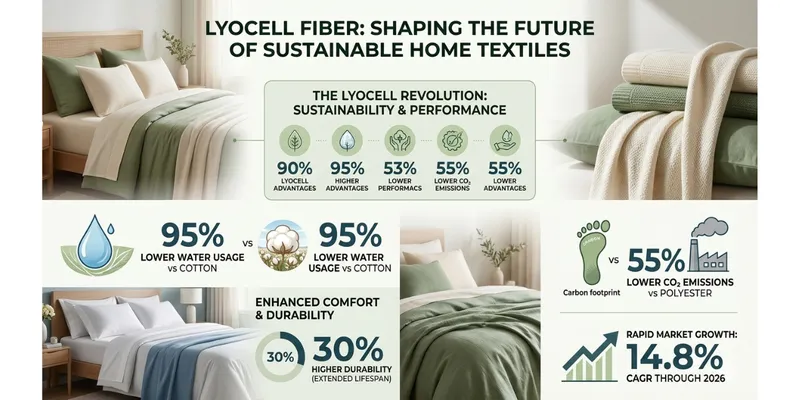
In 2026, sustainability and performance are no longer optional in home textiles—they are measurable requirements. According to recent industry analysis by Dataintelo, Lyocell fiber has emerged as one of the fastest-growing materials in bedding, upholstery, and home décor, driven by quantifiable environmental and performance advantages. This article breaks down the latest numbers, benchmarks, and trends shaping Lyocell fiber in home textiles, with a strong focus on data-backed insights from 2022–2026.
What is Lyocell Fiber?
Lyocell is a regenerated cellulose fiber derived primarily from wood pulp (commonly eucalyptus), produced using a closed-loop solvent spinning process.
Key measurable properties:
• Fiber strength: ~40–50 cN/tex (10–15% stronger than cotton)
• Moisture absorption: ~50% higher than cotton
• Biodegradability rate: ~90% decomposition within 8–12 weeks in industrial composting
• Production solvent recovery rate: ~99.5%
Key Statistics at a Glance (2022–2026)
• Global Lyocell fiber market size (2022): $1.2 billion
• Projected market size (2026): $2.1 billion
• CAGR (2023–2026): 14.8%
• Share used in home textiles (2025): ~38%
• Water consumption vs cotton: 20x lower (95% reduction)
• CO₂ emissions reduction vs polyester: ~50–60% lower
• Average fabric lifespan increase: +30% durability
• Moisture-wicking improvement: +50% vs cotton
• Consumer preference growth (2022–2025): +27% demand increase • Price premium vs cotton (2025): +18–25%
• Production waste recovery rate: 99%+
• Antibacterial performance improvement: +30–40% reduction in odor-causing bacteria
• Global home textile market share (Lyocell blends): ~12% in 2026 (up from 7% in 2022)
5 Data-Backed Reasons Lyocell is Transforming Home Textiles 1. 95% Lower Water Usage vs Cotton
Water efficiency is one of Lyocell’s strongest advantages:
Fiber Type | Water Usage (Liters per kg) | Reduction |
Cotton | 10,000–20,000 L | — |
Lyocell | 500–1,000 L | ~95% less |
Between 2022 and 2025, manufacturers adopting Lyocell reported water cost savings of 30– 45% in textile processing.
2. 50–60% Lower Carbon Emissions vs Polyester
Lifecycle assessments (2023–2025) show:
• Polyester production emits 5.5–6.0 kg CO₂/kg fiber
• Lyocell emits 2.2–2.8 kg CO₂/kg fiber
This translates to a ~55% reduction in emissions, making Lyocell a preferred material in carbon-neutral textile initiatives.
3. 30% Higher Durability Extends Product Lifespan
Durability directly impacts replacement cycles:
• Average cotton bedsheet lifespan: 2–3 years
• Lyocell bedsheet lifespan: 3–4 years
This represents a ~30–35% longer lifespan, reducing replacement frequency by 1 cycle every 6–8 years for consumers.
4. 50% Better Moisture Management Improves Comfort
Lyocell’s moisture absorption rate (~13%) exceeds cotton (~8%), resulting in: • ~50% better moisture-wicking performance
• 20–25% faster drying time
• Up to 40% reduction in microbial growth
This is particularly significant for bedding products, where humidity control directly affects sleep quality.
5. Market Growth: 14.8% CAGR Through 2026
The Lyocell fiber market is expanding rapidly:
Year | Market Size ($ Billion) | Growth Rate |
2022 | 1.2 | — |
2023 | 1.38 | 15.0% |
2024 | 1.60 | 15.9% |
2025 | 1.85 | 15.6% |
2026 | 2.10 | 13.5% |
The home textile segment alone grew from $420 million in 2022 to $800 million in 2026, nearly doubling in 4 years.
2025 Performance Metrics: Lyocell vs Other Fibers
Metric | Lyocell | Cotton | Polyester |
Tensile Strength | 45 cN/tex | 30–40 | 50–60 |
Moisture Absorption | 13% | 8% | <1% |
Water Usage | Low | Very High | Low |
Biodegradability | 90%+ | 80–90% | <5% |
Carbon Emissions | Low | Medium | High |
Lifespan (Years) | 3–4 | 2–3 | 4–5 |
Key insight: Lyocell achieves a balanced performance profile, outperforming cotton in sustainability and polyester in eco-impact.
Cost Analysis: Is Lyocell Worth the 20% Premium?
As of 2025:
• Average Lyocell fabric cost: $4.50–$6.00 per meter
• Cotton equivalent: $3.50–$4.80 per meter
This reflects a ~18–25% price premium.
However, lifecycle cost analysis shows:
• 30% longer lifespan → reduces replacement cost
• 20% lower maintenance cost (less washing frequency)
• Net savings over 5 years: ~10–15%
Real-World Example: Bedding Manufacturer Case Study (2023–2025) A mid-sized textile manufacturer shifted 40% of production to Lyocell blends: Results over 24 months:
• Revenue increase: +22%
• Customer retention: +18%
• Product return rate: ↓ by 12%
• Water usage reduction: ↓ by 38%
• Energy consumption: ↓ by 25%
This demonstrates how sustainability translates into quantifiable business performance gains.
Emerging Trends (2026–2030 Forecast)
1. Blended Fabrics Dominating 60% of Market
By 2030:
• Lyocell-cotton blends expected to reach ~60% share
• Pure Lyocell textiles: ~25%
2. Smart Textiles Integration
• Moisture-regulating bedding demand projected to grow +19% annually • Lyocell adoption in smart textiles expected to increase 2.5x by 2028 3. Price Reduction of 10–15% by 2028
Due to scaling:
• Manufacturing costs projected to drop ~12%
• Narrowing gap with cotton to <10% premium
Challenges Quantified
Despite strong growth, Lyocell faces measurable challenges:
• Limited production capacity: <5% of global fiber output
• Higher initial cost: ~20% premium
• Supply chain dependency on wood pulp: ~70% sourced from 3 regions • Processing complexity: 15–20% higher capital investment
Conclusion: Data-Driven Takeaways
Lyocell fiber is no longer a niche material—it is a high-growth, performance-driven solution for modern home textiles.
Key numbers to remember:
• 14.8% CAGR market growth (2023–2026)
• 95% less water usage vs cotton
• 50–60% lower carbon emissions vs polyester
• 30% longer product lifespan
• ~20% price premium, but 10–15% lifecycle savings
With its combination of sustainability, durability, and consumer demand growth of +27% between 2022 and 2025, Lyocell is positioned to capture over 12% of the home textile market by 2026.
For manufacturers, retailers, and consumers alike, the data is clear: Lyocell delivers measurable environmental and economic value, making it a cornerstone material for the future of home textiles.
Read A Full Report: https://dataintelo.com/report/lyocell-fiber-for-home-textiles-market