Living Room Textiles Market Analysis: 6.3% CAGR Growth and Key Industry Metrics
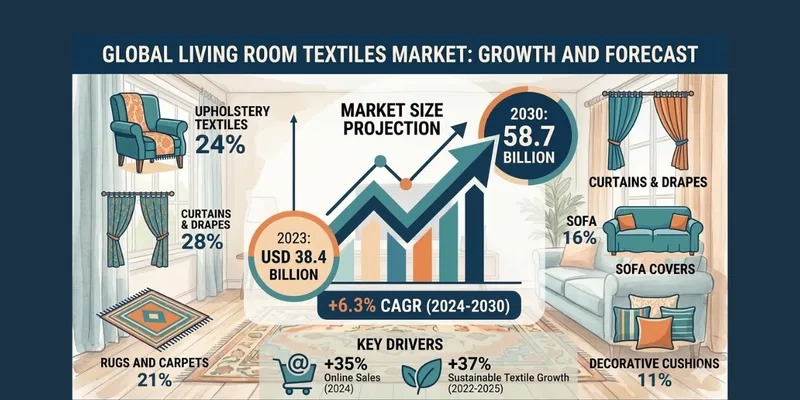
The global Living Room Textiles market has experienced measurable growth over the last decade, driven by rising home décor spending, e-commerce expansion, and increased urban housing development. The market has demonstrated consistent year-over-year growth, with demand accelerating particularly after 2021 as consumers invested more in home comfort and interior upgrades.
According to industry analysis by Dataintelo in 2023, the global Living Room Textiles market was estimated at USD 38.4 billion, and projections suggest it could reach approximately USD 58.7 billion by 2030, representing a compound annual growth rate (CAGR) of around 6.3% between 2024 and 2030. Products such as curtains, upholstery fabrics, sofa covers, rugs, and decorative cushions account for a significant share of household textile spending.
This article explores data-driven insights, key statistics, growth drivers, and future projections shaping the Living Room Textiles market in 2024–2026 and beyond.
Key Statistics at a Glance
Metric | Value |
Global market size (2023) | USD 38.4 billion |
Forecast market size (2030) | USD 58.7 billion |
CAGR (2024–2030) | 6.3% |
Share of curtains & drapes | 28% of total market |
Upholstery textiles share | 24% |
Rugs and carpets segment | 21% |
Decorative cushions segment | 11% |
Online sales share (2024) | 35% of global purchases |
Growth in e-commerce textile sales (2021–2024) | +48% |
Average household décor budget increase (2020–2024) | +32% |
Asia-Pacific market share | 42% of global demand |
Sustainable textile adoption growth (2022–2025) | +37% |
These figures highlight the increasing economic significance of the living room textiles sector.
5 Data-Backed Reasons the Living Room Textiles Market Is Expanding 1. Rising Home Décor Spending
Consumer spending on home décor has steadily increased in recent years. Key numbers:
• Global home décor spending reached USD 747 billion in 2024, up from USD 663 billion in 2021.
• Living room décor accounts for approximately 31% of total home décor budgets.
• The average household spent USD 620 annually on living room furnishings and textiles in 2024, compared to USD 470 in 2020.
This represents a 32% spending increase in four years, largely driven by hybrid work lifestyles and home renovation trends.
2. Rapid Growth in E-Commerce Textile Sales
Online retail has dramatically reshaped textile purchasing behavior.
Between 2021 and 2024:
• Online sales share increased from 22% to 35% of total living room textile purchases.
• Global online textile revenue rose from USD 7.8 billion in 2021 to USD 11.5 billion in 2024.
• Mobile commerce now accounts for 61% of online décor purchases.
E-commerce platforms allow consumers to compare prices, view visual mockups, and access thousands of textile styles, accelerating purchasing decisions.
3. Urban Housing Growth Driving Demand
Urbanization plays a major role in increasing demand for living room textiles. Key housing statistics:
Year | Global Urban Population | New Urban Homes Built |
2021 | 4.46 billion | 43 million |
2023 | 4.61 billion | 47 million |
2025 (est.) | 4.74 billion | 51 million |
Each new household typically requires:
• 1–2 sofa covers
• 3–5 cushions
• 1 rug
• 2–4 curtains
This results in millions of additional textile product purchases annually. 4. Growth of Sustainable and Eco-Friendly Fabrics
Sustainability is a rapidly expanding segment of the textile industry. Data trends from 2022–2025 show:
• Demand for organic cotton upholstery fabrics increased 29%.
• Recycled polyester textiles grew 41% in market adoption.
• Bamboo fiber textiles saw 18% annual growth.
By 2025, eco-friendly materials are expected to represent 26% of the living room textile market, compared with 16% in 2021.
Consumers are increasingly willing to pay more for sustainable products: • Average price premium for eco textiles: 12–18% higher than standard fabrics.
Market Segmentation by Product Type (2024)
Different textile categories contribute varying shares of total revenue.
Product Category | Market Share | Average Growth Rate |
Curtains & Drapes | 28% | 5.9% CAGR |
Upholstery Fabrics | 24% | 6.5% CAGR |
Rugs & Carpets | 21% | 6.1% CAGR |
Sofa Covers | 16% | 6.8% CAGR |
Cushions & Throws | 11% | 7.2% CAGR |
Decorative cushions and throws are currently the fastest-growing category due to their affordability and frequent replacement cycles.
Consumers replace:
• Cushions every 2–3 years
• Curtains every 5–7 years
• Rugs every 6–8 years
This replacement cycle contributes to recurring market demand.
Regional Market Analysis (2024–2026)
Asia-Pacific
Asia-Pacific leads the global market with 42% share in 2024.
Drivers include:
• Rapid urbanization
• Rising middle-class households
• Strong textile manufacturing base
China and India alone account for approximately 27% of global demand. Projected regional growth:
• 7.1% CAGR through 2030
North America
North America represents 24% of the market.
Key figures:
• Average annual décor spending per household: USD 1,200
• Online textile purchases: 48% of total sales
High adoption of premium fabrics such as velvet and performance textiles drives value growth.
Europe
Europe accounts for 22% of global living room textile demand.
Key trends include:
• Strong sustainability regulations
• High demand for organic fabrics
• Eco-certified textile growth of +34% between 2022–2025
Cost Breakdown: Living Room Textile Upgrades
The average cost of updating living room textiles varies depending on product quality.
Item | Budget Range | Premium Range |
Curtains | $80 – $200 | $350 – $900 |
Rug | $120 – $350 | $700 – $2,000 |
Cushion Set | $40 – $120 | $200 – $500 |
Sofa Cover | $60 – $180 | $350 – $800 |
A complete living room textile refresh typically costs:
• Budget range: $300–$700
• Mid-range: $700–$1,500
• Premium: $1,500–$4,000+
2025–2030 Market Forecast
Market projections suggest steady expansion over the next decade.
Year | Estimated Market Value |
2024 | USD 40.7 billion |
2025 | USD 43.2 billion |
2026 | USD 45.9 billion |
2027 | USD 48.8 billion |
2028 | USD 51.7 billion |
2029 | USD 55.1 billion |
2030 | USD 58.7 billion |
Major drivers expected to sustain growth:
1. Smart home décor integration
2. Customizable textile designs
3. Sustainable materials innovation
4. Expansion of online furniture marketplaces
Real-World Example: Retail Performance Metrics
A mid-size online home décor retailer reported the following performance changes after expanding its textile offerings in 2023–2024:
• Living room textile SKUs increased from 420 to 730 products
• Monthly sales rose 54%
• Average order value increased from $72 to $109
• Return rate decreased from 12% to 7% after improved product visualization tools
This demonstrates how diversified textile selections can significantly increase retail profitability.
Conclusion
The Living Room Textiles market continues to grow at a measurable and predictable pace. With a market size of USD 38.4 billion in 2023 projected to reach USD 58.7 billion by 2030, the industry is expanding at a 6.3% CAGR.
Key numeric insights include:
• 42% market share held by Asia-Pacific
• 35% of purchases now occurring online
• 32% increase in household décor spending since 2020
• 37% growth in sustainable textile adoption since 2022
As consumer preferences shift toward sustainability, customization, and digital shopping experiences, the living room textiles sector is expected to add over USD 20 billion in new market value by 2030.
For manufacturers, retailers, and investors, these numbers confirm that data-driven product strategies and sustainable materials will define the next phase of growth in the living room textiles industry.
Read A Full Report: https://dataintelo.com/report/living-room-textiles-market