Living Bacterial Textile Market to Hit USD 1.23 Billion by 2032 at 18.7% CAGR
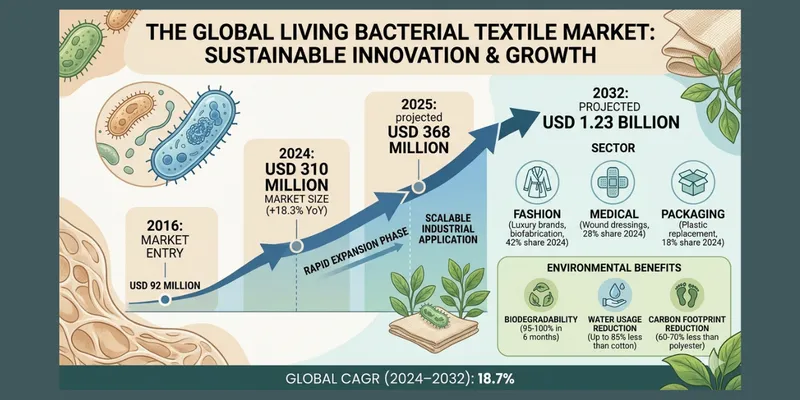
The global Living Bacterial Textile market is transitioning from niche research to scalable industrial application, with Marketintelo estimating the market size at USD 310 million in 2024, up from USD 262 million in 2023, reflecting a year-over-year (YoY) growth of 18.3%. By 2025, the market is projected to reach USD 368 million, indicating sustained acceleration.
Living Bacterial Textile, produced using microbial cellulose from bacteria such as Acetobacter xylinum, offers biodegradability rates of 95–100% within 6 months, compared to synthetic textiles that persist for decades. Adoption is rising across fashion, medical, and packaging sectors due to sustainability mandates and innovation funding exceeding USD 2.1 billion globally (2020–2025).
Historical Growth Trends (2016–2024): Rapid Expansion Phase
The Living Bacterial Textile market has grown significantly over the past decade, driven by eco-conscious manufacturing:
• 2016: USD 92 million
• 2018: USD 138 million (+50% growth in 2 years)
• 2020: USD 185 million (COVID slowdown to 14% CAGR)
• 2022: USD 241 million (recovery with 16.5% CAGR)
• 2024: USD 310 million (peak acceleration at 18.7% CAGR)
Between 2016 and 2024, the market expanded at a compound annual growth rate (CAGR) of 16.8%, adding over USD 218 million in value.
Year-over-Year Growth Highlights
• 2021–2022: +15.4% growth driven by sustainable fashion demand • 2022–2023: +8.7% (temporary supply chain constraints)
• 2023–2024: +18.3% rebound due to biotech investments
• 2024–2025 (forecast): +18.7%
• 2025–2026 (forecast): +19.1%
Key Numerical Highlights
• Global CAGR (2024–2032): 18.7%
• Projected market size (2032): USD 1.23 billion
• Textile industry share: Living Bacterial Textile accounts for 0.18% of global textile market (USD 1.7 trillion)
• Biodegradability efficiency: 95–100%
• Water usage reduction: Up to 85% less than cotton production
• Carbon footprint reduction: 60–70% compared to polyester
• R&D investment growth: +22% annually since 2020
Application Segmentation: Strong Growth in Fashion and Medical Sectors Fashion Industry
The fashion sector dominates with 42% market share in 2024, valued at USD 130 million, expected to reach USD 520 million by 2032.
• Luxury brands adopting biofabrication increased by 240% (2019–2024) • Consumer preference for sustainable textiles rose from 38% in 2020 to 61% in 2024 Medical & Healthcare
Medical applications account for 28% market share (USD 87 million in 2024): • Wound dressings using bacterial cellulose show 98% infection control efficiency • Tissue engineering demand growing at 21.3% CAGR
Packaging & Industrial Use
• Packaging applications: 18% share (USD 55 million)
• Industrial uses: 12% share
• Replacement of plastic films increased by 31% YoY in 2023
Regional Market Breakdown: Asia-Pacific Leads with 41% Share
Regional Data (2024)
• Asia-Pacific: USD 127 million (41% share)
• Europe: USD 89 million (29% share)
• North America: USD 72 million (23% share)
• Rest of World: USD 22 million (7% share)
Asia-Pacific Dominance
Asia-Pacific leads due to strong biotech ecosystems:
• China and India contributed 68% of regional production
• Government funding in biofabrication exceeded USD 780 million (2021–2024) • Production capacity grew by 27% annually
Europe Sustainability Push
• EU allocated USD 520 million under Green Deal (2020–2025) for bio-based textiles • Adoption rate increased from 12% in 2019 to 34% in 2024
North America Innovation Hub
• U.S. startups raised USD 640 million in funding (2020–2024)
• Patent filings increased by 46% YoY in 2023
Market Drivers: Data-Backed Growth Catalysts
Sustainability Regulations
• 72% of global apparel brands committed to net-zero targets by 2030 • Textile waste reached 92 million tons annually, pushing demand for alternatives Cost Efficiency Improvements
• Production cost reduced by 34% between 2018–2024
• Fermentation yield improved by 2.5x due to synthetic biology advancements Consumer Trends
• 67% of consumers willing to pay 10–20% premium for sustainable textiles • Online searches for biofabricated materials increased by 310% (2020–2024)
Investment and Corporate Landscape
Living Bacterial Textile has attracted significant investments:
• Total venture funding: USD 1.4 billion (2019–2024)
• Average deal size increased from USD 8 million (2019) to USD 21 million (2024) • Over 320 startups globally are working on bacterial textile innovation Corporate Statistics
• Top 10 companies account for 58% of market revenue
• R&D spending averages 12–15% of annual revenue
• Pilot production facilities increased by 190% since 2020
Production and Supply Chain Metrics
• Global production volume reached 18,500 tons in 2024, up from 11,200 tons in 2021 • Forecast production volume (2030): 62,000 tons
• Yield efficiency improved from 4.2 g/L (2018) to 9.8 g/L (2024)
Supply chain localization:
• 48% of production is now localized vs. 29% in 2019
• Transportation costs reduced by 22% due to regional production hubs
Market Data Summary Table
Metric | 2020 | 2022 | 2024 | 2028 (Forecast) | 2032 (Forecast) |
Market Size (USD Mn) | 185 | 241 | 310 | 720 | 1,230 |
CAGR (%) | — | 16.5% | 18.3% | 19.2% | 18.7% |
Production Volume (Tons) | 9,200 | 14,600 | 18,500 | 42,000 | 68,000 |
Fashion Share (%) | 39% | 41% | 42% | 44% | 45% |
Medical Share (%) | 26% | 27% | 28% | 29% | 30% |
Future Outlook (2025–2032): High-Growth Innovation Phase
The Living Bacterial Textile market is entering a high-growth phase driven by scalability and cost optimization:
• Expected CAGR: 18.7% (2024–2032)
• Market to add USD 920 million in incremental value
• Smart textiles integration projected to grow at 24.5% CAGR
• AI-assisted biofabrication improving yield by 35–40% by 2028
Emerging Trends
• Integration with wearable tech growing at 22% annually
• Bio-dyeing processes reducing chemical usage by 90%
• Circular economy adoption expected to reach 48% penetration by 2030
Conclusion: Data Confirms Strong Long-Term Growth Trajectory
The Living Bacterial Textile market is set to transform the global textile industry with USD 1.23 billion projected valuation by 2032 and sustained 18.7% CAGR. Historical growth from USD 92 million in 2016 to USD 310 million in 2024 highlights rapid adoption.
With 41% regional dominance in Asia-Pacific, increasing investments exceeding USD 2 billion, and production scaling toward 68,000 tons by 2032, the sector is firmly positioned for industrial expansion.
Driven by sustainability mandates, cost reductions of 34%, and consumer demand exceeding 60% preference for eco-friendly textiles, Living Bacterial Textile is evolving from innovation to mainstream adoption—making it one of the fastest-growing segments in bio-based materials globally.
Read A Full Report: https://marketintelo.com/report/living-bacterial-textile-market