Liberty in the Footprints of History: Conceptual Persian Rug Explores Freedom Through 72 Languages
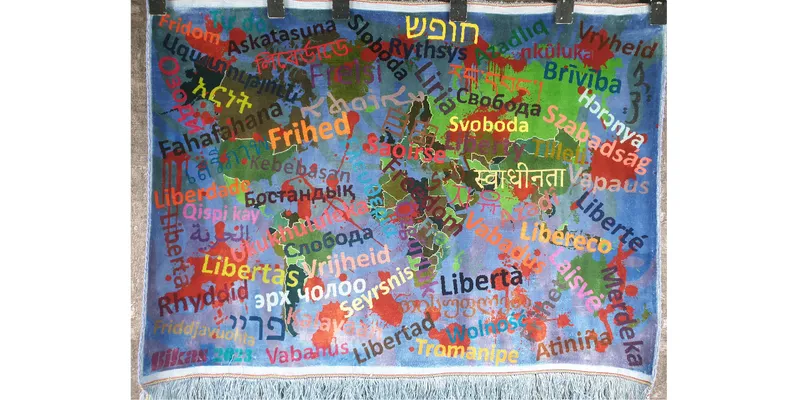
A world map, 72 languages and contrasting colours bring together ideas of freedom, geography, diversity and sacrifice in a handmade Persian rug by Daniel Bikas.
“Liberty” is a conceptual Persian rug that examines the idea of freedom through language, geography, colour and traditional craftsmanship. Created by Australian–Iranian conceptual Persian rug artist Daniel Bikas, the work places the word “Liberty” in 72 languages over a detailed world map, combining contemporary philosophical themes with the visual language of Persian rug making.
The Philosophy of Liberty
Liberty has been examined across philosophy, law, politics, literature, art and everyday life, with its meaning varying according to individual and social circumstances. It can refer to freedom of thought, expression, movement, belief, choice or political participation, while also being associated with individual autonomy, collective self-determination and social justice.
The question of what it means to be free extends beyond physical restrictions. Individuals may face limitations arising from poverty, discrimination, fear, social expectations, political structures or circumstances outside their control. At the same time, societies can establish forms of collective order that restrict certain individual actions in an effort to protect other freedoms.
The concept of liberty has consequently been examined through the relationship between individual choice and collective responsibility, freedom and law, and personal autonomy and the conditions required for people to exercise meaningful choices.
Geography is another element in how freedom is experienced. People live within countries, cultures, institutions, families, communities and historical circumstances, and the opportunities available to individuals can vary considerably. Geography can therefore influence the boundaries within which individual lives develop.
Yet ideas surrounding liberty have also crossed geographical and linguistic boundaries. Different civilizations have developed concepts relating to freedom, dignity, justice, autonomy and self-determination. Although the vocabulary differs, recurring human concerns connect these ideas.
The history of liberty also includes the question of sacrifice. Struggles involving independence, civil rights, political reform, self-determination and other forms of freedom have at times involved imprisonment, violence, displacement and death. Other movements for social and political change have used peaceful resistance, civil disobedience, dialogue, organization and cultural expression.
This history encompasses both conflict and peaceful efforts to change the conditions under which people live. These complexities also provide a subject for artistic expression, where different ideas can be presented together without requiring a single definition or conclusion.
Liberty Woven Into a Persian Rug
The medium of the work is significant to its concept. The Persian rug has traditionally been associated with intricate craftsmanship, symbolism, patience, storytelling and generations of accumulated technical knowledge.
“Liberty” brings a contemporary global concept into this traditional medium. Rather than simply illustrating an idea on a surface, the concept is incorporated into the physical construction of the rug through colours, symbols, languages and material techniques.
The work brings together questions surrounding individual and society, freedom and responsibility, aspiration and sacrifice, diversity and commonality, as well as the relationship between humanity’s imagined ideals and the circumstances in which people actually live.
The Elements of the Rug
At the centre of the composition is the word “Liberty” written in 72 different languages. Each linguistic version is woven in a different colour, creating a varied visual arrangement while retaining the same underlying meaning.
A detailed world map appears behind the languages. Countries are carefully delineated, establishing a recognizable geographical structure within the decorative framework of Persian rug making.
The countries are represented in different shades of green. The green palette creates visual continuity across the map while suggesting life, growth, nature and renewal.
Deep-red abstract marks resembling splashes of blood appear across the green landscape. These forms represent bloodshed and sacrifice associated with historical struggles for freedom, without identifying a particular conflict or nation.
The contrast between green and red forms a central visual element of the rug, placing life alongside loss and growth alongside sacrifice.
The 72 coloured languages, world map, green geographical landscape and red interruptions are combined using traditional techniques of a Persian handmade rug.
The resulting composition brings together typography, cartography, colour, symbolism and craftsmanship, using a traditional medium to address a contemporary global subject.
“Liberty” is a conceptual Persian rug created by Daniel Bikas, an Australian–Iranian conceptual Persian rug artist whose work explores contemporary cultural, philosophical, social, and global themes through the language of Persian rug art.