Lenzing Introduces Three-Tier Cellulosic Fiber Portfolio for Protective Wear
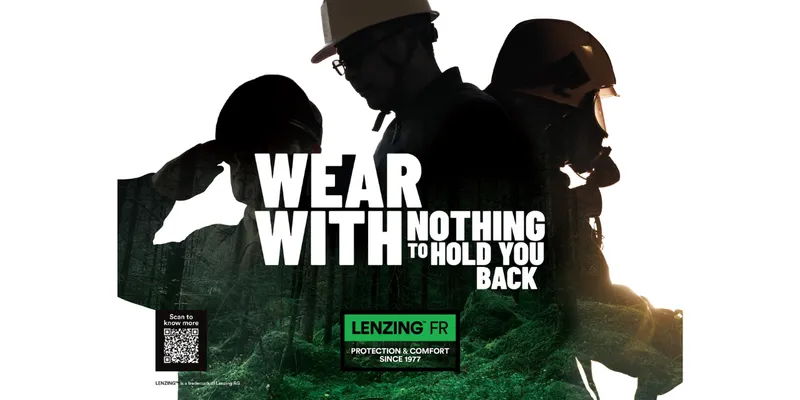
The Lenzing Group has announced the introduction of Lenzing Solutions for Protective Wear, a three-tier portfolio of regenerated cellulosic fibers aimed at addressing varying protection requirements across industries. The system is structured around LENZING™ FR fibers for inherent flame resistance and incorporates TENCEL™ Lyocell fibers to enable hybrid and FR-finished fabric solutions.
Both LENZING™ FR and TENCEL™ Lyocell fibers are EU Ecolabel-certified² and derived from certified or controlled wood sources³. The company stated that this marks the most significant expansion of its protective wear segment since the development of inherently flame-resistant cellulosic fibers in 1977. The launch aligns with projections indicating that the global personal protective equipment (PPE) market could reach USD 130 billion by 2033⁴.
The portfolio was first introduced at CIOSH Shanghai (7–9 April). Kevin Sun, Commercial Manager of FR China team, stated, “CIOSH brings together over 90% of the Chinese industry partners for FR. We took this opportunity to engage in many productive exchanges with our partners, enhancing confidence and trust under the complex geopolitical situation. At this event, we debuted our refreshed brand image in China for the first time. Customers generally commented that our new design is clear and elegant, creating a strong visual impact, while the new slogan conveys a strong sense of security.”
-800x534.webp?2026-04-14T07:06:54.915Z)
The portfolio will be presented in Europe at Techtextil Frankfurt (21–24 April) at Hall 12.1 / Stand D33.
Lenzing’s system is designed to address varying levels of risk across applications such as firefighting, welding, and industrial operations. The company states that no single protective solution can meet all requirements, and the system is structured to support application-specific performance, including protection, comfort, mobility, and heat stress management.
LENZING™ FR fibers form the inherent protection tier and are blended with aramid to deliver built-in flame resistance that does not diminish over time or with washing. These fibers are produced using the Modal process and demonstrate over 70 percent higher wet tenacity compared to conventional FR viscose⁵. They are commonly specified for protective clothing meeting ISO⁶ standards and certified under OEKO-TEX® STANDARD 100⁷.
The hybrid tier combines TENCEL™ Lyocell – A100 fibers with modacrylic, offering flame-resistant textile solutions with a non-fibrillating surface and high-visibility colour capability. The FR-finished tier uses TENCEL™ Lyocell Standard fibers treated with flame-resistant finishing technology, targeting cost-sensitive applications in steel, welding, and metal industries, while maintaining lower water consumption compared to conventional cotton⁸.
The inherent tier is intended for high-risk environments such as firefighting, military operations, and utilities. Hybrid solutions are positioned for oil and gas, industrial, and high-visibility uses, while FR-finished options are designed for heavy industry applications.
Independent testing conducted at 35°C showed that garments incorporating LENZING™ FR fibers blended with aramid resulted in a 29 percent lower increase in core body temperature compared to FR-treated cotton (0.75°C vs 1.05°C), and also outperformed 100 percent aramid and modacrylic-cotton blends. Test participants wearing garments with more than 50 percent LENZING™ FR fiber content sustained physical performance longer under defined conditions¹.
Additionally, dope-dyed LENZING™ FR fibers eliminate separate dyeing processes, enabling up to 50 percent reductions in energy and water use and up to 60 percent lower carbon footprint compared to conventional dyeing methods⁹.
Alexander Gstettner, Global Commercial Director, FR fibers at Lenzing, stated, “For too long, the protective wear industry has relied on a one-size-fits-all fiber approach, yet a structural firefighter and a welding technician face fundamentally different risks. With PFAS regulations accelerating and workers operating in increasingly demanding thermal environments, we see a clear need for a more structured approach. Lenzing Solutions for Protective Wear brings together nearly five decades of flame resistance expertise with three distinct cellulosic fiber tiers; each proven in its category, all backed by credentials² ³ ⁶ ⁷ ⁸ and established trust in the industry.”
The portfolio is supported by European patent No. 2473657 B1, covering high-performance FR fiber technology and its application in yarn and fabric production.
Lenzing Solutions for Protective Wear will be showcased at Techtextil Frankfurt from 21–24 April 2026, with additional product information and application support available via Lenzing Pro (LenzingPro.com).
Full credentials¹⁰: CDP Triple “A” – 4th consecutive year, one of only 23 companies worldwide (2025); EcoVadis Platinum (top 1%); Canopy Dark Green Shirt; SBTi; USDA Certified Biobased (100%); ZDHC; ISO 9001/14001/45001
Traceability: Lenzing Fiber Identification technology for supply chain authenticity
¹ Physiological performance study: 18 volunteers tested four material combinations (LENZING™ FR/aramid blend, FR-treated cotton, 100% aramid, modacrylic/cotton) at 35°C under standardised work-load protocol. Measured parameters: core body temperature, skin temperature, lactate concentration, heart rate.
² EU Ecolabel for textile products (licence no. AT/016/001).
³ Lenzing procures wood and pulp only from certified or controlled sustainable sources. In its Wood and Pulp Policy, Lenzing is committed to procuring wood and pulp exclusively from non-controversial sources.
⁴ Global PPE market projection: Fortune Business Insights, 2025.
⁵ Wet tenacity: LENZING™ FR 14.5 cN/tex vs conventional FR viscose 8.5 cN/tex (wet). Source: Lenzing product data.
⁶ LENZING™ FR and TENCEL™ fiber production is certified under leading international standards: ISO 9001:2015 (Quality management), ISO 14001:2015 (Environmental management), and ISO 45001:2018 (Occupational health & safety).
⁷ LENZING™ FR and TENCEL™ fibers have been certified as harmless to human health, having passed tests for numerous regulated and nonregulated harmful substances under OEKO-TEX® STANDARD 100.
⁸ LENZING™ Lyocell and Modal fibers are made with at least 50 percent less carbon emissions and water consumption, compared to generic (unbranded) lyocell and modal. The results were calculated according to LCA standards (ISO 14040/44) and are made available via the Higg Materials Sustainability Index (MSI) v3.11 (November 2025).
⁹ Results based on “Terinte et al., 2014: Terinte, N., Manda, B.M.K., Taylor, J., Schuster, K.C., and Patel, M. (2014). Environmental assessment of coloured fabrics and opportunities for value creation: spin-dyeing versus conventional dyeing. Journal of Cleaner Production, Vol. 72: 127–138.”; Textile processing steps being similar for Modal and Viscose, therefore savings are based on calculations of fabric production and dyeing via jet dyeing excl. fiber impact.