Laundry Chemicals Market Projected to Reach USD 22.08 Billion by 2034
Market Expected to Expand at 5.97% CAGR as Sustainable Formulations, Automation and Efficiency Gain Importance
Laundry chemicals are increasingly being influenced by changes in formulation performance, sustainability, automation and resource efficiency. While the category has traditionally operated as a high-volume market, these factors are becoming increasingly relevant to manufacturers and users.
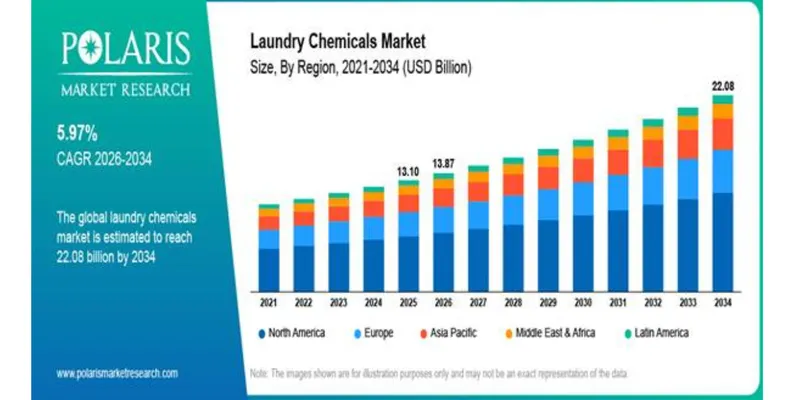
According to Polaris Market Research, the global Laundry Chemicals Market was valued at USD 13.10 billion in 2025 and is expected to reach USD 22.08 billion by 2034. The market is projected to expand at a 5.97% CAGR between 2026 and 2034.
North America was the leading regional market in 2025, holding approximately 39.46% of the global share. Sustainable and biodegradable laundry chemicals are expected to be the fastest-growing product segment, with a CAGR of nearly 8.94%.
Market Moving from Volume to Value
The focus within laundry chemistry is increasingly shifting towards formulations that provide cleaning performance while requiring lower water consumption, reduced chemical volumes, less packaging and fewer resources.
Detergents continued to represent the largest product category in 2025, accounting for nearly 47.82% of market share. Within this category, concentrated and enzyme-based formulations are gaining relevance because of their ability to support stain removal and more efficient washing processes.
This development creates opportunities for chemical manufacturers to link product value with measurable efficiency. For commercial laundries, hotels, hospitals and industrial users, formulations that lower dosing requirements or reduce washing cycles can contribute to operating savings.
Sustainability Gains Importance
Environmental requirements are also influencing the development of laundry chemical formulations. Regulations related to wastewater discharge, surfactants and phosphates are encouraging manufacturers to review conventional formulations.
At the same time, ESG-focused procurement is increasing interest among institutional buyers in biodegradable and environmentally compliant products. Sustainable and biodegradable laundry chemicals are consequently positioned as the fastest-growing product segment.
Product development opportunities include plant-based inputs, phosphate-free formulations, concentrated products, reduced packaging and lower-water cleaning solutions. Sustainability can therefore influence both formulation development and market positioning in the laundry chemicals sector.
Commercial Laundry Represents a Major Market Segment
Commercial laundry accounted for approximately 43.18% of the market in 2025. Growth in this segment has been supported by increasing outsourcing across hospitality, healthcare, restaurants and industrial facilities.
Commercial customers have purchasing requirements that include consistent cleaning results, textile protection, hygiene standards, dosing accuracy, operating costs and throughput.
These requirements create opportunities for integrated chemical solutions rather than standalone detergent products. Suppliers can combine concentrated formulations with automated dosing, monitoring and laundry-management systems.
Such integrated approaches can create recurring revenue opportunities while strengthening relationships between suppliers and commercial laundry customers.
Automation Could Influence Chemical Consumption
The integration of laundry chemicals with automation represents another area of development. Automated dosing equipment, IoT-enabled dispensing systems and AI-based laundry management can adjust chemical usage according to load size, fabric type, soil level and washing conditions.
Polaris Market Research identifies smart laundry automation as an emerging opportunity because these systems can reduce detergent waste and improve water efficiency.
For chemical manufacturers, this could shift the focus from supplying chemicals alone towards systems that also control chemical application. Companies combining formulations with digital dosing and monitoring technologies can address the requirements of institutional markets.
Regional Market Developments
North America continues to represent the largest regional market, supported by commercial laundry infrastructure and institutional hygiene standards. The region’s adoption of concentrated detergents, sustainability-focused products and automated laundry systems reflects the development of higher-value chemical solutions.
In Europe, sustainability requirements are influencing the market. Regulatory considerations related to phosphates, surfactants, wastewater and environmental performance are supporting the movement towards biodegradable and lower-impact formulations.
Asia Pacific is projected to register the fastest growth. Urbanization, rising disposable income, expanding hospitality and healthcare infrastructure and increasing industrial activity are supporting market development in the region.
For chemical manufacturers, the growth outlook in Asia Pacific creates opportunities related to capacity expansion, localized formulation and distribution investments.
Future Outlook
The future development of the Laundry Chemicals Market is expected to involve greater integration between chemistry and technology. Sustainable formulations are expected to continue gaining relevance, while automation can influence the way laundry products are dosed, monitored and purchased.
Raw-material price volatility remains a challenge for manufacturers because several laundry chemical inputs are exposed to petrochemical, energy, transportation and supply-chain fluctuations. Formulation efficiency and supply-chain resilience are therefore important considerations for profitability.
The market is moving beyond conventional detergent supply towards integrated cleaning solutions that address environmental and operational requirements.
Conclusion
The Laundry Chemicals Market is developing from a volume-driven chemicals category towards an industry increasingly influenced by technology, sustainability and resource efficiency.
The market’s projected growth from USD 13.10 billion in 2025 to USD 22.08 billion by 2034 reflects continued demand for laundry chemicals alongside changing requirements for product performance, environmental compliance and operational efficiency.
Manufacturers that combine high-performance chemistry with sustainable formulation, smart automation and resource efficiency will be positioned to address the changing requirements of the market.