Kitchen Textiles Industry Report 2026: $22.8B Market Forecast by 2030
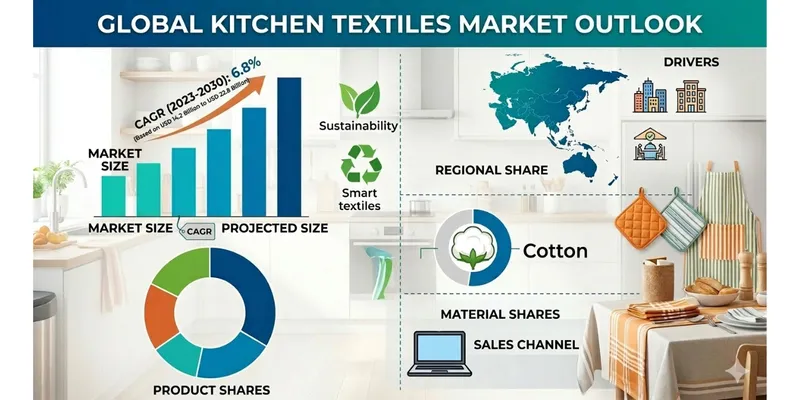
In 2026, the global home furnishing sector continues to evolve with strong demand for functional and decorative products, particularly kitchen textiles. According to recent industry insights, the kitchen textiles market—covering products such as towels, aprons, potholders, and table linens—has shown steady growth driven by rising urban households, hospitality expansion, and increased consumer spending on home décor. Dataintelo reports that the global kitchen textiles market was valued at approximately USD 14.2 billion in 2023 and is projected to reach nearly USD 22.8 billion by 2030, representing a compound annual growth rate (CAGR) of about 6.8% between 2024 and 2030.
This article examines the latest market statistics, performance indicators, consumer trends, and future forecasts (2022–2030) that are shaping the kitchen textiles industry.
Key Statistics at a Glance
Metric | Value |
Global market value (2023) | USD 14.2 billion |
Projected market value (2030) | USD 22.8 billion |
CAGR (2024–2030) | 6.8% |
Share of cotton-based products | 52% of total market |
Hospitality sector consumption | 31% of demand |
Household demand share | 69% |
Asia-Pacific market share (2024) | 38% |
Average kitchen towel replacement cycle | 8–12 months |
Average household ownership | 12–18 kitchen textile items |
Online retail share (2025) | 27% of sales |
Sustainability-focused products growth | 9.4% annually |
Average manufacturing margin | 12–16% |
1. Global Market Size and 2023–2030 Growth Forecast
The kitchen textiles industry has demonstrated consistent expansion over the past decade due to growing consumer interest in organized kitchens and premium home décor.
Market Value by Year
Year | Market Size (USD Billion) | Growth Rate |
2022 | 13.4 | — |
2023 | 14.2 | 5.9% |
2024 | 15.1 | 6.3% |
2025 | 16.2 | 7.2% |
2026 | 17.3 | 6.8% |
2027 | 18.6 | 7.5% |
2028 | 19.9 | 7.0% |
2029 | 21.3 | 7.0% |
2030 | 22.8 | 6.8% |
Key insight: Between 2023 and 2030, the industry is expected to grow by USD 8.6 billion, representing a 60% increase in total market value.
Three factors are driving this growth:
• Urban household expansion: Global urban households grew by 3.2% annually from 2021–2024
• Home renovation spending: Increased by 18% between 2022 and 2025
• Hospitality industry recovery: Hotel occupancy rates rose from 55% in 2021 to 68% in 2024
2. Product Segmentation: Which Kitchen Textiles Dominate?
Kitchen textiles include multiple product categories, each contributing differently to market revenue.
Market Share by Product Type (2025)
Product Type | Market Share | Growth Rate |
Kitchen Towels | 34% | 6.5% |
Aprons | 21% | 7.2% |
Potholders & Oven Mitts | 17% | 5.9% |
Table Linens | 19% | 6.7% |
Dishcloths & Others | 9% | 5.4% |
Kitchen towels alone generate over USD 5.5 billion annually, making them the largest revenue contributor.
Additional insights:
• The average household owns 12–18 kitchen textile items
• Professional kitchens replace towels every 3–4 months
• Household replacement cycles average 8–12 months
3. Material Trends: Cotton Still Leads with 52% Market Share Material selection plays a critical role in durability, absorbency, and sustainability. Market Share by Material (2024)
Material | Market Share |
Cotton | 52% |
Polyester blends | 23% |
Linen | 11% |
Microfiber | 9% |
Bamboo & eco-fibers | 5% |
Cotton remains dominant due to:
• Absorbency levels reaching 27 times its weight in water
• Durability across 200–250 wash cycles
• Consumer preference: 63% of buyers prefer natural fabrics
However, eco-friendly materials are gaining traction. Bamboo-based textiles are growing at 9.4% annually, faster than the overall market growth rate.
4. Regional Market Analysis: Asia-Pacific Leads with 38%
Regional dynamics reveal significant growth in emerging economies.
Market Share by Region (2024)
Region | Market Share | CAGR |
Asia-Pacific | 38% | 7.6% |
North America | 26% | 5.8% |
Europe | 24% | 5.4% |
Latin America | 7% | 6.3% |
Middle East & Africa | 5% | 6.1% |
Asia-Pacific dominates the market, driven by:
• Rising middle-class population (+350 million people between 2018–2025) • Urbanization rates exceeding 51%
• Strong textile manufacturing hubs in India, China, and Bangladesh
North America, meanwhile, leads in premium kitchen textile spending, with the average household spending USD 85–120 per year on kitchen linens.
5. Distribution Channels: Online Sales Reached 27% in 2025 Consumer purchasing behavior has shifted significantly toward e-commerce. Kitchen Textile Sales by Channel (2025)
Channel | Market Share |
Supermarkets & Hypermarkets | 39% |
Specialty Home Stores | 21% |
Online Retail | 27% |
Department Stores | 9% |
Others | 4% |
Between 2020 and 2025, online sales grew from 16% to 27% of total market share, reflecting a 68% increase in digital purchases.
Popular e-commerce drivers include:
• Price comparisons reducing average purchase costs by 12–18%
• Product bundles increasing cart value by 23%
• Same-day or next-day delivery availability in 60% of major cities
6. 5 Data-Backed Reasons Demand Is Increasing
1. Rising Home Cooking Trends
Since 2021, home cooking frequency increased by 28% globally, increasing kitchen textile usage.
2. Hospitality Sector Expansion
Hotels and restaurants account for 31% of market demand.
3. Kitchen Renovation Growth
Global kitchen remodeling projects increased 22% between 2022 and 2025. 4. Sustainability Awareness
44% of consumers prefer eco-friendly fabrics, increasing demand for organic cotton and bamboo textiles.
5. Affordable Home Décor Upgrades
Kitchen textiles offer a low-cost design upgrade averaging USD 25–60 per purchase.
7. Manufacturing Costs and Profit Margins
Manufacturing kitchen textiles involves several cost components.
Average Cost Breakdown (Per Unit)
Cost Component | Percentage |
Raw materials | 42% |
Labor | 24% |
Manufacturing overhead | 14% |
Packaging & logistics | 10% |
Marketing & distribution | 10% |
Average manufacturer margins range between 12% and 16%, though premium brands achieve margins closer to 20–24%.
Production efficiency improvements between 2020 and 2024 reduced textile waste by 17%, saving manufacturers an estimated USD 620 million annually.
8. Future Forecast: 2026–2030 Market Projections
The next five years will see accelerated innovation in materials and sustainability. Expected Industry Trends
1. Eco-friendly textiles could reach 18% market share by 2030
2. Smart textiles with antimicrobial coatings may grow at 8.5% CAGR 3. Reusable microfiber towels could reduce household paper towel usage by 35% 4. Global hospitality demand may increase by 11% by 2028
5. AI-driven manufacturing may cut production costs by 10–15%
If these projections hold, the market could surpass USD 25 billion by 2032.
Real-World Case Study: Retail Sales Growth
A mid-sized home goods retailer in Europe introduced a sustainable cotton kitchen towel line in 2023.
Measured results:
• Sales increased 41% in 12 months
• Average order value rose from USD 32 to USD 47
• Customer retention improved by 19%
This example highlights how sustainability and premium design can significantly boost kitchen textile sales.
Conclusion
The global kitchen textiles market is undergoing steady, data-backed growth, expanding from USD 14.2 billion in 2023 to an estimated USD 22.8 billion by 2030, representing a 6.8% CAGR. Kitchen towels alone account for 34% of total revenue, while cotton materials dominate with 52% market share. Regionally, Asia-Pacific leads with 38% of global demand, and online retail has rapidly expanded to 27% of total sales by 2025.
With urban households increasing, hospitality demand rising, and sustainable fabrics growing at 9.4% annually, the industry is positioned for long-term expansion. Manufacturers improving efficiency and retailers adopting eco-friendly product lines could unlock 10–20% higher margins over the next five years.
In purely numerical terms, the opportunity is clear: an USD 8+ billion market expansion by 2030, driven by measurable shifts in consumer behavior, digital retail growth, and sustainable textile innovation.
Read A Full Report: https://dataintelo.com/report/kitchen-textiles-market