KIRAN SYNTEX LIMITED
1. Introduction
1.1 Brief Introduction of the Company
Kiran Syntex Limited makes polyester dyed yarns. It's listed on BSE and based in Surat. Started as a private company in 1986, went public in 1992.
Products portfolio include:
- Polyester Mono Dyed Yarn
- Polyester Filament Dyed Yarn
- Polyester Air Textured Dyed Yarn
- Polyester Slub Dyed Yarn
- Polyester Space Dyed Yarn
These go mostly to local weavers, garment makers, and exporters in India.
1.2 Industry Overview
The Indian textile and apparel sector is massive, forming 2.3% of GDP, creating 45 million jobs. Surat's the "Textile City," pumping out synthetic fabrics, sarees, dress materials. Polyester yarn demand stays steady for weavers.
But it's cutthroat. Thousands of small factories around Surat fight for business. Hard to raise prices. Crude oil swings hit raw material costs, squeezing margins when buyers won't pay more.
1.3 Purpose of This Analysis
This report checks Kiran Syntex's finances and business over 3-5 years. Look at performance, real challenges, and future paths. Meant for investors or analysts wanting straight facts, not hype.
2. COMPANY OVERVIEW
2.1 Background and History
Kiran Syntex began on October 21, 1986. The plan was to build a dyeing plant for polyester yarn in Mota Borasara, near Surat. They got startup funds from the Gujarat State Finance Corporation (GSFC) and started production in August 1987.
In October 1992, it became a public limited company and listed on the Bombay Stock Exchange. That boosted credibility and let them raise public money. For about 30 years, they zeroed in on dyeing polyester yarn for local textile buyers.
In 2023–24, they cut unprofitable trading activities. Revenue dropped almost to zero for a bit. But management now plans a new dyeing unit to restart manufacturing growth.
2.2 How the Business Works
Kiran Syntex makes and supplies specialized dyed yarns. Their model is simple: buy raw polyester yarn, dye it their way, and sell to weavers and fabric producers. Sales stay mostly in India, with little exporting.
They run their own factory and warehouse. This handles big orders and checks quality. A step-by-step inspection ensures even color, right texture, and strong yarn that fits customer needs.
2.3 Main Products
The company makes yarns tailored to different fabric looks:
- Polyester Mono Dyed Yarn: Single-strand for fine fabrics.
- Polyester Filament Dyed Yarn: Smooth and shiny, mainly for clothes.
- Polyester Air Textured Dyed Yarn: Air jets make it soft like cotton.
- Polyester Slub Dyed Yarn: Uneven thickness for a natural texture.
- Polyester Space Dyed Yarn: Colors change at intervals along the strand.
2.4 Market Position
Kiran Syntex is a small-cap firm with a market value of ₹4–7 crore in early 2026. In Surat's huge textile world, it's one of thousands of small outfits, not a leader. Its edge comes from specialized products and location near local weavers.
It's tiny, though under 25 employees and recent revenues below ₹1 crore. It battles giants like Grasim Industries and Vardhman Textiles. Even against similar small players like Premier Synthetics, competition stays fierce.
3. PROMOTER AND FOUNDER INTRODUCTION
3.1 Promoters and Key Management
The promoter group owns about 46.72% of the total shares. Public shareholders hold the rest, around 53.28%.
The key named promoters and directors on record are:
Name | Designation | Role / Significance |
Mahesh M. Godiwala | Chairman & Managing Director | Principal decision-maker; oversees operations, strategy, and stakeholder relations. |
Ami Godiwala | Promoter | Part of the promoter family holding; involved in governance. |
Dineshkumar D. Patel | Promoter | Holds promoter stake; contributes to governance decisions. |
Manoj D. Patel | Promoter | Promoter shareholder and board participant. |
Daizy Jain | Promoter | Part of the broader promoter group. |
3.2 Professional Background and Role in Company Growth
Mahesh M. Godiwala is Chairman and Managing Director. He handles both board decisions and daily operations. This setup is common in small family-run listed firms in Surat's textile area, where the founder stays deeply involved.
Promoter leadership has guided the company through tough times in synthetic yarns. For example, they recently stopped unprofitable trading to focus on core business. This shows they prioritize quality over quick sales before expanding manufacturing.
No promoter shares are pledged for loans. That's a good sign of no financial stress or risk of share price drops from pledges.
4. FINANCIAL STATEMENT ANALYSIS
Analysis based on standalone statements reported to BSE. Figures in ₹ crore unless noted. The financial year ends in March.
4.1 Income Statement Analysis
Key figures from the last five years:
Particulars | FY21 | FY22 | FY23 | FY24 | FY25 |
|---|---|---|---|---|---|
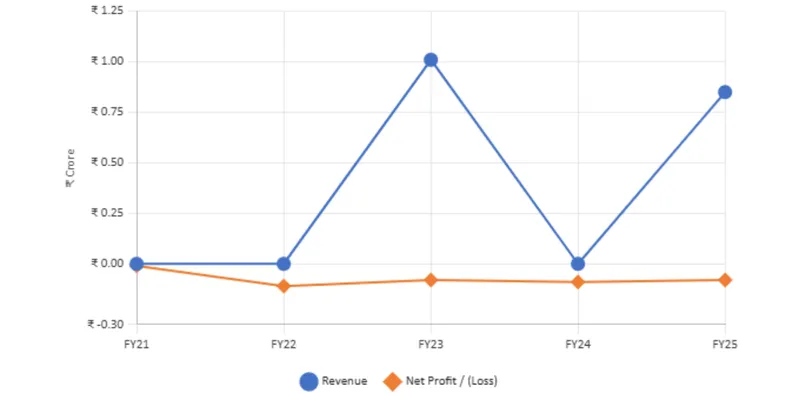
Revenue | 0.00 | 0.00 | 1.01 | 0.00 | 0.85 |
Total Expenses | 0.06 | 0.11 | 1.09 | 0.10 | 0.93 |
Operating Profit | -0.06 | -0.11 | -0.08 | -0.10 | -0.08 |
Net Profit/(Loss) | -0.01 | -0.11 | -0.08 | -0.09 | -0.08 |
EPS (₹) | -0.02 | -0.26 | -0.19 | -0.21 | -0.19 |
Revenue's been all over the place. Almost nothing for two years, then a jump in FY23. FY24 tanked after dropping trading activities. FY25 picked up a bit.
Losses hit every year anyway. Admin costs kept coming even with no sales. That meant negative margins the whole time, tough for a small outfit.
[Figure 1: Revenue vs Net Profit (FY2021–FY2025)]
4.2 Balance Sheet Analysis
Recent three years:
Particulars | FY23 | FY24 | FY25 |
|---|---|---|---|
Total Assets | ~2.30 | ~2.20 | ~2.15 |
Total Liabilities | ~0.25 | ~0.25 | ~0.24 |
Shareholders' Equity | ~2.05 | ~1.95 | ~1.91 |
Book Value per Share (₹) | ~4.82 | ~4.59 | ~4.71 |
Long-Term Debt | Nil | Nil | Nil |
No long-term debt stands out as a plus. Most textile firms lean on loans to cut risk.
Assets stay small. Equity dips from steady losses. Book value around ₹4.71, but market price swings differently. Looks like speculation over solid numbers.
Debtors take 374 days to collect. That's way too long. Cash flow gets squeezed waiting on payments.
4.3 CASH FLOW STATEMENT ANALYSIS
Cash flow position over five years:
Cash Flow Head | FY21 | FY22 | FY23 | FY24 | FY25 |
|---|---|---|---|---|---|
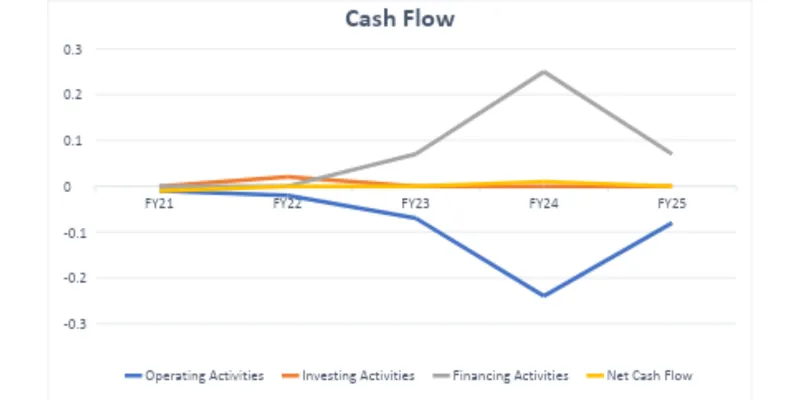
Operating Activities | -0.01 | -0.02 | -0.07 | -0.24 | -0.08 |
Investing Activities | 0.00 | 0.02 | 0.00 | 0.00 | 0.00 |
Financing Activities | 0.00 | 0.00 | 0.07 | 0.25 | 0.07 |
Net Cash Flow | -0.01 | 0.00 | 0.00 | 0.01 | 0.00 |
Operating cash flow stayed negative the whole time. Core operations burn cash instead of making it.
Financing cash comes in some years to cover the gap. That's why net cash flow sits near zero.
FY24 saw the biggest operating loss at -₹0.24 Cr. Happened when trading activities stopped.
[Figure 2: Cash Flow Breakdown (FY2021–FY2025)]
4.4 Key Financial Ratios
Ratio | Value (FY25) | Interpretation |
|---|---|---|
Price-to-Book (P/B) | ~2.0x | Market price beats book value |
Return on Equity (ROE) | -3.96% | Negative from ongoing losses |
Return on Capital Employed (ROCE) | -3.86% | No positive returns on capital |
Debt-to-Equity | ~0 | Almost no debt |
Interest Coverage | Low/Negative | Earnings too weak for interest |
Debtor Days | ~374 days | Takes forever to collect payments |
Operating Profit Margin | Negative | Expenses always top revenue |
Net Profit Margin | Negative | Losses every year |
Ratios paint a weak profitability picture. ROE and ROCE stay negative from constant losses. No debt helps cut risk.
But 374 debtor days is bad news. Slow collections squeeze cash and working capital, especially with negative margins.
4.5 Shareholding Pattern
[Figure: Shareholding Pattern as of December 2025]
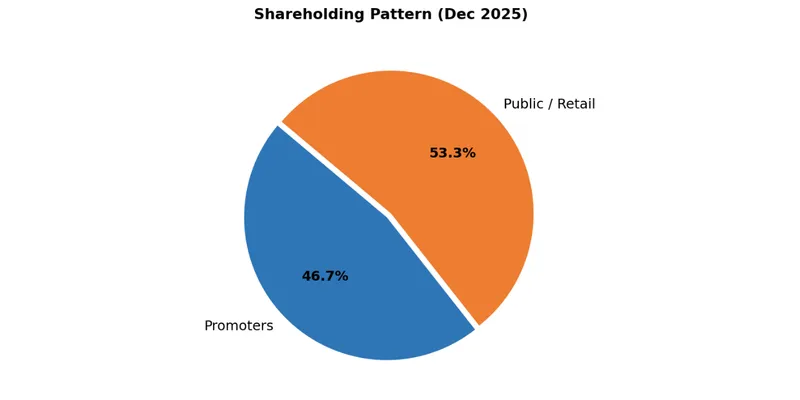
Promoters hold 46.72% of shares. The public owns the rest at 53.28%.
No promoter shares pledged. That's a good stability sign which is no loan pressure on owners.
No real institutional investors. The retail crowd dominates, so volatile prices and speculation are expected.
5. KEY INSIGHTS AND INTERPRETATIONS
5.1 Strengths
- Debt-free balance sheet. No long-term loans means no interest worries or bank pressure—rare in textiles.
- Zero promoter pledging. Owners aren't borrowing against shares, so no forced selling risk.
- Niche focuses on polyester dyed yarn. Steady demand from local weavers if they deliver well.
- Surat location advantage. Right next to customers cuts shipping costs big time.
- Lean setup. Few employees and low fixed costs mean easier breakeven when sales kick in.
5.2 Weaknesses
- Losses every year. Five straight years—no profits, equity keeps shrinking.
- Revenue all over the place. Zero to ₹1 Cr and back. Impossible to predict.
- Debtors at 374 days. Takes over a year to collect—huge cash crunch.
- Tiny scale. Under ₹1 Cr sales, 25 staff. Can't match bigger players' efficiencies.
- No R&D signs. Stuck with basic gear, no new products or tech upgrades.
5.3 Risk Factors
- Small size means big trouble from any hiccup. Losing key staff, raw materials, or one main customer could shut things down.
- Crude oil prices swing wild. Polyester costs follow, and a tiny firm like this can't hedge or bargain much.
- Cutthroat competition in Surat. Tons of micro-makers keep everyone's margins razor-thin.
- Listed company rules are strict. Miss SEBI or BSE filings, and penalties hit hard—easy slip for small ops.
- The new dyeing unit is a gamble. No clear funding or timeline details means high execution risk.
- Stock barely trades. ₹4–7 Cr market cap means tough to buy or sell without big price jumps.
5.4 Future Outlook
The near term looks shaky but with some hope. FY25 revenue hit ₹0.85 Cr, and recent quarters show pickup—₹2.31 Cr in Jun-25, ₹3.95 Cr in Sep-25. Annualized, that could mean ₹9–10 Cr. Huge jump for them.
The new dyeing unit is make-or-break. Modern gear could boost efficiency and margins. The textile sector gets tailwinds from "China+1" shifts—global buyers eyeing India.
Still, no profits yet, slow collections, and thin disclosures keep fundamentals weak. Stock's 92% 1-year gain smells like retail hype, not real progress.
6. CONCLUSION
6.1 Final Evaluation of Financial Health
Kiran Syntex has a real niche in synthetic yarns but struggles hard with revenue. Last decade's been mostly losses, wild sales swings, super slow collections, and tiny scale. Bright spots? Debt-free balance sheet and no promoter pledging—keeps some future options open.
Recent quarters show revenue hope—Q1 FY26 and beyond. If numbers stick and the new dyeing unit actually happens with good funding, profits could come in 2-3 years.
6.2 Investment and Performance Perspective
Pure speculation right now. Stock at 2x book with no profits is hard to justify on numbers alone. Retailers bet on a turnaround that isn't proven yet.
High-risk folks who know small textile turnarounds might watch for new units going live, steady ₹2 Cr+ quarters, better debtor collections. Need two or three before it makes sense.
Conservative or big investors will Skip it as it lacks scale, health, and clear governance.