Kalahridhaan Trendz Limited (KTL)

1. Introduction
Ahmedabad-based KTL operates within a sector that contributes 2.3% to India’s GDP and 13% of its industrial production. As exports are projected to hit US$ 65 billion by FY26, KTL has positioned itself as a specialist in the high-margin embroidery and fabric processing segments. This report evaluates KTL's business model, leadership, and financial trajectory following its high-stakes transition from a private family concern to a public limited entity. To understand KTL’s future, one must first reconcile its aggressive scaling with the inherent volatility of the textile trade.
2. Company Overview
A firm’s corporate lineage often dictates its operational resilience; a rapid transition to public status usually signals either a management team hungry for scale or a strategic need for capital to de-risk highly leveraged operations.
Background and History: Founded as "Kalahridhaan Trendz Private Limited" in May 2016, the company underwent an accelerated conversion to a Public Limited Company by November 2017 (CIN: U17299GJ2016PLC092224). Headquartered in Ahmedabad, KTL’s operational heart lies in its Aradhna Textile Mills unit, a leased facility that provides the bedrock for its dyeing and printing integration.
By integrating embroidery knitting (capacity: 15,000 meters/day) with forward-integrated printing and dyeing, KTL creates a buffer against fashion cycle volatility. However, the decision to remain asset-light by leasing its dyeing unit and registered office—the latter from a promoter-owned partnership, Manish Garments—introduces significant related-party risk and tenure uncertainty that must be weighed against its operational agility. This structural pivot depends entirely on the vision of the individuals at the helm.
3. Promoter / Founder Introduction
Context & Strategic Importance: Vision of the promoter is the key indicator of longevity of the institution in the Indian SME environment. Stability of leadership provides the strategic pivot with a level of depth of knowledge of the market which is lacking in professional managers.
Founder Profiles & Governance:
Niranjan Agarwal, Aditya Agarwal, and Sunitadevi Agarwal are the directors of KTL. Recent increases in revenue have been caused by their shift from a trading-focused mindset to an integrated processing house. Crucially, the business has started to professionalise its governance by appointing independent directors like Ankit Kumar Agrawal and Bharat Kumar Chaudhary.
This move toward a professional board is intended to instill fiduciary rigor and transparency, directly influencing the financial outcomes that define the company’s current valuation.
4. Financial Statements
Summary of Restated Financial Information (₹ in Lacs)
Particulars | Sept 30, 2023 | March 31, 2023 | March 31, 2022 | March 31, 2021 |
Revenue from Operations | 8,427.13 | 18,416.85 | 18,390.14 | 13,235.91 |
Profit After Tax (PAT) | 478.72 | 666.01 | 246.20 | 110.54 |
Basic EPS (₹) | 3.93 | 10.93 | 4.04 | 1.81 |
NAV per Share (₹) | 18.80 | 29.74 | 18.81 | 14.77 |
Total Borrowings | 6,702.43 | 6,105.33 | 5,249.90 | 3,145.56 |
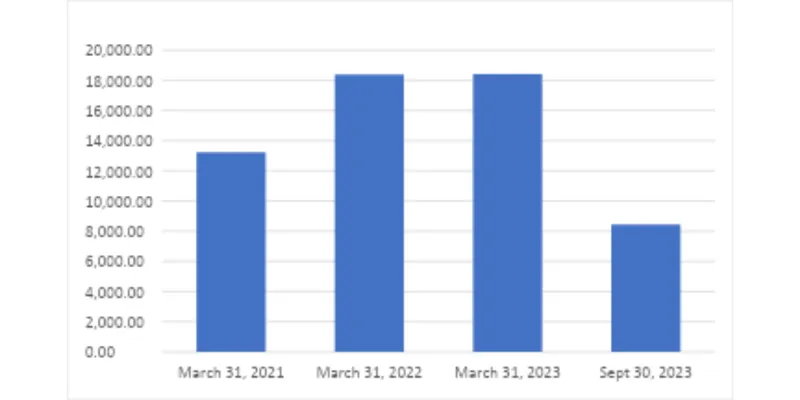
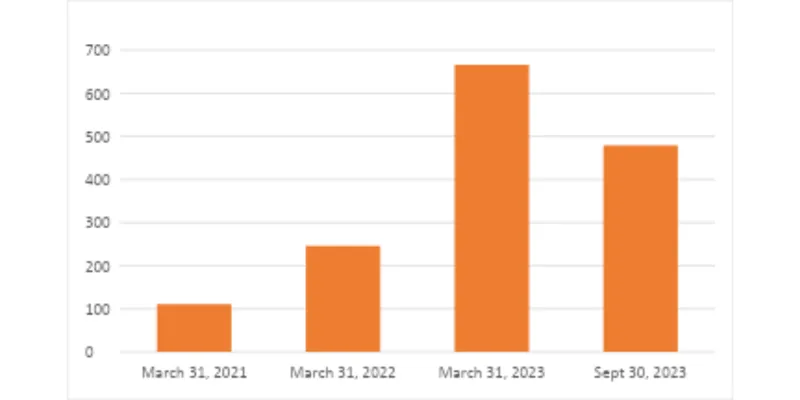
Analysis and Interpretation: Revenue scaled impressively from ₹13,235 Lacs in 2021 to over ₹18,416 Lacs by 2023, while PAT surged nearly six-fold in the same period. However, this growth is heavily debt-fueled, with total borrowings doubling since 2021. Analysts must note the critical liquidity milestone in H1 FY24: KTL generated a positive cash flow from operations of ₹507.31 Lacs, a sharp reversal from the negative ₹68.11 Lacs in FY23. While this signals improved working capital management, the reliance on short-term debt remains high.
5. Insights
Context & Strategic Importance: Beyond the raw data, a SWOT-based interpretation is necessary to identify the "red flags" that quantitative analysis might obscure.
The significant embroidery capacity of KTL is certainly an important element of the business; however, in the case of the "Printed Cloths" segment, there is a very large concern over the level of utilization because in the first half of FY24 there was only 1.62 million meters compared to 32.4 million for FY23. This would indicate that either there has been a large seasonal change or they have lost key job share contracts.
Furthermore, the ₹2,249.10 Lacs IPO is specifically earmarked for Working Capital (₹1,607.00 Lacs) and General Corporate Purposes (₹535.00 Lacs), indicating that the company is currently capital-starved. Dependency on the top-10 customers (66.28% of revenue) further complicates the risk profile.
6. Conclusion
Context & Strategic Relevance: KTL is at a crossroad that will determine its capability to professionalism as to whether it will continue to be a volatile SME or become a solid player in the market.
Final Evaluation: KTL is a "growth-at-risk" story. While revenue and profitability trajectories are robust, the company’s heavy debt, leased infrastructure, and recent drop in capacity utilization for printed cloths demand caution. The successful H1 FY24 pivot to positive operating cash flow is a positive indicator, but the company must prove it can maintain this discipline without the constant infusion of public capital.
Data Source: Excerpts from Prospectus-KTL-Final.pdf (Dated: February 06, 2024).