JDS Banaras Continues Four-Generation Tradition of Banarasi Handloom Weaving Since 1913
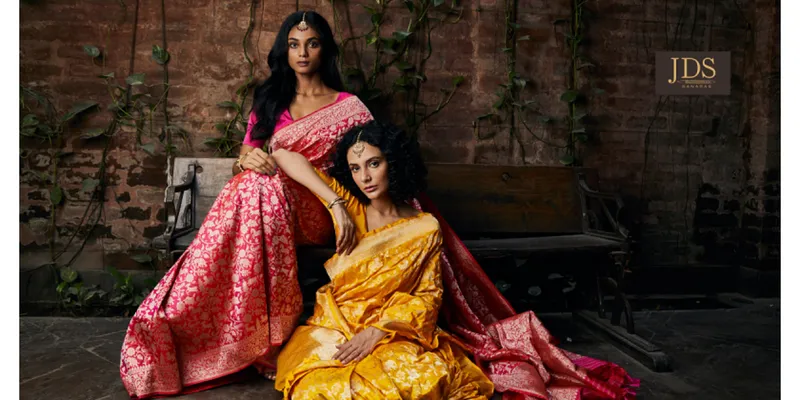
Varanasi-based family business works with more than 3,000 weavers while producing and supplying traditional Banarasi sarees in India and overseas
JDS Banaras, a family-run Banarasi saree business established in 1913, is continuing its four-generation involvement in Banarasi weaving. The Shah family says the business works directly with more than 3,000 weavers and operates across manufacturing, wholesale and retail of Banarasi sarees.
The business was started by the Shah family more than a century ago and has continued under successive generations. According to the company, its operations have remained focused on traditional weaving, quality and direct relationships with weavers, while its retail and online presence has expanded over time.
Four Generations of Family Involvement
The Shah family's association with Banarasi textiles predates the establishment of JDS Banaras in 1913. The business was subsequently developed around the production and sale of handloom and Banarasi sarees.
Rajesh Shah, a fourth-generation member of the family, said the business has focused on maintaining relationships with Varanasi's weaving community across generations.
"Being the best Banarasi saree shop in Varanasi was never about being the biggest — it was about being the most trustworthy," said Rajesh Shah. "Every generation before us worked closely with Varanasi's weavers, and that same relationship is still at the heart of everything we do today."
Rajesh Shah is involved in customer relations and works with weavers, while Viresh Shah oversees business operations and expansion.
Working With More Than 3,000 Weavers
The production of a Banarasi saree involves several stages, including thread preparation, designing, weaving and finishing. JDS Banaras says it works directly with more than 3,000 skilled weavers involved in this process.
The company deals in several traditional Banarasi weaving styles, including Jangala, Shikargah, Meenakari, Brocade, Rangkat, Kadwa and Cutwork. These techniques involve different patterns, colour applications and hand-weaving processes.
The business says its direct engagement with weavers is also intended to support the continuation of traditional Banarasi weaving practices amid the availability of machine-made products marketed as Banarasi sarees.
Manufacturing, Wholesale and Retail Operations
JDS Banaras operates across manufacturing, wholesale and retail, according to the company. It has its own production unit and supplies Banarasi sarees to shops, boutiques, resellers and designers in India and other markets.
Its showroom at Rathyatra Crossing in Varanasi offers Banarasi sarees as well as bridal and Banarasi lehenga collections.
The company's product range includes Katan silk, Tissue silk, Organza, Georgette (Khaddi), Tussar silk, Satin silk, Mashru, Cotton silk and Mooga silk.
Silk Mark Certification for Selected Sarees
With counterfeit and machine-made products also being sold under the Banarasi name, authenticity remains an issue for buyers. JDS Banaras says selected sarees in its collection carry Silk Mark certification, which verifies the authenticity of silk used in the products.
"A Banarasi saree is often passed down from one generation to the next — it's seen as a symbol of love and purity," the brand said. "That's exactly why we believe trust alone isn't enough. Customers should be able to check it for themselves."
Expanding the Banarasi Weaving Legacy Online
Alongside its physical operations, JDS Banaras has also developed an online presence. Its sister brand, Sacred Weaves, was launched online in 2017 to offer Banarasi sarees to customers in India and international markets.
The company says the online business follows the same focus on Banarasi craftsmanship, quality and authenticity while allowing customers who cannot visit Varanasi to access its products.
As the business moves into its second century, the Shah family says it plans to continue combining traditional Banarasi weaving knowledge with contemporary production and retail operations while maintaining its relationship with the weaving community.