Jagjanani Textiles Limited (FY 2024-2025)

- Introduction
In the 2024–2025 fiscal year, the Indian textile sector will be a fundamental pillar of the country's economy, accounting for nearly 14% of all industrial production and 2.9% of GDP. Jagjanani Textiles Limited (JTL) is at a crucial strategic crossroads as the industry negotiates a post-pandemic environment characterised by changing global supply chains and a push toward man-made fibre (MMF) through government incentives. Currently, JTL is less a functioning textile entity and more a corporate shell undergoing a fundamental structural reset. This report evaluates JTL’s financial health and operational transition following a management takeover, assessing whether the new leadership can successfully pivot from a manufacturing past to a viable trading-focused future.
2. Company Overview
To evaluate JTL’s current market standing, one must recognize it as a "startup within an established shell." Historically a Jaipur-based manufacturer, the company has completed a total metamorphosis, abandoning production to focus exclusively on the trading of yarn and fabrics, primarily cotton and polyester-cotton blends.
The company is currently in a "revenue generation" phase post-takeover, having cleared the decks of its previous industrial operations. With a micro-cap valuation of just ₹5.46 crore, JTL exists on the extreme periphery of a sector dominated by giants such as KPR Mill and Vardhman Textiles. However, JTL's current strategy is not one of scale, but of administrative and geographic agility.
The company’s survival now rests less on its historical brand and more on the execution capabilities of the newly formed Board of Directors as they navigate a high-stakes administrative migration.
3. Promoter / Founder Introduction
Leadership is the sole catalyst for JTL’s survival following the "Open Offer" takeover.
Mr. Avanishkumar Manojkumar Patel, Managing Director, and Mr. Shiv Kumar Singhal, Chairman and Whole-Time Director, are leading the transition. Mr. Patel symbolises the new era of leadership following the takeover, while Mr. Singhal, a B.Com. graduate with decades of management and administrative experience, provides the essential continuity.
The proposal made by this team to relocate the Registered Office from Jaipur, Rajasthan, to RoC Ahmedabad, Gujarat, is an important strategic decision.
The need for "cost-effectiveness" and "better accessibility to business opportunities" within India's main textile hub is what motivates this action, which goes beyond simple bureaucracy.
By relocating, management aims to tap into superior professional services and skilled manpower to jumpstart their trading volumes.
The success of this relocation will be the primary indicator of whether the Board can translate geographic proximity into a functional revenue stream.
4. Financial Statement Analysis
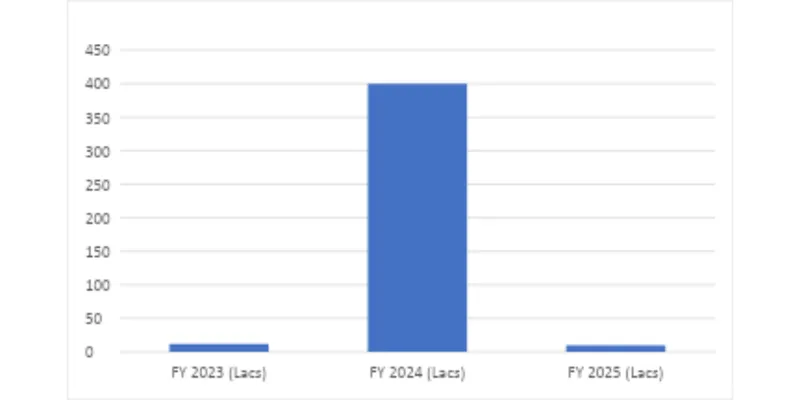
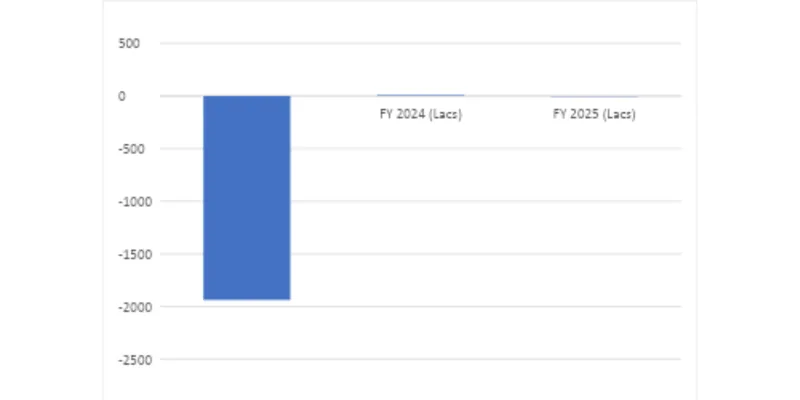
Comparative Financial Data (2023-2025)
Data Point | FY 2025 (Lacs) | FY 2024 (Lacs) | FY 2023 (Lacs) |
Revenue from Operations | 0.00 | 0.00 | 0.00 |
Other Income | 9.65 | 399.68 | 12.00 |
Net Profit / (Loss) | (13.65) | 383.77 | (1.00) |
Total Equity | (5.77) | 7.88 | (1935.89) |
Analysis of Statements
- Income Statement: The company has reported zero operational revenue for three consecutive years. The apparent windfall in 2024 (₹383.77 Lacs profit) was an accounting mirage driven by a "Liability written back" of ₹398.23 Lacs. In FY 2025, the reality of the reset is clearer, with a net loss of ₹13.65 Lacs as other income normalized to ₹9.65 Lacs.
- Balance Sheet: While the "Open Offer" and liability settlements have brought Total Equity closer to a break-even point, the company still faces a staggering Retained Earnings deficit of ₹(2,588.90) Lacs. This mountain of historical losses remains the primary obstacle to a clean valuation.
- Cash Flow: Cash from operations dwindled to ₹8.05 Lacs in 2025 from ₹374.39 Lacs in 2024. Furthermore, the company reported ₹0.00 in finance costs for 2025. While this suggests a lack of immediate debt servicing pressure, it is a double-edged sword; it highlights JTL’s current inability to leverage debt to fund its intended "trading volume" expansion.
- Efficiency Metrics: Stark figures of -233% ROCE and -1400% ROE underscore that the remaining capital is entirely unproductive in its current state.
5. Insights
- Strengths: The primary asset is a cleaned-up balance sheet with significantly reduced debt and a focused management team. Relocating to Gujarat provides a low-cost, high-access base for textile trading.
- Weaknesses: The absence of core revenue is coupled with a lack of institutional leverage. The zero finance cost confirms that the company is currently not utilizing capital markets for growth.
- Risk Factors: High competition and a low promoter holding of 19.86% present significant risks. With so little "skin in the game," the market may remain skeptical of management’s long-term commitment.
- Future Outlook: Management is banking on the Government's Production-linked Incentive (PLI) scheme, specifically targeting MMF (man-made fibre) apparel and fabrics. If JTL can align its trading desk with these incentivized segments during the Diwali and Holi demand cycles, it may finally break its three-year revenue drought.
6. Conclusion
Jagjanani Textiles Limited is currently a "corporate shell" in a gestational state. Its financial health is best described as precarious, evidenced by a massive retained earnings deficit and a total absence of operational income. The recent "Open Offer" takeover is the only factor preventing this entity from becoming a liquidation candidate; it has provided a path forward that the previous structure lacked.
From an analyst’s perspective, JTL is a high-risk turnaround play. Its viability depends entirely on the new management's ability to convert its Gujarat-based administrative reset into actual trading volume during the 2025-26 cycle.
The company continues to be a speculative entity defined by its past losses rather than its future potential until a repeatable, revenue-generating model is proven.
Data Source: Jagjanani Textiles Limited Annual Report 2024-25 and Screener.in Market Data.