ITMF Survey Signals Cautious Improvement in Global Textile Industry Conditions
Business sentiment, orders and capacity utilisation improve in May 2026, while demand and cost pressures continue
The 38th ITMF Global Textile Industry Survey, conducted worldwide during the second half of May 2026, points to an improvement in several key industry indicators compared with the previous survey in March 2026. However, the report notes that the recovery remains limited, with business conditions still weak by historical standards.
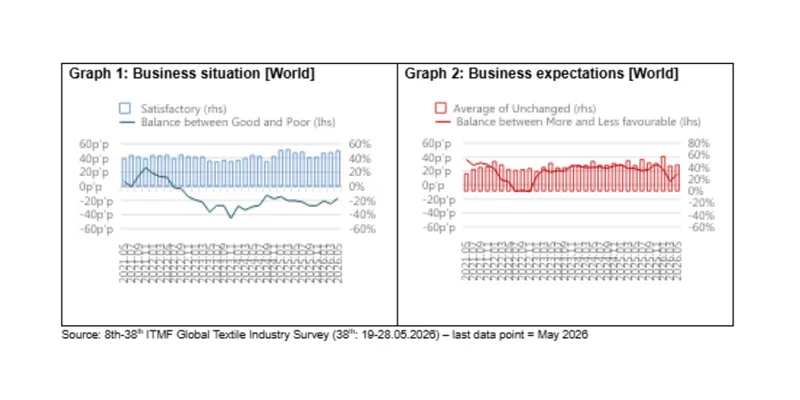
According to the survey, the business situation balance improved to −17 percentage points (pp) from −25pp in March. Business expectations increased to +16pp, up from +5pp, while order intake improved to −9pp from −25pp.
The survey also reported that order backlogs increased to 2.5 months, and capacity utilisation reached 74%. At the same time, order cancellations remained contained, while inventories stayed lean and low.
Regional Performance Varies
The survey found that the recovery differed across regions.
Africa recorded the strongest performance in terms of business situation, order intake, order backlog and business expectations. Improvements were also reported in Europe and North & Central America.
By contrast, Asian production hubs continued to lag behind, with East Asia recording the weakest performance for both current business conditions and the six-month outlook.
Across the textile value chain, businesses operating closer to the end consumer performed relatively better, while capital goods and upstream segments continued to face weaker market conditions.
Demand and Rising Costs Remain Key Challenges
Despite the improvement in several indicators, manufacturers continue to face significant challenges.
According to the survey:
- 53% of participating textile manufacturers identified weak demand as their primary concern.
- 52% cited raw material prices.
- 42% identified energy prices as a major challenge.
- 42% also highlighted geopolitical developments.
The survey states that rising costs have been linked to the war in Iran, which has pushed crude oil prices to around USD 100 and increased gasoline prices by approximately 50% since March. According to the report, these developments have contributed to higher inflation and increased pressure on operating margins.
The survey concludes that whether the improvement recorded in May 2026 can be sustained will depend largely on future energy prices and the resolution of ongoing geopolitical conflicts.