ITMF Releases International Textile Industry Statistics 2024, Reports Lower Global Spinning Capacity
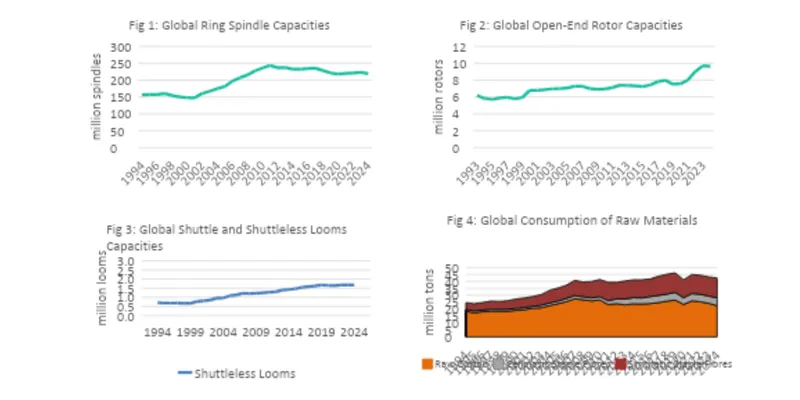
Global short-staple spinning capacity declined in 2024, while air-jet spindle installations continued to grow and shuttle-less loom capacity remained stable.
The International Textile Manufacturers Federation (ITMF) has published International Textile Industry Statistics n°67/2024, presenting updated data on productive capacity and raw material consumption in the global short-staple organized (spinning mill-) sector. The report covers virtually all textile-producing countries and reflects ITMF’s ongoing revision of industry capacity and consumption data.
Full Rewritten Article
The International Textile Manufacturers Federation (ITMF) has released International Textile Industry Statistics (ITIS) n°67/2024, providing updated figures on productive capacity and raw material consumption in the short-staple organized (spinning mill-) sector across virtually all textile-producing countries.
According to ITMF, the organization continues to refine its capacity and consumption time series to better reflect changes in the textile industry's structure. The latest revision includes updated estimates for the year 2024.
The report estimates that the global number of installed short-staple spindles declined to 219 million units, while the number of installed open-end rotors reached 9.6 million, recording a slight decrease compared with 2023.
At the same time, the number of installed air-jet spindles continued to increase, with China remaining the dominant market. ITMF noted that the global trend indicates a gradual shift toward technologies offering higher performance.
Data from the report also shows that the number of installed shuttle-less looms remained broadly stable in 2024, reaching 1.67 million units, representing an increase of 0.3%. Asia and Oceania accounted for 83% of all installed shuttle-less looms worldwide.
The report further states that total raw material consumption in the short-staple organized sector declined slightly to 42 million tons, despite a modest increase in the consumption of cellulosic and synthetic fibres.
Additional details and statistical data are available through ITMF at www.itmf.org.