IPCC 2023 Reveals Costs & Emissions in Textile Production
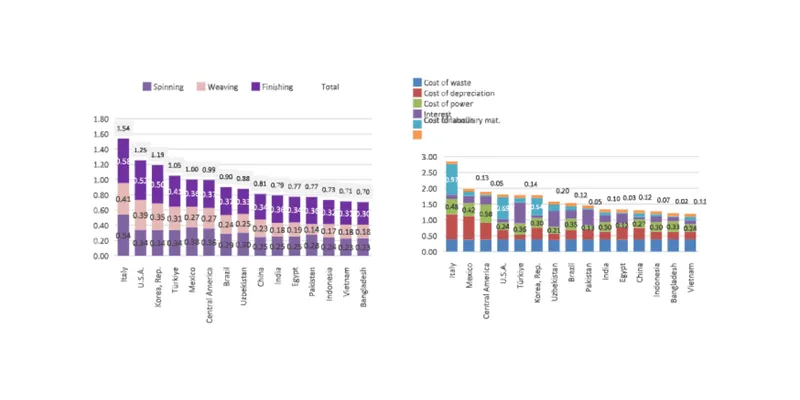
The International Textile Manufacturers Federation (ITMF) has released the latest edition of the International Production Cost Comparison (IPCC), focusing on 2023 data. This comprehensive study benchmarks manufacturing costs across primary textile value chains and breaks down major cost components at each production stage.
Due to the complex nature of the data and the involvement of expert industry input under difficult conditions over the past two years, the report’s development timeline was extended. However, this allowed for deeper analysis, including the inclusion of Uzbekistan and an expanded carbon footprint assessment for all textile products analyzed.
The report continues to offer cost comparisons across spinning, draw texturing, weaving, knitting, and finishing, analyzing cost factors, manufacturing, and total production expenses. For instance, producing one meter of cotton woven fabric in a continuous open width process averaged USD 0.94 in 2023 (excluding raw material), ranging from USD 0.70 in Bangladesh to USD 1.54 in Italy. Spinning yarn contributed USD 0.31/m (Bangladesh: USD 0.23/m, Italy: USD 0.54/m), weaving added USD 0.25/m (Pakistan: USD 0.14/m, Italy: USD 0.41/m), and finishing added USD 0.38/m (Bangladesh: USD 0.30/m, Italy: up to USD 0.58/m).
The spinning cost of NE 30 ring yarn averaged USD 1.63/kg, varying by region—USD 1.19/kg in Vietnam and up to USD 2.85/kg in Italy. Labor costs were highest in Italy (USD 0.97/kg), followed by the US (USD 0.69/kg) and Korea (USD 0.54/kg). At the lower end, labor costs were only USD 0.07/kg in Indonesia, USD 0.03/kg in Egypt, and just USD 0.02/kg in Bangladesh. Energy costs were highest in Central America, Italy, and Mexico, while Pakistan and Egypt had the lowest.
A new addition to the report is the carbon footprint analysis of producing one meter of finished cotton woven fabric using COW finishing. India reported the highest emissions—over 12.5 kg CO₂e/kg—mainly from the spinning (4.4 kg) and weaving (4.3 kg) stages. China also showed high emissions, especially in finishing (3.9 kg). On the other hand, Brazil recorded the lowest emissions at under 4 kg CO₂e/kg, largely thanks to its renewable energy usage. The US and Italy showed lower emissions in early processing stages, reflecting efficiency, while Uzbekistan entered the study with moderate, consistent figures.
For detailed insights and full datasets—including products like NE 30 yarn, textured polyester, and various finishing techniques—visit www.itmf.org/publications.