Inside Uttar Pradesh’s Investment Push: Invest UP on Textiles, Policy, and Regional Growth
The TVC Media team had the privilege of speaking with Prerna Sharma, Additional CEO, Invest UP, who is also Special Secretary to the Government of Uttar Pradesh (IIDD). We spoke with her at the IFBEC-led Textile Industry Investment Roundtable on Saturday, 10 October 2026, at Sofitel Mumbai BKC, hosted by Invest UP with the Ministry of Textiles and industry leaders including Aditya Birla Group, Welspun, Yamuna Machine Works, Kumar Agro Foods and Rossari Biotech, to discuss expanding UP’s textile and apparel ecosystem.
Invest UP is the Investment Promotion and Facilitation Agency of the Government of Uttar Pradesh. It invites investors to participate and invest in their desired sectors, with more than 20 sectoral policies and a skilled workforce to help businesses establish themselves in the state. To learn more, visit invest.up.gov.in.
Editor’s Note: This transcript has been lightly edited for clarity, grammar, and readability. The speaker’s views and intended meaning have been preserved; no substantive content has been added.
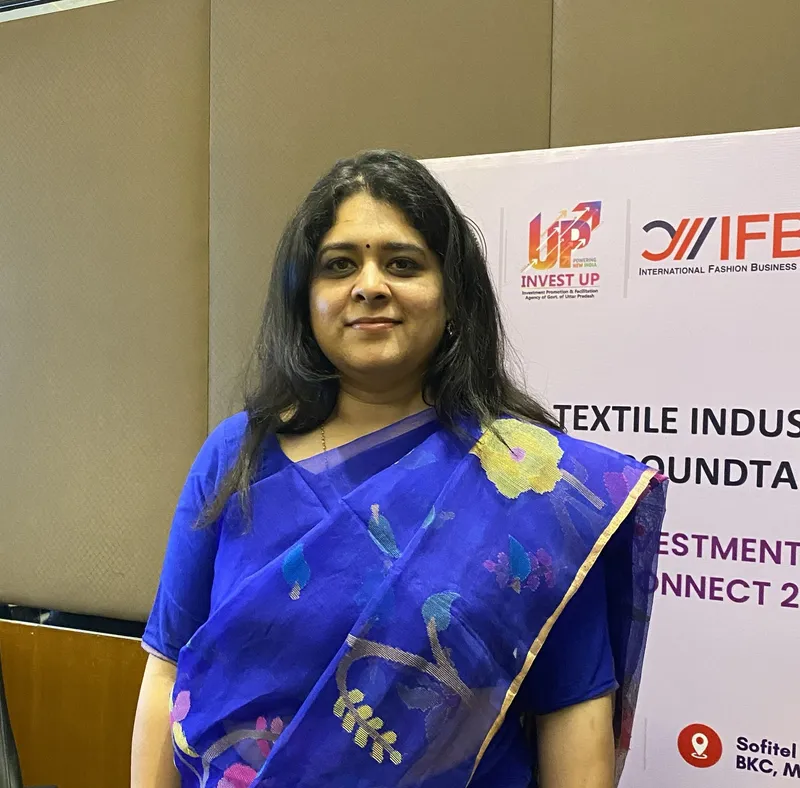
Prerna Sharma
Additional CEO,
Invest UP
Uttar Pradesh has introduced several policies to attract domestic and international investors. What concrete results have these policies delivered so far in terms of actual investments, operational projects and employment?
We have more than 35 sectoral policies and six umbrella policies that Invest UP runs. We are very bullish on the current investment scenario. A lot of investors are coming and enquiring about UP, about the land and infrastructure facilities we offer. So far, we have been able to ground more than ₹12.5 lakh crore of investments. The experience these investors have had with us has been very good, and we continue to move forward.
What investment opportunities does UP offer in textile manufacturing, garment production and technical textiles, and what incentives are available to businesses looking to establish or expand their operations in the state?
For textiles specifically, there is a textile policy run by the Textile Department, where subsidies vary from 25 to 35 percent, and we have exemptions on stamp duty and electricity duty, depending on your threshold value.
Then there is the IIEPP, our main industrial investment policy, which has varying benefits. You can choose a capital investment subsidy with boosters of up to 42 percent, a PLI top-up, or GST reimbursement, whichever suits you better.
After that, we have the FDI and Fortune Global 500 policy, which is one of our best policies. Apart from these benefits, we also offer a 75 to 80 percent land subsidy, which is one of the key defining areas for FDI investment.
UP has a strong textile heritage and numerous traditional manufacturing clusters. How is the government helping small and medium-sized textile enterprises modernize their production, adopt new technologies and compete in modern international markets?
As you mentioned, UP has a lot of traditional textiles. We come from the land of Banarasi sarees, Lucknow's chikankari and the carpets of Mirzapur, with different strengths in different areas. The departments that look after them, such as the Handloom Department and the Sericulture Department, offer subsidies and incentives for modernizing machinery. There is also a lot of research going into adopting newer technologies better suited to traditional methods.
Apart from the incentives and subsidies the government offers, the MSME Department also has an export cell that helps them export these products to other parts of the world. And because of our traditional strengths in manufacturing, there is a large talent base available in UP that can work in other textile sectors as well.
What are the major challenges investors face when setting up business in Uttar Pradesh, particularly regarding land approvals and regulatory procedures, and what measures is the government taking to address them?
Our investors do not face any problems, but sometimes an investor might be confused about where to go. For all investment decisions, Invest UP is the place to come. We are the single nodal agency for all investment coming into the state. You might want to work under a departmental policy, but you will still have to come to Invest UP for your investment intent and decision.
We will not only work on improving our regulatory scenario, but we are already a very good state in the ease of doing business category. We also believe in the speed of doing business. One of the things UP closely monitors is the turnaround time of applications, and I would like to tell you it is one of the lowest in India.
How is the government encouraging investment in smaller cities and less developed districts of Uttar Pradesh, particularly in textile clusters, so that industrial growth and employment opportunities reach a wider population?
We have always tried to address the regional imbalance between geographies in UP, and that is why our subsidies are positioned the way they are. If you invest in Bundelkhand, you get a greater subsidy than if you invest in NCR. Reimbursement in Bundelkhand goes up to 300 percent, while for NCR it is 100 percent. That is how we are trying to target the regional imbalance.
Apart from this, the government is actively acquiring land in these areas. We have developed a new authority called BIDA, the Bundelkhand Industrial Development Authority, and we have already acquired land the size of Noida. The intent of the government is to establish a large industrial cluster there. We are finding anchor investors who are ready to come and invest in that region. Once the industrial region is fully developed and thriving, I am sure it will give jobs to local people and boost the local economy in a way that the regional imbalances will correct themselves.
As the textile industry increasingly focuses on sustainability, recycling and environmentally responsible manufacturing, what policies or incentives is Uttar Pradesh introducing to encourage green textile production?
As you mentioned, ESG compliance is one of the leading factors in how international brands source from India, and it is changing the way things work. It is no longer just about producing a product; it is about how sustainably you can produce it. Obviously, we are a long way from there, because textiles were initially associated with red category industries, which are very polluting.
So wherever we are forming clusters and parks, we are facilitating them with CETPs. Apart from that, the PM MITRA Park coming up in the Lucknow-Hardoi region is going to be a completely ESG-compliant place.
Looking ahead, what are the government's key investment and employment targets for the next three to five years, particularly for the textile and garment sector, and how will the government measure progress toward achieving them?
One of the major things we want to concentrate on is technical textiles. We understand it is a niche sector. Currently, market penetration for technical textiles in India is 5 to 10 percent, but in developed countries it goes up to 35 to 40 percent. As a country, and in terms of market depth, we will be growing at that pace, and to catch up, we will have to develop and deploy technical textile operations in UP.
Technical textiles has various categories. We are looking at sports textiles, and Meerut is an important sports manufacturing cluster. We are trying to develop a centre of excellence and testing labs around it. There is also defence technical textiles, which can be centred around the Kanpur-Lucknow region and along our defence corridors. These are two sunrise areas we want to work on.
Apart from that, the PM MITRA Park, I think, is going to be at the centre of this five-year vision for textiles in UP.
To see the full interview with Prerna Sharma of Invest UP, and to explore more conversations with leading figures shaping the textile and investment ecosystem, check out the TVC Media YouTube channel. You’ll find exclusive interviews, policy insights, and on-the-ground coverage from the events driving India’s industrial growth.