Inside the Operating Room: How Medical Textiles Interact with Surgical Workflows
Overview
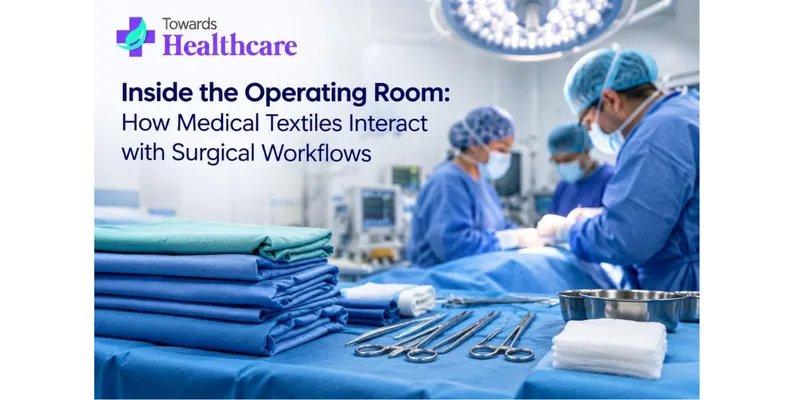
Inside an operating room, every movement matters. Surgeons need freedom to work, nurses need to move equipment, and patients need to remain protected throughout the procedure.
Medical textiles quietly support this entire process. Surgical gowns, drapes, masks, caps, sterile covers, and other textile-based products help create protective barriers while working alongside the people, instruments, and procedures inside the operating room.
The challenge is not simply to make a fabric protective. It must perform its function without unnecessarily interfering with the surgical workflow.
Medical Textiles Are Part of the Surgical Environment
Medical textiles are often viewed as protective products, but their role extends further.
A surgical gown needs to provide an appropriate barrier while allowing the wearer to move. A surgical drape needs to help establish a sterile field while remaining stable around the patient and surgical equipment.
The fabric therefore becomes part of the working environment.
According to CDC guidance, surgical gowns and drapes should provide resistance to liquid and microbial penetration, while their performance is influenced by factors such as fabric repellency, pore size, design, and construction.
From Preparation to Procedure
The interaction between textiles and surgical workflow begins before the first incision.
Surgical teams prepare themselves with appropriate attire, including gowns, masks, and other protective equipment. Sterile gowns and drapes are used when sterility is required.
This means medical textiles have to arrive at the operating room in a condition that supports the sterile procedure. For reusable products, cleaning, processing, packaging, and sterilization become important parts of the textile's journey.
The textile is therefore not an isolated product. Its performance depends on what happens before, during, and after surgery.
When Fabric Meets Movement
An operating room is a highly active environment.
Surgeons bend, stretch, turn, reach, and work for extended periods. Nurses and other staff move around the operating table, handle equipment, and assist with instruments.
A medical garment that restricts movement can become a practical problem.
This is why textile construction matters. Flexibility, drape, tensile strength, seam performance, air permeability, and surface characteristics can influence how a surgical garment behaves during use.
Research on surgical gowns has shown that fabric structure and joining methods can affect properties such as air permeability, drape, tensile strength, and seam performance.
The Role of the Surgical Drape
Surgical drapes have a different job from gowns, but they are equally connected to workflow.
They help define and maintain the operative field while creating a barrier between the surgical area and surrounding surfaces.
The drape must stay where it is placed, accommodate equipment and the patient's position, and manage exposure to fluids.
Material selection therefore becomes important. Fabric structure, fluid resistance, absorbency, surface friction, and construction can influence how the drape behaves during a procedure.
Recent research has also examined how different drape materials can affect fluid management and the stability of devices placed on the surgical field.
Managing Fluids Without Disrupting the Procedure
Blood and other body fluids are an unavoidable part of many surgical procedures.
Medical textiles need to manage these exposures without compromising the protective barrier.
This creates a difficult material balance.
A fabric with greater barrier protection may provide stronger resistance to liquid penetration, but additional layers can also affect comfort and breathability. The CDC notes that reinforced gowns can improve resistance to liquid strike-through but may be less comfortable.
The objective is therefore not simply maximum protection.
It is appropriate protection for the clinical task.
Protection and Comfort Must Work Together
Long surgical procedures can place considerable physical demands on healthcare workers.
A garment that traps excessive heat or moisture may become uncomfortable over time. On the other hand, reducing material layers too much could affect the desired protective performance.
This makes medical textile design a balancing exercise between:
- Barrier protection
- Breathability
- Flexibility
- Moisture management
- Strength
- Weight
- Comfort
- Sterility requirements
Modern medical clothing therefore requires more than a fabric that simply looks and feels suitable.
Designing Around the Surgical Workflow
Medical textile manufacturers increasingly need to understand how their products will actually be used.
Where does the surgeon need maximum movement?
Which areas of a gown experience greater exposure?
Where might a drape experience fluid accumulation?
How does the material behave when equipment is placed over it?
These questions connect textile engineering with real clinical workflows.
The result can be more application-specific products rather than one material being used for every surgical situation.
The Importance of Seams, Layers and Construction
The fabric itself is only part of the equation.
A surgical garment contains seams, closures, cuffs, layers, reinforcements, and other structural elements. These components can influence the final performance of the product.
A high-performing fabric may not deliver the same performance if the garment construction creates weak points.
This is why medical textile development increasingly considers the complete product architecture, rather than evaluating the fabric alone.
Disposable or Reusable?
The operating room also presents an important material choice: disposable or reusable textiles.
Both approaches involve different considerations around performance, processing, cost, waste, and resource use.
Reusable gowns and drapes must withstand repeated cleaning and, where required, sterilization while maintaining their functional properties. Disposable products reduce the need for reprocessing but create additional material and waste-management considerations.
The CDC notes that facilities evaluating disposable and reusable surgical textiles need to consider protection as well as the costs and environmental implications associated with each approach.
Where Medical Textile Innovation Is Going
The next generation of surgical textiles is likely to focus on more precise performance.
Manufacturers are exploring advanced nonwovens, engineered fiber structures, specialized membranes, coated materials, multifunctional fabrics, and improved reusable textile systems.
The goal is not simply to make medical clothing stronger.
It is to develop textiles that respond better to the actual demands of surgical environments.
Future materials could combine barrier performance with improved airflow, moisture management, flexibility, durability, and resource efficiency.
The global medical clothing market size was estimated at USD 122.74 billion in 2025 and is predicted to increase from USD 130.65 billion in 2026 to approximately USD 229.31 billion by 2035, expanding at a CAGR of 6.45% from 2026 to 2035, according to Towards Healthcare
Why It’s Important in Medical Clothing
The operating room demonstrates why medical clothing cannot be treated like conventional apparel.
A surgical gown or drape has to work within a complex environment involving people, movement, fluids, equipment, sterility, and time-sensitive procedures.
Medical textiles sit at the center of these interactions.
Their performance can influence how comfortably healthcare workers move, how effectively protective barriers function, and how smoothly products fit into clinical workflows.
Conclusion
Medical textiles may not be the most visible part of an operating room, but they are constantly interacting with the surgical environment.
From the gown worn by the surgeon to the drape surrounding the operative field, every textile has a specific role.
The future of medical clothing will depend on designing these materials around real clinical needs, combining protection with movement, comfort, durability, and workflow compatibility.
About Author
Payal Rabde is a Healthcare Market Research Analyst at Towards Healthcare Research & Consulting with over 4+ years of experience in pharmaceutical, biotechnology, medical device, and healthcare market research. She holds an MBA in Pharmaceutical-Biotechnology Management and a B.Pharm, specializing in market analysis, forecasting, competitive intelligence, and strategic healthcare insights.
About Towards Healthcare Research and Consulting
Towards Healthcare Research & Consulting is a global strategy consulting firm with a presence in both Canada and India. We provide innovative solutions customized to the healthcare sector, helping business leaders overcome challenges and accelerate growth. We specialize in delivering advanced technological solutions, clinical research services, and powerful data analytics. Our focus is on building meaningful partnerships that foster innovation and deliver actionable insights to drive success in healthcare.
Reference:
https://www.towardshealthcare.com/insights/medical-clothing-market-sizing