Innovations in Textile Sizing Chemicals: From Starch to Smart Solutions
From Traditional to Smart: Evolving Trends in Textile Sizing Chemicals
Textile sizing chemicals play a critical role in yarn preparation, enhancing fiber strength and reducing breakage before weaving. These agents ensure fabrics achieve desired durability, smoothness, and finish, making them indispensable in modern textile manufacturing. Rising demand for high-quality fabrics and sustainable processes has spurred innovations in both chemical formulations and application methods.
The Role of Sizing Chemicals in Textile Production
Applied to cotton, polyester, nylon, and other yarns, sizing chemicals protect fibers from mechanical stress during weaving. While traditional solutions relied on starches, gums, and synthetic resins, recent developments have introduced eco-friendly and water-based alternatives. These modern formulations reduce environmental impact while improving worker safety.
Emerging Innovations
- Sustainable Formulations: Biodegradable and bio-based sizing agents are gaining traction, cutting water and chemical waste and supporting compliance with stricter environmental regulations.
- Advanced Synthetic Polymers: New polymer-based sizing chemicals offer enhanced adhesion, elasticity, and abrasion resistance, enabling tailored solutions for different fiber types.
- Nanotechnology Integration: Nanomaterials in sizing agents provide added functionality, such as antimicrobial effects, UV protection, and moisture management—key for technical textiles.
- Digitalization and Automation: Sensor-driven processes and data analytics optimize chemical application, ensuring precision, consistency, and efficiency while reducing labor dependency.
Global Market Outlook
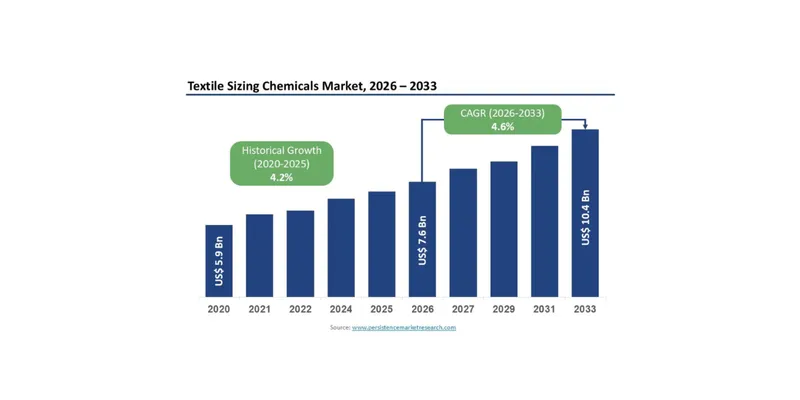
The global textile sizing chemicals market is expanding steadily. Persistence Market Research projects its value to rise from US$ 7.6 billion in 2026 to US$ 10.4 billion by 2033, at a CAGR of 4.6%. Growth is driven by the apparel sector’s focus on durable, high-quality fabrics, the home textiles market’s aesthetic demands, and the rapidly advancing technical textiles industry, where performance-oriented solutions are critical.
Future Prospects
Sustainability and innovation will continue to shape the textile sizing chemicals market. Eco-friendly formulations, energy-efficient production, and advanced functional properties for smart textiles are expected to drive next-generation developments. As the industry evolves, sizing chemicals are becoming increasingly sophisticated, supporting both conventional and high-performance textile applications worldwide.