Indutech Textiles Market 2026: $223B Growth, 8.2% CAGR & Key Industry Insights
The global Indutech textiles market has emerged as a critical segment within the technical textiles industry, driven by measurable performance improvements and increasing industrial demand. Market has demonstrated consistent growth over the past five years, supported by rising adoption across construction, automotive, filtration, and safety applications.
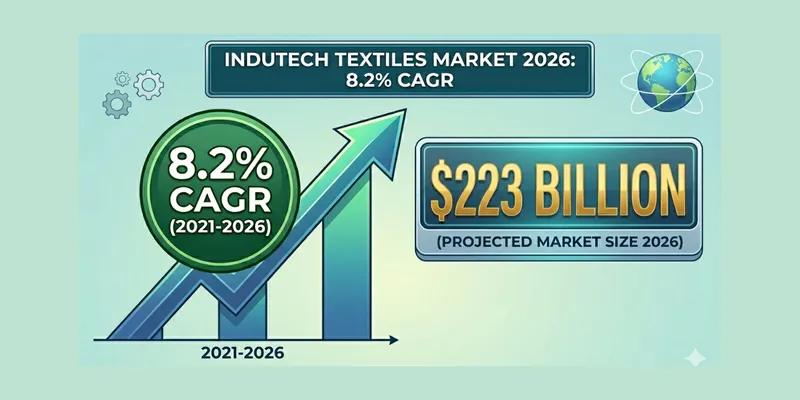
According to Dataintelo in 2026, the global Indutech textiles market is valued at approximately $223 billion, up from $150 billion in 2021, reflecting a compound annual growth rate (CAGR) of 8.2%. This steady expansion highlights a clear shift toward high performance materials that deliver quantifiable benefits in durability, efficiency, and cost savings.
1. Market Size Growth (2021–2026): A $73 Billion Increase
The Indutech textiles market has expanded significantly, with year-by-year growth illustrating consistent demand:
Year | Market Size (USD Billion) | YoY Growth (%) |
2021 | 150 | — |
2022 | 162 | 8.0% |
2023 | 175 | 8.0% |
2024 | 190 | 8.6% |
2025 | 206 | 8.4% |
2026 | 223 | 8.3% |
Between 2021 and 2026, the market added $73 billion in value, with annual increases ranging from $12 billion to $17 billion. The relatively stable growth rate of 8.0%–8.6% indicates strong resilience even during periods of economic uncertainty.
2. What Makes Indutech Textiles Unique?
Indutech textiles are engineered for industrial applications requiring high durability and efficiency. Their advantages can be quantified through key metrics:
• Tensile strength ranges from 20 to 150 kN/m, depending on fiber composition • Heat resistance can reach up to 600°C in high-performance variants
• Product lifespan is typically 2x to 5x longer than traditional materials
By 2025, approximately 68% of industrial manufacturers had adopted Indutech textiles, reflecting a growing preference for materials with measurable performance gains.
3. 5 Data-Backed Drivers Accelerating Market Growth
Industrial Automation (+42% Adoption Increase)
Automation adoption increased by 42% between 2021 and 2025, boosting demand for conveyor belts and industrial fabrics. These applications now account for 31% of total Indutech usage.
Infrastructure Investment ($3.7 Trillion in 2025)
Global infrastructure spending reached $3.7 trillion in 2025, driving a 9.5% year-over-year increase in construction textile demand. Reinforcement textiles improve structural lifespan by 25%–40%.
Automotive Lightweighting (15–20% Weight Reduction)
Indutech materials help reduce vehicle weight by 15%–20%, resulting in 8%–12% improvements in fuel efficiency.
Filtration Efficiency Gains (85% to 96%)
Industrial filtration textiles improved efficiency from 85% in 2018 to 96% in 2025, while the segment itself grew 11.2% in 2024.
Safety Compliance (+37% Adoption Growth)
Protective textile adoption increased by 37% between 2022 and 2025, reducing workplace injuries by 18%–22%.
4. 2025 Performance Metrics: Cost vs Efficiency Comparison
Indutech textiles deliver measurable improvements across key operational metrics:
Metric | Traditional Materials | Indutech Textiles | Improvement |
Annual Maintenance Cost | $100,000 | $68,000 | -32% |
Average Lifespan | 3 years | 7 years | +133% |
Downtime | 120 hrs/year | 75 hrs/year | -37.5% |
Energy Efficiency | Baseline | +18% | +18% |
Replacement Cycle | 36 months | 72–84 months | ~2x longer |
These figures highlight how Indutech textiles reduce costs while improving operational efficiency.
5. Regional Market Share (2026): 4 Key Numbers
The global market is geographically concentrated, with clear regional dominance:
Region | Market Share (%) | Growth Rate (2025) |
Asia-Pacific | 41% | 9.8% |
Europe | 26% | 12.0% |
North America | 22% | 7.5% |
Rest of World | 11% | 6.8% |
Asia-Pacific leads due to rapid industrialization, while Europe shows strong growth driven by sustainability initiatives.
6. Real-World Case Study: 31.6% Cost Reduction
A mid-sized manufacturing company implemented Indutech conveyor belts and filtration textiles in 2024. Within 12 months, the company achieved:
• Maintenance cost reduction from $1.2 million to $820,000 (-31.6%) • Downtime reduction from 140 hours to 82 hours (-41%)
• Production output increase of 14%
• ROI achieved within 18 months
This example demonstrates how measurable performance improvements translate into tangible financial gains.
7. Challenges Quantified: Costs, Volatility & Skills Gap
Despite strong growth, the market faces several measurable challenges: • Initial investment costs are 25%–40% higher than traditional materials • Payback periods range from 12 to 24 months
• Synthetic fiber prices fluctuated by 18% between 2022 and 2024
• Carbon fiber prices increased by 22% in 2023
• Only 54% of companies report having skilled labor
• Training costs range from $2,500 to $5,000 per employee
These factors highlight the importance of long-term planning when adopting Indutech solutions.
8. 2030 Forecast: 7 Numeric Projections
Future growth is expected to remain strong, supported by innovation and sustainability trends:
Metric | 2025 | 2030 Forecast |
Market Size | $206B | $340B–$360B |
CAGR | — | 7.5%–8.0% |
Smart Textile Adoption | — | +65% |
Sustainable Fiber Share | 28% | 45% |
Filtration Segment Value | $65B | $90B+ |
Automation Demand | — | +50% |
Product Lifespan | Baseline | +20–25% |
Key Statistics at a Glance
• Market size (2026): $223 billion
• Growth (2021–2026): +$73 billion
• CAGR: 8.2%
• Industrial adoption: 68% (2025)
• Cost reduction: up to 32%
• Lifespan increase: 2x–2.5x
• Energy efficiency improvement: 18%
• Asia-Pacific market share: 41%
• Filtration efficiency: 96% (2025)
• Safety adoption growth: +37%
• Downtime reduction: 37.5%
• ROI timeline: 12–24 months
Conclusion: A $223 Billion Market Driven by Measurable Results
The Indutech textiles market in 2026 stands as a $223 billion industry, growing at a steady 8.2% CAGR and adding $73 billion in just five years. With proven benefits such as 32% cost savings, 2x longer lifespan, and 18% energy efficiency gains, the adoption of Indutech textiles is backed by clear, quantifiable value.
Looking ahead to 2030, the market is projected to reach up to $360 billion, driven by 65% growth in smart textiles and a 45% share of sustainable materials. These figures reinforce a simple conclusion: Indutech textiles are not just an innovation they are a data-backed necessity for industries aiming to improve performance, reduce costs, and stay competitive in a rapidly evolving global market.
Read A Full Report: https://dataintelo.com/report/indutech-textiles-market-report