Industrial Laundry for Returnable Textiles Market to Surpass USD 9.8 Billion by 2032, Growing at 6.7% CAGR
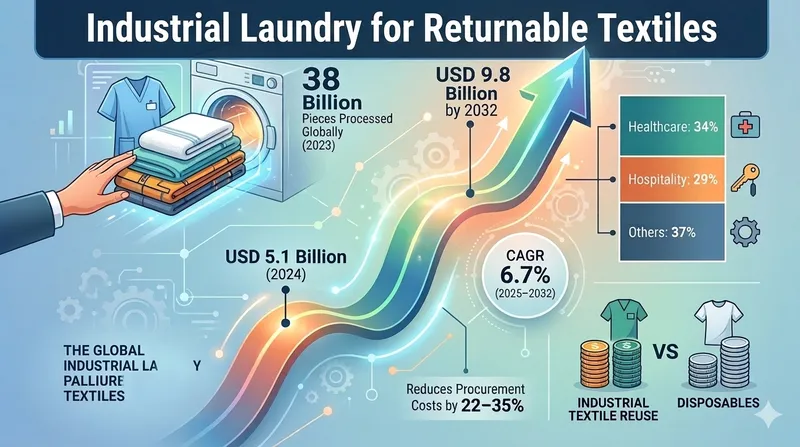
Industrial laundry for returnable textiles has become a critical operational component in sectors such as healthcare, hospitality, food processing, and manufacturing. According to recent industry analysis by Marketintelo, the global industrial laundry for returnable textiles market was valued at USD 5.1 billion in 2024 and is projected to reach USD 9.8 billion by 2032, expanding at a compound annual growth rate (CAGR) of 6.7% between 2025 and 2032.
Returnable textiles include reusable garments, uniforms, surgical linens, towels, and industrial wipes that circulate repeatedly through commercial laundry systems. Rising hygiene standards, cost efficiency compared with disposable textiles, and strict regulatory requirements are accelerating market demand.
In 2023, more than 38 billion reusable textile pieces were processed globally in industrial laundry systems, compared with 29 billion in 2018, reflecting a 31% increase in five years.
Key Numerical Highlights
• Global industrial laundry for returnable textiles market size: USD 5.1 billion (2024) • Projected market size: USD 9.8 billion by 2032
• Expected CAGR: 6.7% (2025–2032)
• Total reusable textile processing volume: 38 billion pieces in 2023 • Healthcare segment share: 34% of total demand
• Hospitality sector share: 29%
• Asia-Pacific growth rate: 7.9% CAGR, the fastest globally
• Industrial textile reuse reduces procurement costs by 22–35% compared with disposable alternatives
Historical Market Growth (2016–2024)
Over the past decade, the industrial laundry for returnable textiles market has experienced steady growth due to increased adoption of circular textile systems.
Between 2016 and 2024, global revenue expanded from USD 3.2 billion to USD 5.1 billion, representing an overall increase of 59%.
Year-over-year data illustrates the sector’s resilience even during economic disruptions.
Year | Market Value (USD Billion) | YoY Growth |
2016 | 3.2 | — |
2018 | 3.8 | 8.4% |
2020 | 4.2 | 5.1% |
2022 | 4.7 | 6.4% |
2024 | 5.1 | 5.8% |
In 2020, the healthcare sector drove demand, with hospital textile processing volumes increasing 18% due to infection-control protocols during global health crises.
By 2022, demand from hospitality and tourism rebounded sharply, increasing industrial laundry volumes by 12% compared with 2021.
Demand Drivers and Operational Efficiency
The rapid expansion of the industrial laundry for returnable textiles market is largely driven by operational cost savings and sustainability advantages.
Reusable textiles can withstand 75–120 wash cycles, reducing procurement costs significantly. In comparison, disposable textile alternatives increase operational costs by 25– 40% over a five-year period.
Key operational metrics include:
• Average industrial washer capacity: 50–200 kg per cycle
• Typical large-scale facility processing: 20–40 tons of textiles per day
• Energy-efficient systems reduce water usage by 35% compared with traditional laundry systems
• Automated sorting technologies improve processing efficiency by 18–22%
Large hospitals process 6–9 million textile pieces annually, while major hotel chains process approximately 3–5 million pieces per property each year.
Sector-Wise Demand Distribution
The industrial laundry for returnable textiles market is strongly influenced by institutional demand.
Healthcare remains the largest segment, followed by hospitality and manufacturing. Market share by sector (2024):
• Healthcare & hospitals: 34%
• Hospitality & tourism: 29%
• Food processing & pharmaceuticals: 18%
• Manufacturing & industrial workwear: 12%
• Others: 7%
Hospitals globally generated demand for 13 billion reusable textile units in 2023, including surgical gowns, bed linens, and patient garments.
Meanwhile, the hospitality sector processed nearly 10.6 billion textile units during the same year.
Regional Market Analysis
Regional adoption of the industrial laundry for returnable textiles market varies based on healthcare infrastructure, labor costs, and sustainability regulations.
North America
North America accounted for 32% of global market revenue in 2024, equivalent to approximately USD 1.63 billion.
The United States processes more than 11 billion reusable textile items annually through commercial laundries. Healthcare regulations such as HLAC certification standards have driven investments in automated industrial laundry systems.
Between 2019 and 2024, North American market revenue grew at an average 5.5% CAGR. Europe
Europe holds the second-largest share at 29%, valued at USD 1.48 billion in 2024.
Countries such as Germany, France, and the United Kingdom collectively operate more than 1,200 industrial textile laundries.
The European Union’s circular economy strategy aims to increase reusable textile adoption by 45% by 2030, which is expected to significantly expand the industrial laundry for returnable textiles market.
Asia-Pacific
Asia-Pacific represents the fastest-growing regional market, with a 7.9% CAGR forecast between 2025 and 2032.
The region’s market size reached USD 1.4 billion in 2024, driven by rapid expansion in healthcare infrastructure and hospitality sectors in China, India, and Southeast Asia.
India alone has more than 6,500 commercial laundry facilities, and the hospital linen processing market grew 11% annually between 2021 and 2024.
Other Regions
• Latin America market size (2024): USD 370 million
• Middle East & Africa market size: USD 220 million
• Combined growth rate: 6.2% CAGR
Tourism expansion in the UAE and Saudi Arabia is increasing demand for hotel textile processing services.
Technology and Automation Investments
Technological advancements are transforming the industrial laundry for returnable textiles market.
Smart automation systems and IoT-enabled washers improve operational efficiency and reduce downtime.
Recent industry investments include:
• Global automated laundry equipment investment: USD 1.3 billion in 2023 • AI-powered textile tracking adoption: 28% of large facilities
• RFID textile tracking systems reduce textile loss by 20–25%
• Automated folding and sorting machines improve productivity by 30%
Industrial laundry plants equipped with RFID technology can track more than 500,000 textile items per day.
Sustainability Impact and Environmental Benefits
Environmental sustainability is a major driver behind the adoption of reusable textile systems.
Compared with disposable textiles:
• Water consumption reduced by 28–35%
• Textile waste reduced by 65–70%
• Carbon emissions reduced by 22% per usage cycle
Globally, reusable textile systems prevented approximately 3.1 million tons of textile waste in 2023.
Several governments are also supporting sustainable laundry systems through incentives and infrastructure investments exceeding USD 450 million globally between 2022 and 2025.
Future Market Forecast (2025–2032)
The industrial laundry for returnable textiles market is expected to maintain steady growth due to increasing demand for hygiene compliance and cost-effective textile management.
Forecast projections include:
• Market size 2026: USD 6.4 billion
• Market size 2028: USD 7.6 billion
• Market size 2030: USD 8.7 billion
• Market size 2032: USD 9.8 billion
Processing volumes are expected to rise from 38 billion textile units in 2023 to nearly 55 billion units by 2032, representing a 45% increase.
Healthcare demand alone is projected to account for 18 billion reusable textile units annually by 2030.
Data-Driven Conclusion
The global industrial laundry for returnable textiles market is entering a strong expansion phase driven by sustainability initiatives, rising hygiene regulations, and cost efficiencies.
Market revenue increased from USD 3.2 billion in 2016 to USD 5.1 billion in 2024, and is projected to reach USD 9.8 billion by 2032, reflecting a 6.7% CAGR. Textile processing
volumes are expected to grow from 38 billion units to more than 55 billion units over the next decade.
Asia-Pacific will lead growth with 7.9% CAGR, while North America and Europe will continue dominating market share with a combined 61% share.With increased automation, RFID tracking adoption, and government sustainability initiatives, the industrial laundry for returnable textiles market is positioned to become a critical component of global circular textile economies over the next decade.
Read A Full Report: Industrial Laundry for Returnable Textiles Market Research Report 2033