Industrial Innovation Through Technical Textiles: Market Growth & Opportunities
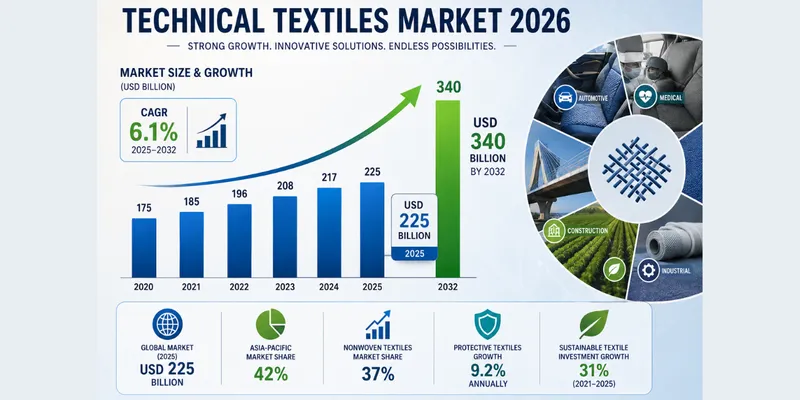
The global technical textiles industry is entering a high-growth phase in 2026, driven by rising demand across healthcare, automotive, construction, agriculture, defense, and industrial manufacturing. The technical textiles market is witnessing accelerated adoption due to advancements in smart fabrics, sustainability initiatives, and high-performance material engineering.
Unlike conventional textiles used primarily for aesthetics, technical textiles are engineered for functionality and performance. In 2025, the global technical textiles market was valued at approximately USD 225 billion, and projections indicate it could surpass USD 340 billion by 2032, growing at a CAGR of 6.1% during the forecast period.
Key Statistics at a Glance
Metric | Value |
Global Market Size (2025) | USD 225 Billion |
Forecast Market Value (2032) | USD 340 Billion |
CAGR (2025–2032) | 6.1% |
Asia-Pacific Market Share | 42% |
Automotive Textile Growth | 7.4% CAGR |
Medical Textile Segment Value (2025) | USD 38 Billion |
Smart Textile Adoption Growth | 12.8% CAGR |
Sustainable Textile Investment Increase (2021–2025) | 31% |
Industrial Textile Share | 28% of total market |
Construction Textile Demand Increase (2024–2026) | 18% |
Nonwoven Textile Market Share | 37% |
Protective Textile Demand Growth | 9.2% annually |
What Are Technical Textiles?
Technical textiles are specially designed textile materials manufactured for technical performance rather than decorative appearance. These textiles are used in over 12 major industries, including:
1. Automotive
2. Healthcare
3. Construction
4. Aerospace
5. Agriculture
6. Sports
7. Defense
8. Industrial filtration
9. Packaging
10. Geotextiles
11. Marine
12. Environmental protection
In 2025, industrial applications accounted for nearly 63% of total technical textile consumption globally.
5 Data-Backed Drivers Accelerating Market Growth in 2026
1. Automotive Lightweighting Increased Textile Demand by 22%
Automotive manufacturers are aggressively replacing heavier materials with lightweight textile composites to improve fuel efficiency and EV battery performance.
• Technical textiles reduce vehicle weight by 15%–25%
• Electric vehicle production grew by 35% globally in 2025
• Automotive textiles market expected to reach USD 52 billion by 2030
Airbags, seat belts, insulation systems, and fiber-reinforced composites are major contributors to this demand.
2. Medical Textiles Crossed USD 38 Billion in 2025
Healthcare applications remain among the fastest-growing technical textile categories. Medical textiles include:
• Surgical gowns
• PPE kits
• Implantable fabrics
• Wound dressings
• Hygiene products
Between 2020 and 2025:
• Global PPE demand increased by 240%
• Antimicrobial textile adoption rose by 31%
• Disposable medical textile production increased by 18% annually
The aging population is also driving growth, with people aged over 65 expected to represent 16% of the global population by 2050.
3. Smart Textiles Recorded 12.8% CAGR
Smart and wearable textiles are becoming a major innovation segment. Examples include:
• Temperature-regulating fabrics
• Conductive textiles
• Health-monitoring wearables
• Military sensing garments
The smart textile market was valued near USD 6.5 billion in 2024 and could exceed USD 15 billion by 2030.
Research funding for wearable textile technology increased by approximately 27% between 2022 and 2025.
4. Sustainable Technical Textiles Investment Rose 31%
Sustainability has become a critical industry focus.
Manufacturers are increasingly adopting:
• Recycled polyester
• Bio-based fibers
• Water-efficient dyeing
• Low-carbon manufacturing
From 2021 to 2025:
• Recycled fiber utilization increased by 29%
• Water consumption in advanced textile facilities declined by 18%
• Carbon emissions reduction targets expanded across 70% of large textile manufacturers
The eco-friendly technical textile segment alone is projected to grow at 8.3% CAGR through 2032.
5. Construction and Infrastructure Spending Boosted Geotextiles
Infrastructure expansion is increasing the use of geotextiles in roads, drainage systems, erosion control, and soil stabilization.
Key figures include:
• Global infrastructure spending exceeded USD 4 trillion in 2025
• Geotextile demand rose by 18% from 2024 to 2026
• Asia-Pacific construction textile consumption increased by 24%
Geotextiles can improve road durability by nearly 50%, reducing long-term maintenance costs.
Regional Market Breakdown: 2026 Performance Metrics
Asia-Pacific Leads with 42% Market Share
The Asia-Pacific region dominates the technical textiles market due to strong manufacturing bases in China and India.
Key regional numbers:
• China contributes approximately 32% of global production
• India’s technical textile exports grew by 11.5% in 2025
• Japan increased smart textile R&D spending by 14%
Government incentives and industrial expansion continue to support regional dominance. North America Focuses on High-Performance Applications
North America accounted for nearly 24% of global revenue in 2025.
Key sectors include:
• Aerospace textiles
• Defense fabrics
• Medical textiles
• Industrial filtration
The U.S. technical textile sector invested over USD 3.2 billion in advanced manufacturing technologies during 2024–2025.
Europe Prioritizes Sustainability
Europe remains a leader in sustainable textile innovation.
• EU textile recycling initiatives increased by 21%
• Sustainable textile regulations expanded across 27 EU nations
• Germany accounted for nearly 29% of Europe’s industrial textile production Technical Textile Segments by Market Share
Segment | Market Share |
Industrial Textiles | 28% |
Nonwoven Textiles | 37% |
Mobiltech (Automotive) | 16% |
Meditech (Medical) | 14% |
Geotech (Construction) | 11% |
Protective Textiles | 9% |
Nonwoven textiles continue dominating due to their lower production costs and high efficiency in filtration and healthcare applications.
Real-World Example: Technical Textiles in Infrastructure
A highway stabilization project in Southeast Asia used advanced geotextiles across a 120- kilometer roadway.
Results included:
• Soil erosion reduction by 48%
• Maintenance costs reduced by 34%
• Project completion time shortened by 19%
This demonstrates how technical textiles directly improve operational efficiency and infrastructure lifespan.
Challenges Impacting the Market
Despite strong growth, several issues remain:
Raw Material Price Volatility
Synthetic fiber prices fluctuated by nearly 14% in 2025 due to supply chain instability. High Initial Investment
Advanced textile machinery can cost between USD 500,000 and USD 5 million depending on production scale.
Recycling Complexity
Only around 23% of technical textile waste is currently recycled globally due to material complexity.
Future Outlook: 2030 and Beyond
The future of technical textiles looks highly promising as industries increasingly demand lightweight, durable, and sustainable materials.
By 2032:
• Smart textile adoption could increase by 150%
• Sustainable textile production may account for 45% of total industry output • Industrial automation in textile manufacturing could improve productivity by 30% • AI-driven textile quality inspection systems may reduce defects by 40%
Emerging innovations such as nanofibers, conductive fabrics, and biodegradable industrial textiles are expected to reshape the industry landscape.
Conclusion
The technical textiles market is rapidly evolving into one of the most important segments of the global textile industry. With the market projected to grow from USD 225 billion in 2025 to over USD 340 billion by 2032, the sector is benefiting from rising demand across healthcare, automotive, construction, and smart wearable applications.
Key data points including 6.1% CAGR, 42% Asia-Pacific market share, 12.8% smart textile growth, and 31% sustainability investment expansionhighlight the strong momentum shaping the industry in 2026. Companies investing in innovation, sustainable manufacturing,
and high-performance materials are likely to gain significant competitive advantages in the years ahead.
Read A Full Report: https://dataintelo.com/report/technical-textiles-market