India’s Textile Industry Nears USD 190 Billion, Targets USD 350 Billion by 2030: Giriraj Singh
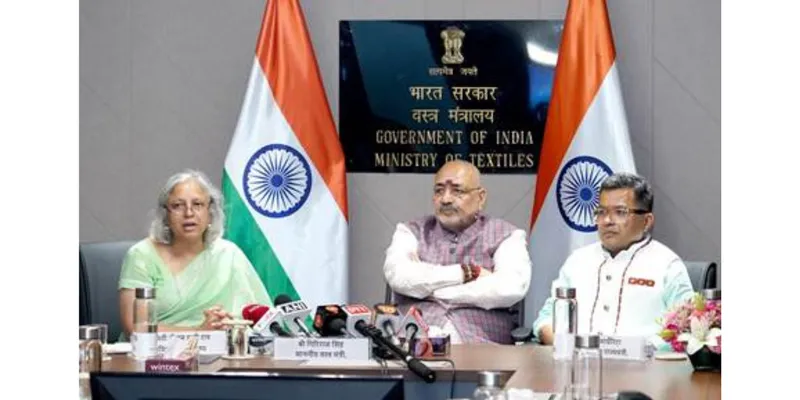
Textiles Minister outlines 12 years of sectoral growth driven by policy reforms, infrastructure, exports, technical textiles and employment initiatives
Union Minister of Textiles Shri Giriraj Singh, while presenting the Ministry of Textiles' achievements over the past 12 years, said India's textile and apparel sector has undergone significant transformation under the leadership of Prime Minister Shri Narendra Modi.
Addressing the media, the Minister said the Government’s 5F vision—Farm to Fibre, Fibre to Factory, Factory to Fashion and Fashion to Foreign—has helped build an integrated textile value chain connecting farmers, manufacturers, weavers, artisans and exporters.
According to the Minister, India’s textile industry has expanded to nearly USD 190 billion in 2025-26 and is projected to reach USD 350 billion by 2030. The domestic textile market has grown from approximately ₹6 lakh crore in 2014-15 to over ₹16 lakh crore, reflecting the sector’s expansion and contribution to the economy.
He added that the textile and apparel sector currently provides direct employment to more than 5.3 crore people and is expected to generate nearly 2 crore additional jobs over the next three years.
Government Initiatives Supporting Sector Growth
Shri Giriraj Singh said the Government has introduced several initiatives aimed at strengthening the textile ecosystem. These include:
- PM MITRA Parks
- Production Linked Incentive (PLI) Scheme
- National Technical Textiles Mission (NTTM)
- Textiles Export Promotion Mission (TEEM)
- National Fibre Mission
- Raw Material Support Scheme (RMSS)
He said these programmes are promoting investment, technology adoption, sustainability and export competitiveness.
To support cotton farmers and ensure raw material availability, the Government launched the Cotton Productivity Mission and removed import duty on cotton.
The Minister also noted that export competitiveness has been supported through RoSCTL and RoDTEP schemes. India's network of Free Trade Agreements (FTAs) has expanded from 10 FTAs covering 19 countries in 2014 to 18 FTAs covering 56 countries, creating new opportunities for exports and investment.
Despite global trade challenges, India has diversified its export destinations and recorded export growth in 135 countries.
Growth in Technical Textiles and Infrastructure
The Minister said India has strengthened its position in technical textiles, with the market expanding from around USD 6 billion to USD 25 billion under the National Technical Textiles Mission.
He said investments in research, innovation, incubation and industry-academia collaboration are contributing to the development of a future-ready textile sector.
On infrastructure, Shri Giriraj Singh highlighted the development of integrated textile parks and seven PM MITRA Parks across key states. These projects are expected to attract investments worth ₹70,000 crore and generate around 21 lakh employment opportunities.
He also noted that the powerloom sector has benefited from technology upgradation initiatives, while NIFT has expanded its academic presence and introduced projects such as VisioNxt and INDIASize to strengthen India’s fashion and design ecosystem.
The Minister said these achievements reflect the Government’s commitment to transforming India into a design-led, innovation-driven, sustainable and export-oriented global textile hub.
Focus on Handloom and Handicrafts
Minister of State for Textiles Shri Pabitra Margherita said India’s handloom and handicrafts sectors have witnessed significant progress over the last 12 years.
He stated that nearly ₹2,000 crore has been invested under the National Handloom Development Programme, benefiting lakhs of weavers through improved looms, skill development, infrastructure support and market access.
He added that initiatives including the Government e-Marketplace (GeM), India Handmade portal, GI tagging, Mega Handloom Clusters, and the Weavers’ MUDRA Scheme have strengthened livelihoods and reduced dependence on intermediaries.
According to the Minister, the handicrafts sector has also benefited from cluster development, skill upgradation, artisan identity cards and marketing support, helping artisans improve productivity and income.
Women Empowerment Through the Textile Sector
Secretary, Ministry of Textiles, Smt. Neelam Shami Rao, said the textile sector continues to play an important role in women empowerment by providing employment opportunities and supporting women entrepreneurs.
She expressed confidence that continued policy support, infrastructure development, investment promotion, skill enhancement and technological innovation would further strengthen India's position as a global textile manufacturing hub and contribute towards the goal of Viksit Bharat.