India’s Recent FTAs Improve Market Access, But US Trade Relationship Remains Central to Export Growth
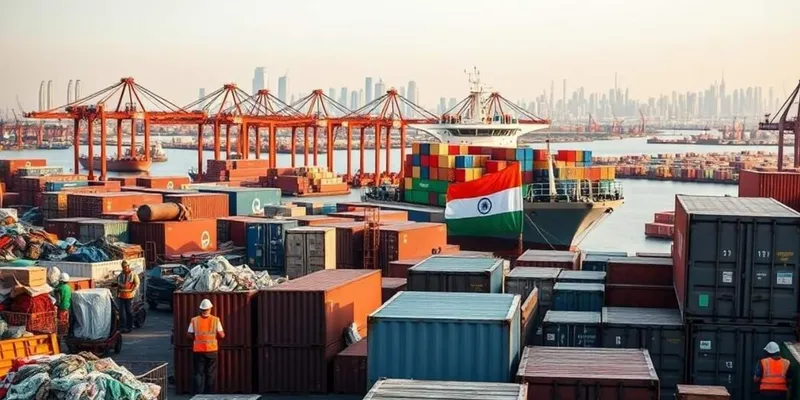
Analysis highlights the scale of India’s trade surplus with the US and examines how recent trade agreements with the EU, UK and Japan compare in commercial impact.
India’s recent free trade agreements with the European Union, the United Kingdom, and Japan have been widely welcomed for expanding market access. However, according to an analysis by Surjit S Bhalla, the broader commercial impact of these agreements should be viewed alongside the significantly larger trade relationship India maintains with the United States.
The analysis notes that during 2020–25, India’s annual goods trade surplus with the United States averaged approximately $42 billion. By comparison, the combined annual goods trade surplus with the European Union, the United Kingdom, and Japan was approximately $12 billion, creating a ratio of roughly 4 to 1 in favour of the US market.
According to the analysis, the US market has become India’s largest destination for high-value manufactured exports, including pharmaceuticals, electronics, gems and jewellery, engineering goods, and chemicals. India exports approximately $79 billion in goods annually to the United States while importing around $37 billion, generating the $42 billion surplus.
The article states that the European Union is India’s second-largest goods trading partner and currently runs a surplus of around $18 billion annually with India. This surplus is attributed partly to petroleum re-exports following Russia’s invasion of Ukraine, along with exports of pharmaceuticals and engineering products.
The analysis observes that the EU-India Free Trade Agreement is expected to reduce tariffs of 9–12 per cent on Indian textiles and garments entering Europe. It also notes that Vietnam, which signed an EU agreement in 2020, benefits from zero tariffs. At full implementation, the EU agreement is estimated to add approximately $8–10 billion annually to India’s goods balance, although this would still remain below the current surplus with the United States.
The article identifies the India-UK Comprehensive Economic and Trade Agreement (CETA), signed in July 2025, as delivering duty-free access for 99 per cent of India’s exports to the UK by value. However, it notes that India’s current goods surplus with the UK is approximately $5 billion.
Regarding Japan, the analysis states that the Comprehensive Economic Partnership Agreement (CEPA), signed in 2011, had targeted $25 billion in bilateral trade by 2014. India’s exports to Japan today are approximately $6 billion, while the trade balance has shifted from a small deficit at the time of signing to a deficit of around $11 billion. According to the article, CEPA reduced most tariffs but did not remove Japan’s non-tariff barriers. Following the July 2026 Modi-Takaichi summit, both countries agreed to review and negotiate a CEPA upgrade.
The article also highlights India’s trade relationship with China, noting that India’s goods trade deficit reached approximately $99 billion in 2024–25, with imports of $113 billion against exports of $14 billion. It states that the combined surplus generated through India’s agreements with the EU, UK and Japan would not offset even one-eighth of that deficit.
The analysis further notes that India has expanded trade engagement across several regions. Existing agreements cover partners including Japan, South Korea, Singapore, ASEAN member states, Australia, New Zealand, the United Arab Emirates, and Oman, while negotiations continue with other countries and regional blocs.
According to the article, an India-US agreement covering goods and services, with stable, near-zero tariffs across sectors including pharmaceuticals, electronics, gems, engineering goods, IT services, and professional mobility, would represent the most consequential trade agreement India has signed and support its broader economic objectives.
The analysis concludes by stating that while recent trade agreements improve market access, future negotiations should focus on trade relationships capable of delivering larger structural gains for India’s export economy.