India’s Ready-Made Garment Exports Rise 20% in October 2026, Signalling Industry Revival
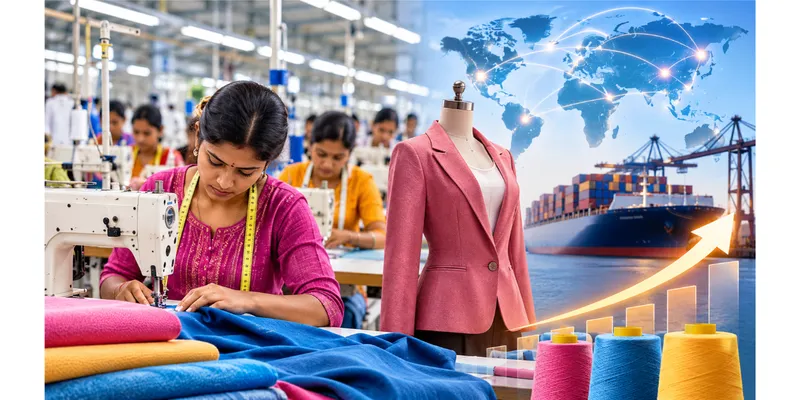
Rupee-denominated export growth reaches 30% as stronger overseas orders increase demand for Indian apparel, while workforce availability remains a key operational challenge.
India’s ready-made garment (RMG) exports recorded a 20% increase in October 2026 compared with October 2025, while growth in rupee terms reached 30%. The Apparel Export Promotion Council (AEPC) has described the performance as a sign of recovery in the apparel export industry, highlighting strong overseas orders and the need to address workforce availability to sustain growth.
India’s ready-made garment export sector is showing signs of recovery, with exports increasing 20% in October 2026 compared with the corresponding month in 2025. Growth in rupee terms stood at 30%, according to the Apparel Export Promotion Council (AEPC).
AEPC Chairman Dr A. Sakthivel described the export performance as an encouraging development for the apparel industry, citing the availability of substantial orders and rising demand from international buyers.
“The 20% growth in RMG exports in October 2026 is a very encouraging development. The industry has abundant orders in hand, and the immediate priority is to ensure adequate workforce availability to meet the growing demand,” he said in a statement on Saturday.
According to Dr Sakthivel, exporters are experiencing an improving business environment and have a strong pipeline of orders from overseas buyers. Indian garment manufacturers are witnessing firmer demand across several key international markets.
He identified workforce availability as the sector's immediate concern, noting that manufacturers need sufficient labour to execute orders within agreed timelines and at the required scale.
Labour shortages have become an operational challenge as order books continue to strengthen. Addressing this gap will require focused skill development initiatives, labour mobilisation and supportive measures. These steps are expected to help exporters convert existing orders into higher shipments and maintain momentum in the coming months, according to him.
AEPC is also facilitating market outreach opportunities to help member exporters explore and expand their presence in major international destinations. Its planned initiatives include engagements in Japan, London, Denmark, New York, Las Vegas, France and Dubai, along with participation in Bharat Tex ’27, positioned as a global platform bringing together the Indian textile and apparel value chain.
Dr Sakthivel urged exporters to make use of AEPC-supported platforms to develop new business connections, explore emerging markets, diversify export destinations and secure additional orders as competition intensifies and buyers increasingly seek supply chain resilience.
He also connected the sector's growth prospects with improved market access through free trade agreements and quicker resolution of workforce-related constraints. According to him, coordinated efforts by industry stakeholders, the government and AEPC could help strengthen competitiveness and support a stronger export trajectory.