India’s FTA Drive and the Textile Employment Opportunity: Linking Agriculture, MSMEs, Clusters and Services
V. K. Batra
V. K. Batra and Associates
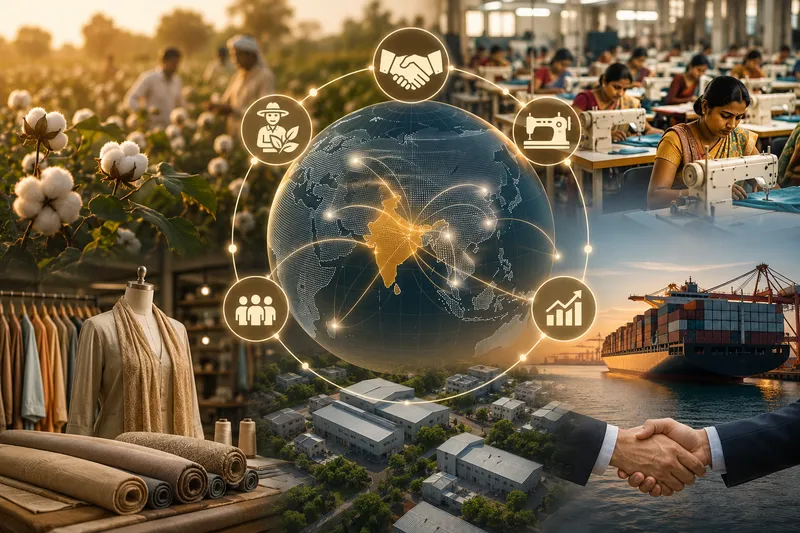
India’s textile sector is entering a decisive decade. The Free Trade Agreement drive of the Ministry of Commerce and Industry has created a new opening for labour-intensive products such as garments, home textiles, made-ups, carpets, technical textiles, handloom products, handicraft-based textiles and value-added apparel. The opportunity is not only commercial; it is developmental. Textiles already employ more than 45 million people directly, with women forming more than half of the workforce in textiles and apparel. The sector contributes about 2% of GDP and around 11% of manufacturing GVA. Therefore, any export-led expansion in textiles is also an employment, women’s participation, MSME and rural-transition strategy.
The policy environment is now supportive. India’s textile and apparel exports, including handicrafts, rose from USD 35.87 billion in FY 2023-24 to USD 37.75 billion in FY 2024-25. In FY 2025-26, textile exports including handicrafts increased from ₹3,09,859.3 crore to ₹3,16,334.9 crore, showing resilience despite global headwinds. India is already the world’s sixth-largest exporter of textiles and apparel, with about 4% global share, but this share is still far below India’s labour strength, cotton base, entrepreneurial spread and cluster depth. The gap itself is the opportunity.
The FTA route can convert this opportunity into orders. The India–UK CETA gives zero-duty access to nearly 99% of India’s exports to the UK and specifically benefits labour-intensive sectors including textiles. Under India–Australia ECTA, all Indian exports became eligible for zero-duty market access into Australia from 1 January 2026. The India–New Zealand FTA also provides zero-duty access for labour-intensive sectors including textiles, apparel, leather, footwear, gems and jewellery and processed foods, while adding a long-term investment commitment. These agreements show that India’s trade policy is moving from defensive tariff protection to outward-looking market access.
However, FTAs alone cannot create exports. Orders will come only when Indian clusters can deliver price, quality, compliance, speed and scale. Competing countries built textile export power by linking labour, infrastructure, logistics, credit and buyer servicing. India has all these elements, but they are fragmented. Cotton is grown in one region, yarn is spun elsewhere, processing is concentrated in a few centres, garments are stitched in different clusters, and MSMEs often carry the production burden without sufficient design, compliance, testing, working capital, insurance or buyer-connect support. The FTA opportunity will be encashed only when scattered capacity is converted into a coordinated national textile employment mission.
The most important reform is planned labour transfer. Rural India still has excessive dependence on agriculture. PLFS data for October–December 2025 shows that 58.5% of rural employment was in agriculture and 63.2% was self-employment. Agriculture must become more productive, but it cannot remain the residual employer of underemployed labour. Textiles are ideal for transition because they are labour-intensive, women-friendly, skill-adaptable and MSME-based. With short training, rural workers can enter stitching, packing, checking, finishing, weaving support, embroidery, warehousing, dispatch, export documentation, e-commerce fulfilment and urban textile services.
This requires a four-sector strategy. Agriculture should release surplus labour while improving cotton productivity, mechanisation, aggregation and farm-to-fibre linkages. Textile clusters should absorb trained labour into higher-value production. MSMEs should receive credit, technology, compliance and marketing support. Urban services should provide logistics, testing, design, digital marketing, finance, legal documentation, packaging and warehousing. The objective should not be to weaken agriculture, but to raise productivity in agriculture, manufacturing, MSMEs and services together.
The Government already has instruments for this integration. PM MITRA Parks, based on the Farm-to-Fibre-to-Factory-to-Fashion-to-Foreign vision, aim to attract around ₹70,000 crore investment and create nearly 20 lakh direct and indirect jobs across seven integrated textile parks. The Export Promotion Mission, with an outlay of ₹25,060 crore, including ₹20,000 crore credit guarantee support, is designed to help MSMEs, first-time exporters and labour-intensive sectors. These schemes should be linked directly with FTA market mapping. Each cluster—Panipat, Tiruppur, Surat, Ludhiana, Bhilwara, Karur, Noida, Jaipur, Varanasi, Solapur and others—should be mapped product-wise against the UK, EU, Australia, New Zealand, UAE, Japan, Africa and Latin America.
This also has a balance-of-payments significance. India cannot depend only on narrow export baskets or import-heavy sectors. Textiles use domestic raw material, domestic labour, Indian MSMEs and local entrepreneurship. A shift from raw cotton and yarn exports to finished garments, home textiles, carpets, hotel linen, medical textiles, technical textiles and branded products increases value addition and foreign exchange earnings. It also creates a preventive strategy against future external account stress by broadening exports through labour-intensive domestic value chains.
Therefore, India’s textile policy should not remain confined to one ministry. It must become a joint mission of Commerce, Textiles, MSME, Agriculture, Skill Development, Labour, Finance, DGFT, RBI, SIDBI, state governments and export promotion councils. The target should be simple: convert FTAs into export orders, export orders into MSME expansion, MSME expansion into labour absorption, and labour absorption into national productivity.
The coming decade can become India’s decade of textile-led employment exports. The markets are opening, the policy tools exist, and the clusters are ready. What is required is execution. If India links FTA access with labour transfer, cluster modernisation, MSME credit and urban services, textiles can become a central instrument of Viksit Bharat 2047—creating jobs, correcting export imbalance, improving balance-of-payments strength and raising productivity across the economy.
Source Note: Data points consolidated from official Government of India public releases and statistical updates, including textile export figures, FTA access details, PLFS rural employment data, PM MITRA targets and Export Promotion Mission outlay.