India’s Fiscal Deficit at ₹5.7 Trillion in H1 FY26: CareEdge
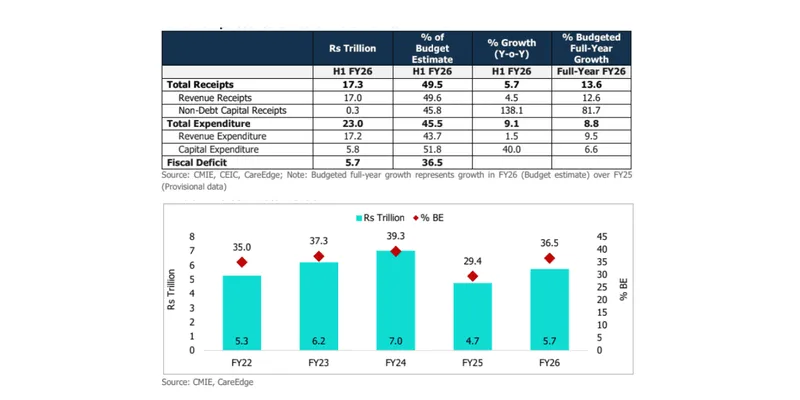
Non-tax revenue surge and capital expenditure support fiscal stability amid subdued tax performance.
India’s central government maintained fiscal discipline in the first half of FY26, supported by strong non-tax revenues and rationalised spending, even as tax collections slowed due to reduced income tax inflows and the impact of GST rationalisation.
The central government’s fiscal position in the first half of FY26 (April–September 2025) reflected moderation in tax revenues, though non-tax income—driven by record-high dividend transfers from the Reserve Bank of India (RBI)—helped stabilise overall finances.
According to CareEdge Research, total receipts in H1 FY26 stood at ₹17.3 trillion, accounting for nearly 50% of the full-year target. While revenue receipts rose by 4.5%, non-tax revenues jumped by 30.5%, offsetting a 2.8% decline in net tax revenues. The government’s fiscal deficit for the period was ₹5.7 trillion, or 36.5% of the annual budget estimate, slightly higher than the 29.4% recorded in the same period last year but consistent with earlier fiscal years.
Tax Revenues:
Gross tax revenue grew by just 2.8% year-on-year, well below the 12.5% full-year projection. Direct taxes rose by 3.1%, with corporate tax growth at 1.1% and income tax up 4.7%. The slower pace is partly attributed to the income tax rate rationalisation introduced in the Union Budget. Indirect tax collections also moderated to 2.8%, with GST up 3.2% and excise duties up 8.1%, while customs duties contracted by 5.2%. The full impact of the new two-tier GST structure, implemented in September 2025, is still unfolding.
Non-Tax Revenues and Capital Receipts:
Non-tax revenues recorded a sharp rise, led by the ₹2.7 trillion dividend transfer from the RBI—exceeding budget expectations. Non-debt capital receipts achieved 46% of the annual target, bolstered by asset monetisation efforts, with further improvement expected from the upcoming IDBI Bank stake sale.
Expenditure Trends:
Total expenditure reached ₹23 trillion, or 45.5% of the full-year allocation. Capital expenditure rose by a robust 40% in H1, reflecting continued emphasis on infrastructure growth. The Department of Food and Public Distribution received an unusually high share (8.6%) of capex allocations, likely linked to food subsidy adjustments. Adjusted for these transfers, overall capex increased by 29%, with major investments continuing in roads and railways.
Fiscal Outlook:
While fiscal performance remains broadly on track, the slowdown in tax collection and lower nominal GDP growth—estimated at around 8% versus the 10.1% budget assumption—pose challenges for the rest of the year. Nonetheless, higher non-tax revenue and careful expenditure management may help the government stay aligned with its fiscal consolidation roadmap.