India’s Festive E-Commerce Sales: Trends 2022–2024
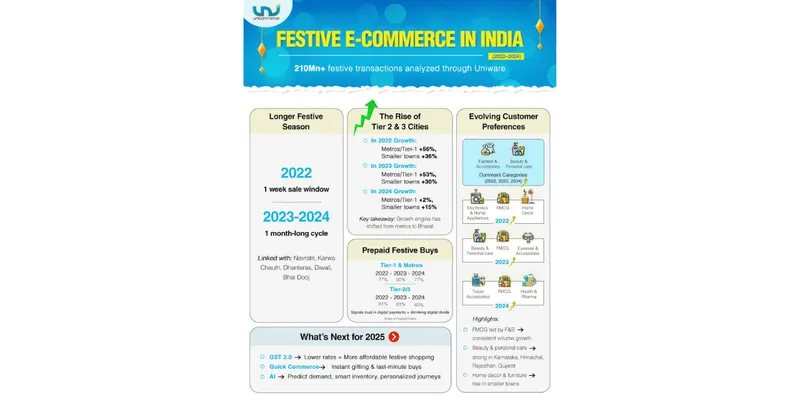
India’s festive season has always been a peak period for e-commerce, with millions of buyers flocking online for discounts and offers. Between 2022 and 2024, festive sales not only expanded in size but also showcased major changes in consumer preferences, shopping categories, and regional participation, based on more than 210 million festive transactions processed through Unicommerce’s flagship platform, Uniware.
Longer Shopping Windows
Festive e-commerce has moved beyond short sale bursts. In 2022, the sale period lasted just over a week, whereas by 2024 it had grown into a month-long cycle. What once centered around Navratri now begins earlier and continues across multiple waves including Dussehra, Karwa Chauth, Diwali, and Bhai Dooj — turning festive sales into an extended celebration.
Rise of Tier 2 & 3 Cities
Regional participation has also shifted. In 2022, metros and tier-1 cities led growth with 56%, while tier-2 and tier-3 towns grew by 36%. A similar trend continued in 2023 with 53% growth in metros versus 30% in smaller towns. However, by 2024, metro growth slowed sharply to 2%, while tier-2 and tier-3 towns grew by nearly 15%. Collectively, smaller towns now contribute over half of festive orders (55.33% in 2022, 51.91% in 2023, and 52.97% in 2024). This indicates that while metros drove initial growth, smaller towns are now the backbone of festive e-commerce, showing how online shopping is penetrating deeper into Bharat.
Shifting Customer Preferences
Category choices have evolved significantly. Beauty & personal care (BPC) and fashion & accessories remained leading contributors across the three years, while FMCG led volume growth, particularly food & beverages. In 2022, electronics and home appliances were strong drivers; 2023 saw rising demand for eyewear, accessories, and wellness products; and by 2024, health, pharma, and travel accessories gained momentum. This transition highlights how festive buying has shifted from big-ticket items to broader lifestyle and wellness-driven consumption.
Fashion and accessories continue to dominate, especially in Karnataka and Maharashtra, while BPC products are strong in Karnataka, Rajasthan, Himachal Pradesh, and Gujarat. Smaller towns such as Rohtak, Jodhpur, Raipur, and Kamrup are increasingly driving demand for home décor and furniture, showing lifestyle upgrades beyond metros.
Digital Payments Dominate
Prepaid transactions have become the preferred payment mode during festive sales. In metros and tier-1 cities, prepaid orders accounted for 77% in 2022, peaked at 80% in 2023, and remained strong at 77% in 2024. Smaller towns showed similar trends with prepaid transactions rising from 61% in 2022 to 63% in 2023, before settling at 60% in 2024. This points to growing trust in digital payments and the narrowing digital divide between metros and Bharat.
Outlook for Festive 2025
The upcoming festive season is expected to witness robust growth, boosted by recent GST rate reductions (effective 22nd September 2025). Lower taxes on FMCG items (grains, dairy, shampoos), textiles (including apparel), and electronics will make festive purchases more attractive. Businesses are likely to highlight products benefiting from reduced tax slabs to appeal to value-conscious shoppers.
Additionally, quick commerce (q-comm) and AI-driven tools will redefine festive shopping. Q-comm is enabling last-minute gifting and essentials delivered in minutes, while AI is refining demand forecasting, inventory optimization, and personalized shopping experiences. Together, they are shaping a festive season that is faster, smarter, and more customer-centric than ever.