India’s CPI Inflation Eases to Record Low of 0.3% in October
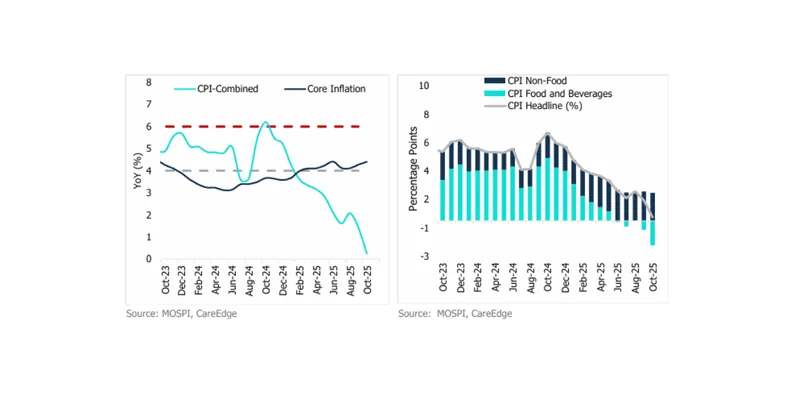
Food deflation and GST reforms drive inflation to multi-year low
India’s consumer price inflation (CPI) fell sharply to 0.3% in October 2025 — the lowest on record — supported by easing food prices, deflation in vegetables and pulses, and the positive impact of GST rate rationalisation.
India’s headline CPI inflation continued its downward trend in October 2025, easing to a historic low of 0.3%, according to CareEdge Ratings. The decline was largely driven by deflation in the food and beverages segment and the positive effects of GST rationalisation implemented in late September.
Deflation within the food basket deepened to 3.7% in October, compared with 1.4% a month earlier. Notably, prices of vegetables (-27.6% YoY), pulses (-16.2%), and spices (-3.3%) recorded sharp declines. While edible oil inflation moderated, it remained elevated at 11.2%, limiting further downside in food inflation.
Despite subdued local demand, global vegetable oil prices continued to rise — up 10.9% YoY as per the FAO Global Vegetable Oil Price Index. Moreover, Kharif oilseed sowing was down 5.3% this year, indicating that price pressures in edible oils could persist. However, the government’s reduction in customs duty on imported edible oils and GST cuts on certain edible fats are expected to help mitigate inflationary effects.
Among other categories, fruit inflation eased to 6.7% in October from 9.8% in September. Overall, the food inflation trend remains moderate, supported by adequate reservoir levels, favourable sowing conditions, and improved agricultural productivity. Nevertheless, delayed monsoon withdrawal and heavy rains in some regions may pose minor risks.
Excluding precious metals, core inflation stood at a benign 2.5%, while inflation in that category alone pushed up overall core inflation to 4.4%. Global commodity prices are expected to remain largely stable amid weak global growth, excess capacity in China, and OPEC’s move to increase crude output.
Looking ahead, CareEdge projects inflation to average 0.9% in Q3 and rise modestly to 3.1% in Q4 FY26, with FY26 inflation expected to average 2.1% overall. This sustained moderation offers the Reserve Bank of India (RBI) more flexibility to focus on growth amid uncertain global trade and economic conditions. If growth softens in the second half of FY26, the benign inflation outlook may even allow scope for a rate cut.