India’s Cotton Sector Looks to New Age Fibres for the Next Phase of Growth
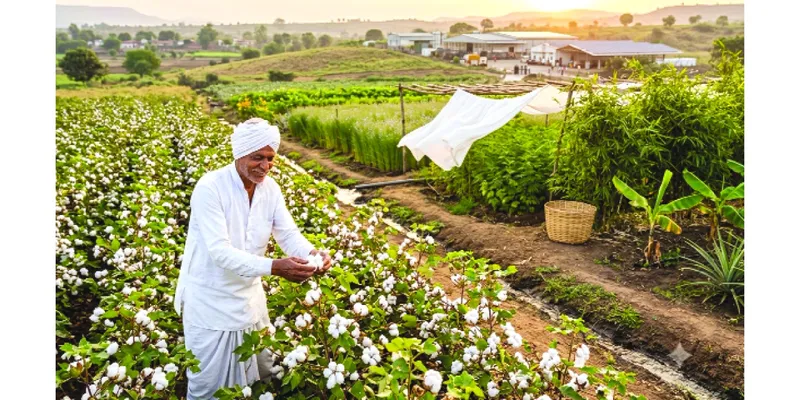
From cotton cultivation and traceability to milkweed, hemp and banana fibre, India’s fibre strategy is expanding beyond its traditional cotton base.
World Cotton Day, observed every year on 7 October, highlights the longstanding role of cotton in India’s textile and agricultural economy. India remains the world’s second-largest cotton producer and the largest cotton-growing nation by acreage, while new initiatives are also focusing on productivity, fibre quality, traceability and the development of alternative fibre resources.
Cotton Remains Central to India’s Textile Economy
India’s association with cotton dates back thousands of years, with Indian muslin historically described as “woven air”. Cotton has remained closely linked to the country’s textile production, agriculture and economic development.
India currently has nearly 115.25 lakh hectares under cotton cultivation, representing more than one-third of the world’s cotton acreage. The country is the world’s second-largest cotton producer and the largest cotton-growing nation by acreage. India is also the only country in the world to commercially cultivate all four species of cotton.
Nearly six million farmers depend directly on cotton cultivation, while millions more are connected to the crop through ginning, spinning, weaving and garmenting. Cotton accounts for around 60 per cent of India’s textile fibre consumption, compared with about 30 per cent globally.
The sector continues to face challenges including low productivity, dependence on rain-fed cultivation, climate and pest risks, uneven access to modern technology and concerns over fibre quality.
Kapas Kanti Targets Higher Cotton Productivity
The Mission for Cotton Productivity—Kapas Kanti, with an outlay of more than 5,000 crore ₹, takes an integrated approach covering the cotton value chain from seed and farmers to ginning, spinning, manufacturing and global markets.
The mission aims to increase cotton lint productivity from 440 kg to 755 kg per hectare and raise production to 498 lakh bales by 2030-31.
Its measures include climate-resilient and high-yielding varieties, modern farming practices, farmer demonstrations, scientific research, quality improvement, testing, traceability and sustainable fibre development.
MSP procurement has been expanded to 571 centres, alongside digital systems intended to improve transparency and efficiency in procurement.
The CotBiz (Cotton Seed & Bale Billing System) and BITS (Bale Identification and Traceability System) are being used to strengthen efficiency, transparency and traceability across the cotton value chain.
At the same time, Kasturi Cotton Bharat is focused on quality, certification and traceability for Indian cotton.
HDPS Focuses on Cotton Yield Improvement
Around 60 per cent of India’s cotton is grown in rain-fed areas, making productivity and resilience key areas of focus.
Modern technologies, improved varieties, High Density Planting System (HDPS), improved agronomic practices and stronger extension activities are being taken to cotton-growing areas.
Under conventional cultivation, farmers usually harvested about 5–7 quintals of seed cotton per acre. With HDPS, using about 5.5 packets of seed and 29,000 plants per acre, yields have risen to around 12 quintals per acre.
The next stated target is 18 quintals of seed cotton per acre, with farmers playing an active role in the effort.
Ginning Quality Also Comes Into Focus
Higher cotton production is also being linked with improvements in fibre quality and ginning efficiency.
With lint recovery currently at around 32–33 per cent, modernising ginning has been identified as an important area. During interactions with ginners, the focus has been placed on quality and efficiency, with modern machinery interventions helping move lint recovery towards 35 per cent and improving the cleanliness and quality of Indian cotton supplied to global markets.
India’s fibre requirement is projected to increase from around 15 MMT today to nearly 23 MMT by 2030. Cotton alone is not expected to meet this projected requirement, creating a focus on other fibre resources.
New Age Fibres Expand India’s Fibre Basket
The development of New Age Fibres is being positioned as another part of India’s fibre strategy, with emphasis on research, development and commercialisation.
A dedicated 300 ₹ crore under the Mission for Cotton Productivity is supporting this area, with the stated objective of creating opportunities for farmers, rural enterprises and sustainable manufacturing.
The fibre range includes milkweed, flax, ramie, sisal, kapok, hemp, bamboo, banana, nettle and pineapple leaf fibre.
Milkweed, traditionally known as Aak or Madar and used in offerings to Lord Shiva, is being explored as a New Age Fibre. Cultivation has expanded to 15–16 acres, with around 10,000 kg of floss/fibre extracted from Uttar Pradesh, Haryana and Rajasthan. Its potential applications include insulation, sustainable filling materials, textiles and extreme-cold-climate defence clothing.
Sisal has applications in automotive interiors, geotextiles, composites, construction reinforcement and sustainable packaging. Ramie has potential applications in apparel, denim blends and technical textiles.
Pineapple Leaf Fibre (PALF) can be used to develop fashion textiles, leather alternatives and bio-composites from agricultural residue. Banana fibre is used for yarn, paper, handicrafts, furnishings and technical textiles.
Other fibres, including bamboo, flax, hemp, nettle and kapok, add further options for textiles, home furnishings, insulation and technical products.
From Cotton Heritage to a Broader Fibre Strategy
India’s fibre requirements and the development of renewable, biodegradable and low-carbon materials are creating a wider focus beyond conventional cotton.
The strategy outlined for New Age Fibres covers both traditional fibre resources and newer applications, with attention to research, commercialisation and sustainable manufacturing.
India’s fibre development approach is being linked to the 5F vision, covering Farm to Fibre, Fibre to Factory, Factory to Fashion and Fashion to Foreign markets.
The stated focus is to combine India’s long-established cotton base with the development of New Age Fibres, sustainable materials, innovation and advanced technology as the country works towards the next phase of its textile fibre economy.