India’s Cotton Consumption Could Reach 425 Lakh Bales as Spinning Capacity Expands
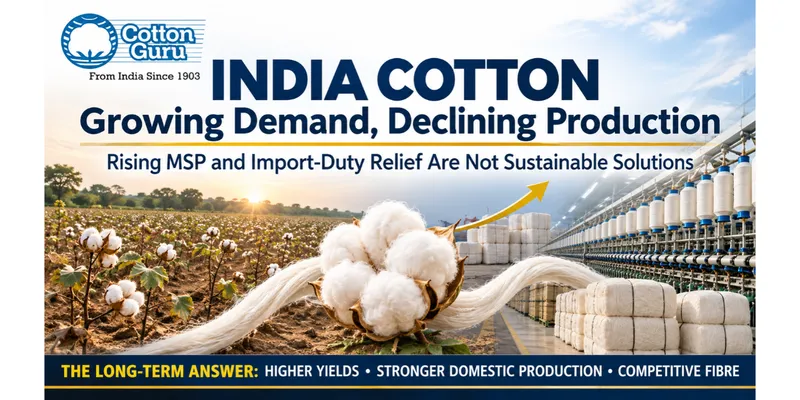
With 28.5–30 lakh new spindles expected to enter production in 2027, industry commentary calls for a national mission to raise domestic cotton output to 5 crore bales by 2030–31.
The extension of the customs duty exemption on cotton imports until December 31 provides temporary relief to India's spinning industry amid price volatility and concerns over domestic fibre availability. However, with new spinning capacity expected to increase cotton consumption to 400–425 lakh bales in 2027–28, the industry faces growing pressure to strengthen domestic cotton production and productivity.
Cotton Import-Duty Exemption Provides Temporary Relief
The government's decision to extend the customs duty exemption on cotton imports until December 31 gives domestic spinning mills continued access to international supplies from Brazil, the United States, Australia, Africa and other cotton-producing regions.
Imported cotton offers mills an alternative when domestic arrivals are limited or local prices rise beyond import parity. It also provides a price-balancing mechanism that can help manage raw-material costs and protect operating margins.
However, greater access to international supplies also increases competition for Indian farmers and ginners. Productivity, fibre quality and price competitiveness will become increasingly important for domestic cotton to remain competitive.
Imported Cotton Influences Domestic Price Movements
The availability of imported cotton can limit the extent to which domestic prices rise, as mills can compare local prices with import parity.
Domestic arrivals, international cotton prices and exchange-rate movements will therefore remain important factors in determining market prices.
While the exemption offers a supply option for spinners, the longer-term challenge is to improve domestic production and competitiveness without creating structural dependence on imported fibre.
New Spinning Capacity Could Push Cotton Consumption to 425 Lakh Bales
Industry estimates indicate that approximately 28.5–30 lakh new spindles are expected to be commissioned between January and December 2027.
As these installations become operational and reach commercial utilisation, India's cotton requirements could increase substantially.
Cotton consumption during 2027–28 is projected to potentially reach 400–425 lakh bales of 170 kg each, compared with the current-season estimate of 365 lakh bales. This would represent an increase of approximately 35–60 lakh bales.
The expansion presents a supply challenge for the domestic cotton sector. While additional spinning capacity can support yarn production, employment, value addition and textile exports, insufficient domestic cotton availability could increase reliance on overseas suppliers.
The industry's manufacturing expansion will therefore need to be supported by a corresponding improvement in domestic fibre production.
Proposed Mission to Raise Cotton Production to 5 Crore Bales
The industry commentary proposes a national-level white paper and action plan under Mission 5 Crore Bales by 2030–31.
The proposed initiative would bring together farmer organisations, Cotton Farmer Producer Organisations (FPOs), ginners, spinners, textile manufacturers, research institutions and government departments.
The suggested production trajectory is:
Cotton season | Proposed production target |
|---|---|
2026–27 | 280 lakh bales |
2027–28 | 330 lakh bales |
2028–29 | 385 lakh bales |
2029–30 | 440 lakh bales |
2030–31 | 500 lakh bales |
These figures are proposed industry targets, not official production forecasts, and would require annual review.
Key Areas for Improving Domestic Cotton Productivity
The proposed mission identifies several interventions to increase output, including high-yielding seeds, improved agronomy, efficient water management, mechanisation, integrated pest management and wider adoption of modern farming technologies.
The suggested implementation measures include:
- Farmer partnerships: Establish regular engagement with Cotton FPOs and farmer associations to identify productivity constraints and develop district-level programmes.
- Government schemes: Mobilise relevant central and state schemes covering seeds, irrigation, mechanisation, research and extension services.
- Industry participation: Encourage ginners, spinners and textile manufacturers to support farmer education, demonstration farms, quality improvement and supply-chain partnerships.
- CSR funding: Use corporate CSR resources for sustainable cultivation, farmer training, water conservation and technology adoption.
- Monitoring and accountability: Set annual targets for production, yield, quality and farmer income, supported by transparent monitoring.
Industry Focus on Farming Practices and Research
The commentary also calls for the textile industry to examine the factors behind stagnant cotton yields and insufficient productivity improvement.
While seed quality and availability remain important, it argues that progress will also depend on farming practices, research partnerships, technology adoption and greater willingness to experiment with new approaches.
It further cautions against allowing the urgency for reform to fade when market conditions improve. Sustained coordination between farmers, industry participants and research institutions is identified as necessary for long-term productivity gains.
District-Level Productivity Improvement as a Strategic Priority
The commentary recommends that the 5-crore-bale ambition should be implemented through a district-wise productivity improvement programme rather than focusing only on increasing cultivated acreage.
Each major cotton-growing district should have a defined yield-improvement target based on its soil conditions, climate, irrigation facilities and existing productivity.
The proposed interventions include:
- Developing and adopting high-yielding, locally suitable and scientifically validated seeds.
- Improving agronomy, plant population, soil health and water utilisation.
- Strengthening integrated pest and disease management to reduce crop losses.
- Expanding demonstration farms, farmer field schools and technology transfer.
- Building partnerships among FPOs, farmer associations, research institutions and textile companies.
- Combining government schemes with CSR-funded productivity projects.
- Monitoring district-level yield, production, fibre quality and farmer profitability annually.
The proposed yield ambition of 800 kg of lint per hectare is also highlighted, with region-specific and scientifically validated interventions recommended to support its achievement.
Building Domestic Fibre Security Alongside Spinning Capacity
The commentary notes that surplus and competitively priced cotton has historically supported the growth of the textile industry. Reliable fibre availability can encourage investment, support capacity utilisation, enable downstream value addition and strengthen exports.
With 28.5–30 lakh additional spindles expected and cotton consumption potentially reaching 400–425 lakh bales in 2027–28, the need to expand domestic production has become more pressing.
Imports may help bridge temporary supply gaps, but the proposed strategy is for them to supplement domestic production rather than become a permanent source of fibre security.
The central recommendation is to build domestic competitiveness through more productive farms, improved cotton quality and stronger collaboration across the value chain.
“BUILD COMPETITIVENESS, NOT DEPENDENCE” is the guiding message of the proposed 5-crore-bale mission, which aims to align India's cotton production ambitions with the expansion of its spinning and textile manufacturing capacity.