India’s Bank Spreads Rise Slightly as Lending Rates Ease in October 2025
Festive Credit Demand and Loan Mix Shift Support Fresh Spread Expansion
In October 2025, India’s banking system saw a slight uptick in outstanding spreads as lending rates eased, deposit rates softened, and fresh lending activity strengthened ahead of the festive season, according to CareEdge’s latest Interest Rate Tracker.
India’s banking sector witnessed steady movement in lending–deposit spreads in October 2025, with both lending and deposit rates showing slight declines while fresh lending activity strengthened ahead of the festive season, according to the latest CareEdge “Interest Rate Tracker – October 2025” report.
During the month, the spread between scheduled commercial banks’ (SCBs) outstanding weighted average lending rate (WALR) and outstanding weighted average domestic term deposit rate (WADTDR) expanded marginally by two basis points to 2.46%, driven by improved credit traction and a shift toward higher-yield portfolios. Outstanding lending rates eased by 2 bps to 9.24%, reflecting transmission of previous policy rate cuts and competitive pricing pressure. Outstanding deposit rates also fell 4 bps to 6.78%, aided by repricing across private and public sector banks.
Fresh spreads, however, rose more sharply—up 17 bps month-on-month to 3.07%—supported by festive credit demand, an increased focus on higher-yield segments, and deliberate efforts by banks to protect margins amid slower pass-through of policy rate cuts. Fresh lending rates climbed 14 bps to 8.64%, while fresh deposit rates dipped slightly to 5.57%.
In November 2025, the one-year median MCLR fell by 5 bps to 8.55%, driven by easing funding costs and significant reductions among foreign banks. Public sector and private banks also reported monthly declines, reflecting ongoing adjustments to liability repricing and liquidity conditions.
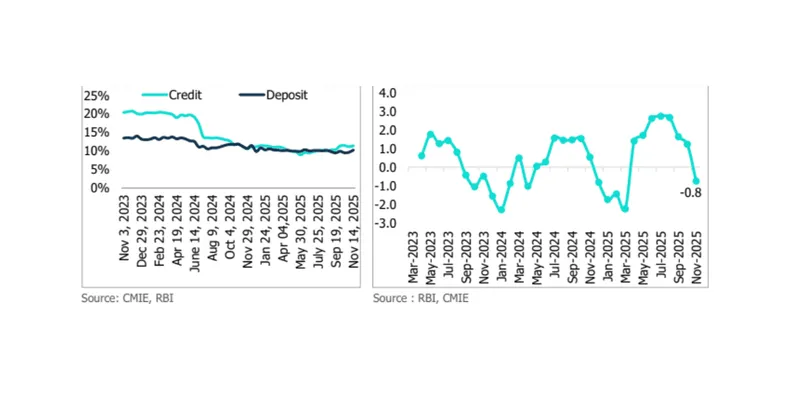
Bank credit growth continued to outpace deposit growth as of mid-November, rising 11.4% year-on-year, supported by GST rate cuts, resilient retail and MSME borrowing, and renewed corporate credit demand amid high bond yields. Deposits grew 10.2%, with some shift of household funds toward higher-return alternative investments.
System liquidity briefly slipped into deficit in late November due to GST outflows and festive currency demand, though conditions are expected to stabilise with remaining CRR cuts.
CareEdge notes that while spreads improved modestly in October, margin expansion remained constrained by sticky deposit costs. Private banks saw stronger gains than public sector banks, which continue to operate with larger low-yield portfolios. Margin sustainability going forward will depend on banks’ ability to rebalance portfolios toward higher-yield retail and MSME lending while carefully managing deposit repricing.