Indian Manufacturing Output Rebounds in Q2 FY27, but Cost and Geopolitical Risks Persist: FICCI
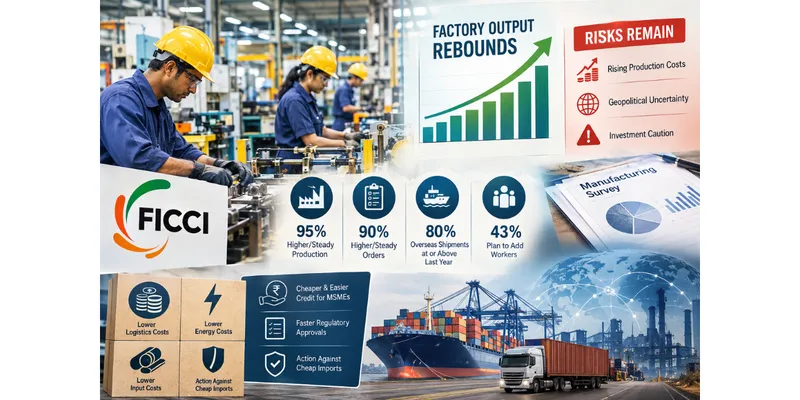
95% of manufacturers report higher or stable production, while rising input costs and geopolitical uncertainty continue to affect investment decisions
India’s manufacturing sector recorded a recovery in the July–September quarter of FY27, with 95% of manufacturers reporting higher or steady production, compared with 77% in the previous quarter, according to the Federation of Indian Chambers of Commerce and Industry (FICCI) quarterly manufacturing survey.
The survey also found an improvement in demand and order levels during the second quarter. However, rising production costs and continued geopolitical uncertainty are creating challenges for companies considering capacity expansion and new investments.
“This edition of the manufacturing survey reflects rebound in the sentiment for production compared to the previous quarter indicating recovery signs from the prevailing geopolitical situation,” said FICCI.
Orders and Capacity Utilisation Improve
Around 90% of respondents reported higher or steady order levels in Q2 FY27, compared with 77% during the April–June quarter.
FICCI attributed the improvement to overall positive sentiment and stable domestic fundamentals supporting manufacturing growth. The industry body also linked the recovery to the easing impact of the West Asia crisis.
Average capacity utilisation increased to around 75%, compared with 72% in the previous survey.
Among the nine sectors covered by the survey, glass recorded the highest capacity utilisation at 88%, while machine tools recorded the lowest at 68%.
Overseas Shipments Show Improvement
Around 80% of manufacturers reported overseas shipments at or above year-ago levels, compared with 74% in the first quarter of FY27.
“Export diversification efforts by the government and industry seem to be yielding results,” said FICCI.
The improvement in exports comes as manufacturers continue to operate amid changing global trade conditions and geopolitical uncertainty.
Production Costs Continue to Rise
Despite the improvement in production and demand, manufacturers reported increasing cost pressures.
Nearly 83% of manufacturers said their cost of production had increased as a share of sales, compared with 79% in the previous quarter.
FICCI said the increase reflected higher production costs during the quarter.
“The increase in cost of production compared to last year is mainly due to higher raw material costs, energy costs, currency depreciation, increased logistics, and utility costs,” it added.
Investment Outlook Remains Steady
Higher costs and uncertainty in the global environment are making manufacturers cautious about expanding capacity.
FICCI described the overall investment outlook for the next six months as “steady.”
Respondents cited geopolitical uncertainty, including tariffs, trade restrictions and demand uncertainty, as well as operational challenges such as skill gaps, raw material shortages, higher logistics costs and regulatory issues.
“The Challenges faced by respondents in expanding capacities include uncertainty due to the geopolitical situation (tariffs, trade restrictions and demand uncertainty) and operational issues (skill gaps, raw material shortages, increasing logistics costs and regulatory challenges),” FICCI said.
The effects of the West Asia conflict also remain visible in parts of the industry. In the miscellaneous category, inventory levels remained flat, which FICCI attributed largely to low demand caused by geopolitical tensions and working capital limitations.
Hiring Intentions Improve
Hiring plans also showed an improvement during the quarter.
Around 43% of manufacturers plan to add workers over the next three months, compared with 35% in the previous quarter.
At the same time, around 67% of respondents said they were not facing workforce availability issues at factories. The remaining 33% reported a shortage of skilled workers in their sectors.
“Most sectors are not facing shortage of labour at factories as around 67 per cent of respondents mentioned that they do not have any issues with workforce availability. The remaining 33 per cent feel that there is still lack of skilled workforce available in their sector. And, there is a need to step up efforts both at the government and industry level,” said the survey report.
Automotive Sector Expects Stronger Growth
Among the sectors covered, automotive and auto components was the only sector where respondents expected strong growth of 10–20%.
However, supply-side constraints could affect growth in leading sectors. In the automotive industry, unavailability of labour, raw materials and components were identified by FICCI as significant constraints.
Manufacturers Seek Lower Costs and Easier Credit
To sustain the recovery, manufacturers called for measures to reduce logistics, energy and input costs.
They also sought cheaper and easier access to credit for micro, small and medium enterprises (MSMEs), faster regulatory approvals and quicker action against cheap imports.
Overall, the FICCI survey points to an improvement in manufacturing production, demand, capacity utilisation, exports and hiring intentions during Q2 FY27, while cost pressures, supply constraints and geopolitical uncertainty continue to influence investment and expansion decisions.